Create my document
Login

Choose country

FranceBelgiqueEspañaUnited StatesUnited KingdomالمغربDeutschlandItalia
Leave Request

Holiday Refusal Letter Template UK | Reject Leave Request

Lawyer-drafted letter to refuse or reschedule annual leave under the Working Time Regulations 1998. Serve valid counter-notice and avoid disputes. Word & PDF.
4.7/59 reviews50 000+ downloadsInstant download
Share

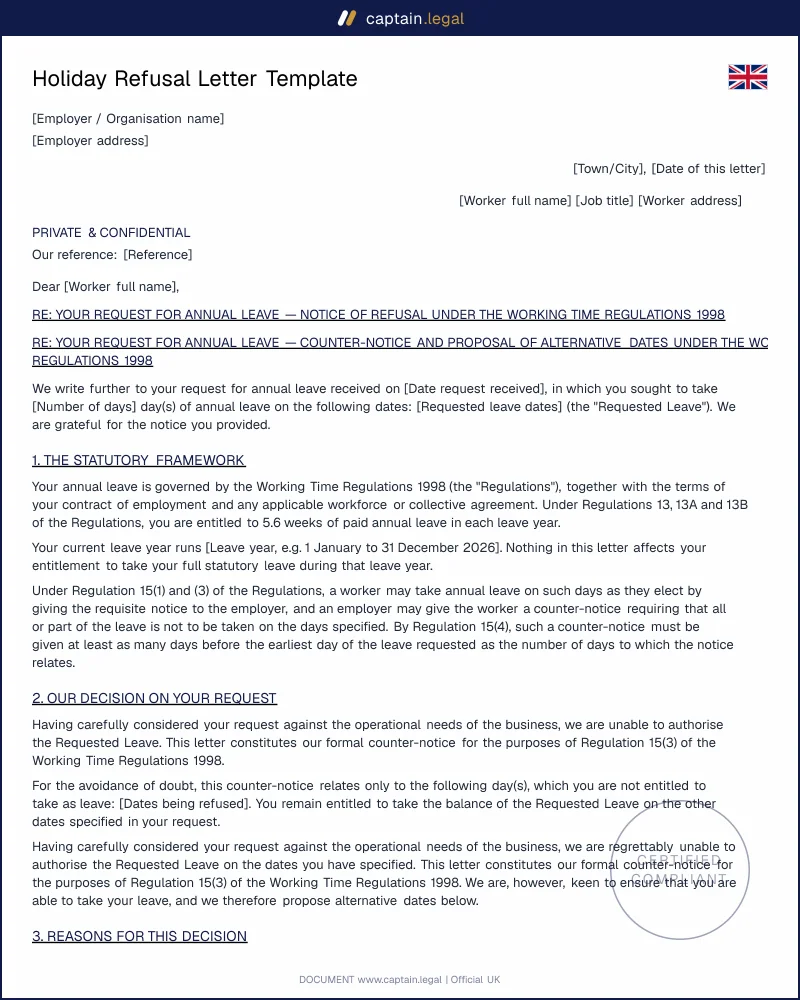
A holiday refusal or counter-notice letter is the document an employer uses to decline an annual leave request, or to propose alternative dates, under the Working Time Regulations 1998. It records the decision in writing, sets out the correct statutory counter-notice period, and confirms approved dates for payroll, handovers and rota planning. The point is to keep the exchange procedural rather than personal : a refusal grounded in Regulation 15 reads as administration, not a slight against the employee. This template suits any UK business that needs to manage competing holiday requests during busy periods without inviting a grievance, and it doubles as the written confirmation that ends the familiar "but we agreed it in the corridor" dispute before it starts.

Compliant

2026 Legislation

50,000+ clients

trust us

Affordable

From $4.90 / doc

Secure payment

Instant download

Holiday Refusal Letter Template UK | Reject Leave Request

Secure payment · No subscription

Fill in the template

What is a holiday refusal or counter-notice letter?

In UK employment practice the phrase covers two related but distinct documents that the Working Time Regulations 1998 treat under the same procedural rule. A counter-notice is the formal instrument by which an employer tells a worker that some or all of the days they have requested cannot be taken, served under Regulation 15(2) and 15(4). A holiday refusal letter is the plain-English business communication that carries that counter-notice, usually adding the commercial reason, any alternative dates on offer, and a record of the employee's remaining entitlement for the leave year.

The distinction matters because a refusal that does not satisfy the statutory notice rule is, in effect, no refusal at all. An employer who simply says "no" in a corridor or on a messaging app has not served valid counter-notice, and the leave may be taken by default. The letter exists precisely to convert a managerial decision into a document that survives scrutiny at a later grievance hearing or tribunal. It is also the natural place to keep tone neutral. A well-drafted refusal never argues with the employee's reasons; it states the operational position, cites the regulation, and where possible offers a workable alternative. For the contractual backdrop to these exchanges, our full-time contract of employment template sets out the leave terms a counter-notice operates within.

2

When do you need this document?

The everyday trigger is a clash of dates. Two members of a small team ask for the same week in August, the rota cannot absorb both, and you need to approve one and decline the other in a way that looks even-handed. Serving a written counter-notice on the second request, with the operational reason stated plainly, protects you against the accusation that the decision was personal or arbitrary. The second common scenario is a request that lands too late for the workload : a developer asks for a fortnight off the week a major release is due, and the business genuinely cannot release them. Here the letter proposes alternative dates rather than issuing a flat refusal, which keeps the relationship intact and shows good faith.

A third situation is the employee who has exhausted, or is about to exhaust, their entitlement for the year. You refuse not on operational grounds but because the days simply are not there, and the letter records the remaining balance so there is no later argument. Then there are the edge cases that separate a careful employer from an exposed one. A refusal that happens to fall on a religious festival can slide into indirect discrimination under the Equality Act 2010 unless you can justify it, so the reason needs to be demonstrably operational. Equally, blocking the carry-over of leave that a worker could not take because of long-term sickness is risky, since accrued statutory leave in those circumstances has protected status. When the refusal sits close to a disciplinary or capability issue, the UK redundancy notice letter and dismissal documents in our employment range show how a parallel decision should be evidenced.

3

Key clauses included in our template

  • The statement of decision opens by identifying the original request by date received and dates sought, then states unambiguously whether the request is refused in full or in part. Vague openings like "we are unable to accommodate" are replaced with the precise days declined, because a counter-notice that does not specify the affected days fails the Regulation 15(4) requirement to identify when leave is not to be taken.
  • The statutory counter-notice block sets out the date of service and confirms that the notice is given at least as many days before the leave as the leave requested. This is the clause that gives the letter its legal force, and the template prompts you to check the contract first in case a relevant agreement under Regulation 15(5) changes the default period.
  • The operational reason is drafted in neutral, business-focused language : cover requirements, a project deadline, an overlapping booking already approved. It deliberately avoids commentary on the employee's purpose for the leave, which keeps the document defensible if it is later read in a grievance.
  • The alternative dates offer turns a refusal into a negotiation. Where the business can accommodate the same length of leave in a different window, the template invites the employee to confirm, which evidences reasonableness and often resolves the matter without escalation.
  • The entitlement record captures the worker's remaining statutory and contractual leave for the year, closing off the later dispute about how many days are left. For staff on irregular hours, this ties back to the leave terms in the zero-hours contract template.
4

Regional considerations

The Working Time Regulations 1998 apply across England, Wales and Scotland on identical terms, so the counter-notice mechanism under Regulation 15 is the same wherever your business operates in Great Britain. The practical variation is contractual rather than geographic. Many employers improve on the statutory 5.6 weeks, and any enhanced contractual leave can carry its own notice rules through a relevant agreement, which then displaces the default arithmetic. Always read the individual contract before relying on the statutory timetable.

Northern Ireland sits outside the 1998 Regulations and instead applies the Working Time Regulations (Northern Ireland) 2016, which mirror the Great Britain position closely but are a separate instrument, so a letter drafted for a Belfast workforce should cite the Northern Ireland regulations rather than SI 1998/1833. Sector matters too. Workplaces with recognised trade unions frequently operate collective agreements that set bespoke notice and refusal procedures, and those agreements take precedence over the statutory default. Seasonal businesses in retail, hospitality and agriculture often impose annual shutdown periods or block-out dates by serving employer notice under Regulation 15(2)(a), directing when leave must be taken; the same counter-notice discipline applies, and the dates must still be specified in writing. If your business has set out leave policy in its written particulars, the Section 1 statement template is the document that should already record those block-out arrangements.

5

How to fill out this holiday refusal letter

You begin by entering the employer and employee details and the date the original leave request was received, which fixes the start of the counter-notice clock. From there the form asks whether you are refusing the whole request or only part of it, and prompts you to list the specific days being declined, because the regulation requires those dates to be identified rather than described in general terms. The template then calculates the counter-notice position for you : it checks that the date of service leaves enough clear days before the requested leave to satisfy the rule that counter-notice must be at least as long as the leave itself.

Next you choose the operational reason from a neutral set of options or write your own, and decide whether to offer alternative dates. If you do, the form captures the proposed window and the request for the employee to confirm. You then record the remaining entitlement for the leave year, and the document assembles into a clean letter that reads as a measured business communication rather than a rejection. The output downloads in editable Word and as a finished PDF, so you can adapt the standard wording to a particular case and keep a signed copy for the file. For the wider set of leave documents this connects to, the UK leave request templates bring the request and response sides together.

6

Common mistakes to avoid

The error that undoes more refusals than any other is late service. Employers treat the deadline as advisory, send the refusal a few days before the holiday, and discover that the counter-notice period had already expired, leaving the leave validly booked by default. The fix is mechanical : count the days the moment the request arrives, and serve any refusal well inside the Regulation 15(4) window. A close relative of this mistake is the oral refusal. A decision communicated in passing, by text or in a quick chat, carries no evidential weight and does not satisfy the statutory requirement to specify the days in writing, so it offers no protection if the matter escalates.

The second cluster of mistakes is about content. Some employers state no reason at all, which invites the inference that the refusal was capricious, while others say too much and stray into commentary on why the employee wanted the time, which is exactly the material a tribunal will scrutinise for discrimination. Keep the reason operational and brief. Never refuse a request tied to a religious observance, a disability-related need, or pregnancy-related leave without taking advice first, because what looks like a routine scheduling decision can become an Equality Act 2010 claim. Finally, employers forget to check the contract, apply the statutory default, and overlook a relevant agreement that set a longer notice period; the result is a technically invalid notice. The UK dismissal letter sits in the same family of decisions where getting the evidential trail right is what protects the business.

Key takeaways

Working Time Regulations

A refusal must be a valid counter-notice

A holiday refusal is not just a manager saying no. Under the Working Time Regulations 1998, the employer needs to serve a counter-notice under Regulation 15, usually via a written letter. If you do not meet the statutory procedure, the refusal may not count, and the employee could argue the leave stands. Put it in writing so it holds up in a grievance or tribunal.

Notice periods

Get the timing right or lose control

Regulation 15(4) is where mistakes happen. The worker must give notice at least twice the length of the leave requested (five days off means ten days’ notice). If the employer wants to block the request, the counter-notice must be at least as long as the leave itself, served before the leave starts. Miss that window and the request may slip through by default.

Operations and risk

Keep it neutral, record dates, avoid disputes

Use the letter to keep the exchange procedural rather than personal: state the operational reason, cite Regulation 15, and offer alternative dates where possible. Confirm what is approved for payroll, handovers and rota planning, and note remaining entitlement for the leave year. This also prevents the common “we agreed it in the corridor” argument and reduces the chance of a grievance.

Frequently Asked Questions

Yes. Annual leave under the Working Time Regulations 1998 is not a right to take holiday on any day you choose; it is a right to a quantity of paid leave during the year. Under Regulation 15(2) an employer can refuse a particular request or even direct when leave is taken, provided it serves valid counter-notice and does not prevent you from taking your full 5.6 weeks across the leave year. The refusal must be procedurally correct, must specify the days declined, and must arrive in good time. A refusal served too late, or one that would stop you using your statutory entitlement altogether, is not lawful.

The counter-notice must be at least as long as the leave being refused. If an employee asks for five working days off, the employer has to serve its refusal at least five days before the first day of the requested leave; to block a fortnight, two weeks' counter-notice is needed. This default sits in Regulation 15(4) of the Working Time Regulations 1998. The clock runs from the date the counter-notice is actually served, which is why a written letter with a clear date is essential. A contract or collective agreement can change this period under Regulation 15(5), so always check the contractual terms before relying on the statutory timetable.

The template produces a document that is legally effective as a counter-notice when it is completed correctly and served within the statutory window. Its force comes from compliance with Regulation 15 of the Working Time Regulations 1998, not from the document itself; a letter that specifies the days declined and meets the notice period does the legal work the regulation requires. The wording is drafted to UK employment practice and is reviewed to keep pace with statutory rates and accepted HR procedure. It does not replace tailored legal advice in contentious cases, particularly where discrimination or long-term sickness is in play, but for ordinary scheduling decisions it gives you a defensible record.

Yes, and in most situations it is the better course. Offering an alternative window of the same length keeps the working relationship intact and demonstrates that the refusal was driven by genuine operational need rather than obstruction. The template includes an alternative-dates clause and invites the employee to confirm acceptance, which creates a clean record that you behaved reasonably. This is particularly useful when you are managing competing requests, because it lets you decline one booking while still honouring the employee's underlying entitlement. If the alternative is accepted, the confirmation also doubles as the written approval your payroll and rota planning need.

The letter is delivered in two formats. You receive a fully editable Word file so you can adjust the standard wording to the specific case, change the operational reason, or add details the situation calls for, and a finished PDF for sending and filing. Keeping both means you have a working copy and a clean record. The PDF is the version you would typically serve on the employee and retain for the personnel file, because a fixed document with a clear date of service is what evidences that valid counter-notice was given under the Working Time Regulations 1998.

The regulations do not strictly require you to state a reason for serving counter-notice, but in practice you should give a brief operational one. A refusal with no reason invites the suspicion that it was arbitrary or, worse, discriminatory, which is precisely the inference a tribunal draws when a request linked to religion, disability or family circumstances is declined without explanation. The safe approach is a short, neutral statement of the business need: cover requirements, an existing approved booking, a delivery deadline. Avoid commenting on why the employee wanted the time, since that commentary is what turns a routine scheduling decision into evidence in a discrimination claim.

No. The Regulation 15 counter-notice procedure applies to annual leave only. Statutory sick pay, maternity, paternity, adoption, shared parental and unpaid parental leave each operate under their own statutes with separate notice and eligibility rules, and you cannot refuse them in the way you can refuse a holiday request. Sickness absence, for instance, is governed by self-certification for the first seven days and fit-note evidence after that, with Statutory Sick Pay eligibility set by separate regulations. This template is built specifically for annual leave refusals and counter-notices; using it for a statutory family-leave request would apply the wrong legal test, so reach for the dedicated document in those cases.

4.7/5

9 verified reviews · 50 000+ downloads

Holiday Refusal Letter Template UK | Reject Leave Request
  • Immediate access to the document
  • PDF + Word download
  • Compliant with 2026 legislation
  • Reviewed by lawyers
Fill in the template
Secure payment · No subscription
Updated on May 30, 2026

You might also like

Annual Leave Request Form UK
Holiday Approval Letter UK