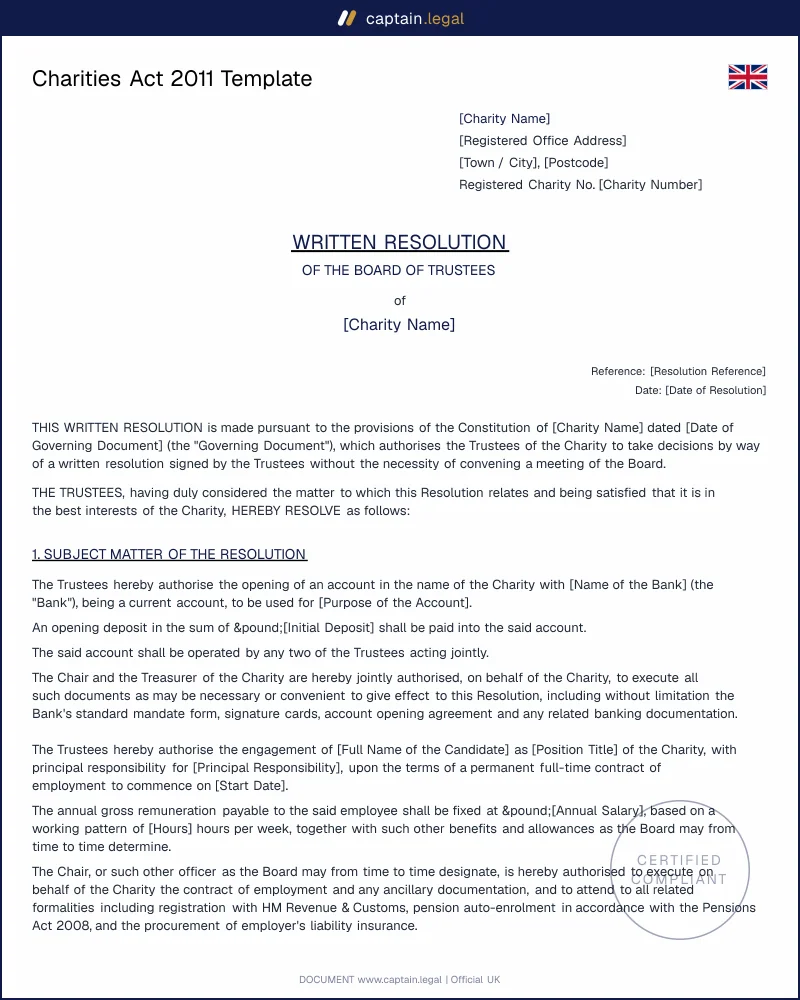
A trustees' written resolution is the formal mechanism a UK charity board uses to take, and properly record, a decision without convening a full meeting. Signed by the charity trustees, dated, and filed with the governance records, the document carries the same legal weight as a resolution passed at a quorate meeting, provided the governing document and the applicable regulations allow it.
This template is built for UK charity trustees, chairs and company secretaries who need a clean, defensible audit trail when decisions arise between scheduled meetings: opening a bank account, approving a lease, appointing officers, or authorising exceptional expenditure. It is drafted to the Charities Act 2011 and the model articles you are most likely to be operating under.
Compliant
2026 Legislation
50,000+ clients
trust us
Affordable
From $4.90 / doc
Secure payment
Instant download
Written Resolution UK: Charities Act 2011 Template
Secure payment
What is a trustees' written resolution?
A trustees' written resolution records a decision of the charity trustees taken outside a meeting. The trustees circulate the proposed wording, each signs, and the resolution takes effect on the date the last required signature is obtained. The legal weight is identical to a resolution passed at a quorate board meeting, provided your governing document permits decisions in writing and the procedural requirements are met.
The mechanism is sometimes confused with a members' written resolution, which is a different instrument. Members' resolutions apply to the membership of a CIO or a charitable company, govern matters reserved to the members (changing the objects, amending the constitution, removing trustees), and follow their own statutory rules under the Charitable Incorporated Organisations (General) Regulations 2012 or the Companies Act 2006. A trustees' resolution is a board decision; the two should not be drafted from the same template.
In practice, the trustees' written resolution is the workhorse of governance between meetings: the document you reach for when a funder needs evidence that a decision was formally taken, when a bank wants a board minute before activating a mandate, or when an auditor asks why a sum was approved outside the budget cycle.
Legal framework
The starting point for any charity in England and Wales is the Charities Act 2011, which consolidates the duties of trustees and the powers of the Charity Commission. The Act does not directly mandate written resolutions; it leaves each charity's governing document to set out how trustees take decisions. Validity is read first against your constitution, articles, or trust deed, then against the general law.
For Charitable Incorporated Organisations, the rules are tighter. Regulation 13 of the Charitable Incorporated Organisations (General) Regulations 2012 (SI 2012/3012) expressly authorises CIO trustees to take decisions by unanimous written resolution signed by every charity trustee entitled to vote. If you operate under a CIO constitution drafted to the Charities Act 2011, check the trustee decision-making clauses before circulating a resolution for signature.
For charitable companies limited by guarantee, the articles of association govern rather than statute. The Companies Act 2006 written resolution regime in Part 13 applies to members, not directors, so directors' (trustees') resolutions sit in the articles. Most charity-friendly model articles require unanimity or a stated majority, often with a deeming provision for email approval.
For unincorporated charities under a trust deed or association constitution (including those drafted to the Charity Commission's GD2 or GD3 models, available in our unincorporated charity constitution template), the procedure depends entirely on the governing document. Where the constitution is silent or ambiguous, the Charity Commission's CC48 guidance on charities and meetings sets the regulator's expectations on quorum, notice and recording of written decisions.
When do you need this document?
The most common trigger is the bank. Opening a new account, changing signatories, or activating online banking limits almost always requires a board resolution; banks will not act on an email chain, and most reject a typed note that does not reference the constitutional basis. A clean written resolution, signed by the required number of trustees, clears the request in days rather than weeks.
The next most frequent scenario is employment. Recruiting a chief executive, signing a senior contract, approving a redundancy package, or accepting a resignation outside the meeting cycle are decisions the board, not management, must own. Trustees who put their name to a UK-compliant employment contract on behalf of the charity should be acting on a resolution that authorises both appointment and terms.
Major contracts and property decisions sit in the same category. Signing a lease, accepting a substantial donation with restrictions, authorising a grant agreement, or agreeing a partnership all merit a written resolution. If the value or risk would push the matter onto a serious incident report to the Charity Commission, the decision must be on paper, signed, dated and filed.
Two edge cases deserve attention. An urgent regulatory deadline is the first: a funder reverts with a same-day requirement, or a Commission filing falls due between meetings. The second is the conflict-affected decision, where one trustee withdraws and the remainder must act quickly; the resolution should record the conflict, the withdrawal, and the residual quorum on its face.
Key clauses included in our template
The Captain.Legal template is built around wording that holds up in front of a bank, a funder, an auditor or the Charity Commission. The clauses you will complete cover the procedural core and the substantive decision.
- The identification of the charity sets out the registered name, the charity number and, where applicable, the company number, with the registered office. Banks and funders cross-check these against the public register, so the wording must match your register entry exactly. A resolution showing a trading name rather than the registered charity name is routinely rejected.
- The recital of legal basis explains why the trustees act in writing rather than at a meeting: the relevant clause of your governing document, or regulation 13 of the Charitable Incorporated Organisations (General) Regulations 2012 for a CIO. This single line distinguishes a defensible resolution from a piece of correspondence.
- The operative resolution is drafted in plain, single-purpose language ("IT IS RESOLVED THAT …"). Where the board authorises several connected actions, each becomes a separate numbered resolution, so a later challenge to one does not pull down the others.
- The delegation and signing authority clauses specify who is authorised to give effect to the decision (typically the chair, the treasurer, or a named officer) and what they may sign on the charity's behalf. The bank or counterparty examines this clause first.
- The conflicts of interest declarations record any trustee with a direct or indirect interest, whether they withdrew, and whether the remaining quorum was preserved. Unmanaged conflicts are the leading cause of resolutions being unwound later.
- The signature block and dating provisions require each trustee to sign and date individually, with the resolution taking effect on the latest date appearing on any signature page.
Regional considerations
Although the UK is one country in everyday speech, charity regulation is devolved, and trustees should know which regulator their written resolution will sit in front of if challenged.
England and Wales are governed by the Charities Act 2011 and supervised by the Charity Commission for England and Wales. The Commission expects trustees to operate by the governing document and to keep proper records. For CIOs, written trustee resolutions are authorised by regulation 13 of SI 2012/3012. For charitable companies, the question is decided by the articles, with regard to the Commission's 15 questions trustees should ask.
Scotland is governed by the Charities and Trustee Investment (Scotland) Act 2005 and supervised by the Office of the Scottish Charity Regulator (OSCR). SCIOs have their own framework under the Scottish Charitable Incorporated Organisations Regulations 2011, with provisions on written resolutions and quorum. A SCIO board cannot rely on the English CIO regulations; the wording must reference Scottish law.
Northern Ireland is governed by the Charities Act (Northern Ireland) 2008 and supervised by the Charity Commission for Northern Ireland (CCNI). NI has no CIO equivalent: charities are either unincorporated, charitable trusts, or companies limited by guarantee. Written resolutions turn on the governing document or, for charitable companies, the articles read with the Companies Act 2006. CCNI's guidance is broadly aligned with the Commission's English approach, but the regulator and statutory framework differ.
For cross-border charities registered in more than one jurisdiction, a single written resolution is workable, but the recitals should record that the decision is taken by the trustees in their capacity under each registration. The signed copy goes to each regulator's file. One signed resolution, three regulator files is the safe default.
How to fill out this trustees' written resolution
You start by telling the form which legal form your organisation takes: CIO, charitable company, SCIO, unincorporated charity, or charitable trust. The wording, the recitals and the statutory references adjust to that choice. You then enter the registered name and registration number exactly as on the public register, plus the registered office address, so the resolution matches what the bank or funder will check.
From there, the form walks you through the substance. You add the resolution itself in clear language, the reasons for the decision in one or two sentences, and any delegated authority you want to grant for execution. The form prompts you to identify each trustee entitled to vote, mark any who must withdraw for conflicts, and confirm the resulting quorum.
The conflicts section is sequenced before the signature block on purpose: declaring a conflict after signing is one of the most common UK charity governance failures and undermines the whole document. The template insists on the declaration first.
Once the wording is settled, you download the resolution in Word or PDF, circulate it for signature, and store the executed copy with your governance records. The Captain.Legal flow produces a clean, paginated document with a coherent signature block ready for counterpart execution.
Common mistakes to avoid
The first mistake is treating the resolution as a formality and skipping the recital that explains why the trustees act in writing. Without the reference to your constitution, your articles, or regulation 13 of the Charitable Incorporated Organisations (General) Regulations 2012, the document reads as a memo, and the bank or auditor will say so. The second is bundling unrelated decisions into a single resolution: a composite forces an all-or-nothing position later, and separate numbered resolutions are the disciplined answer.
Signature management is the third. Trustees sign on different dates, the resolution is effective only when the last required signature is obtained, and a missing signature from an eligible trustee is fatal. Confirm the trustee register before circulation, not after. The fourth, common in charitable companies limited by guarantee, is forgetting that the trustees are also directors with parallel duties under the Companies Act 2006 familiar to anyone running a UK limited company; the resolution should acknowledge both capacities where the decision touches contracts, employment or property. The fifth, and most frequent, is failure to file: a signed resolution that nobody can locate two years later is, for evidential purposes, no resolution at all.
Frequently Asked Questions
20 verified reviews · 50 000+ downloads
- Immediate access to the document
- PDF + Word download
- Compliant with 2026 legislation
- Reviewed by lawyers
You might also like