An unincorporated charity constitution is the founding rulebook of a charitable association that has chosen not to incorporate as a company or a CIO. It sets out the charity's objects, who its members and trustees are, how meetings are run, how money is handled, and how the body can be wound up. For thousands of small community groups, faith-based initiatives, sports clubs with charitable aims, and grass-roots associations across England and Wales, this single document is both the governing instrument the Charity Commission expects to see and the practical handbook trustees rely on at every committee meeting. Drafted properly, it gives donors and funders the confidence to commit and protects volunteers from foreseeable disputes.
Compliant
2026 Legislation
50,000+ clients
trust us
Affordable
From $4.90 / doc
Secure payment
Instant download
UK Charity Constitution Template (Charities Act 2011)
Secure payment
What is an unincorporated charity constitution?
An unincorporated charity is, in plain terms, an association of two or more people who have agreed in writing to advance one or more charitable purposes, without setting up a separate legal entity. The constitution is the written agreement that binds the structure together. It is not a contract with a third party ; it is the internal law of the association, binding on every member and every trustee from the moment they join.
The drafting matters. Section 3 of the Charities Act 2011 defines what counts as a charitable purpose, and section 4 requires demonstrable public benefit. A constitution that fails to track this statutory language will be sent back by the Charity Commission for redrafting, often after weeks of waiting. Captain.Legal's template is built directly from the Commission's own GD3 model constitution for charitable associations, then adapted to reflect the Charities Act 2022 reforms and the recent guidance on trustee payments and conflicts of interest.
It is worth being clear about what this document is not. It is not a trust deed, which suits a charity run by a small group of trustees with no wider membership. It is not articles of association, which a charitable company needs. And it is not a CIO constitution, which only takes effect once the Commission has registered the body as a charitable incorporated organisation. If your group needs full corporate personality and limited liability for its trustees, browse our UK charity templates library for the CIO foundation and association alternatives.
Legal framework
The cornerstone is the Charities Act 2011, which consolidated four decades of charity legislation and now sits alongside the Charities Act 2022 reforms phased in over the last two years. Section 3 sets out the thirteen heads of charitable purpose, ranging from the relief of poverty and the advancement of education to the promotion of community development and animal welfare. Every objects clause in your constitution must fall within one or more of these heads, and the wording must be specific enough that a Commission caseworker can identify the public benefit without guesswork. Vague phrasing such as "to do good in the community" is regularly rejected.
The supervisory body is the Charity Commission for England and Wales, an independent non-ministerial department whose register currently lists more than 169,000 charities. Registration becomes compulsory once an unincorporated charity's gross annual income exceeds £5,000. Below that threshold, the body is still a charity in law and still bound by the Charities Act 2011 ; it simply cannot use the title "registered charity" or quote a registration number. The same threshold triggers the duty to file annual accounts under Part 8 of the Act, and a separate regime applies to exempt and excepted charities such as certain religious bodies and Scout groups.
A handful of other statutes shape the drafting. The Equality Act 2010 dictates how membership criteria can be framed, the Data Protection Act 2018 and UK GDPR govern member records, and the Trustee Act 2000 sets the standard of care owed by every trustee, paid or unpaid. The Commission's own model governing documents and trustee guidance remain the most authoritative free source for the underlying drafting conventions, and are the baseline our template builds on. Trustees should read the Commission's CC3 guidance before adopting any constitution, because the duties it summarises are personal and non-delegable.
When do you need this document?
The clearest trigger is setting up a new charity from scratch. Two or more founders sitting around a kitchen table cannot register with the Commission, open a charity bank account, or apply for grants without a written governing document, and an unincorporated constitution is by far the simplest of the four legal forms to adopt. It can be agreed at a founding meeting, signed the same evening, and used the next morning to approach a high street bank for a community account.
The next most common situation is a grass-roots group that has been operating informally for some time, often a PTA, a local arts initiative, or a residents' welfare collective, and is now being asked to produce a constitution by a funder. The National Lottery Community Fund, almost every local-authority small-grants scheme, and most parish councils ask to see a signed constitution before releasing a single penny. Without one, even modest applications stall.
Two edge cases are worth flagging. A church or religious group affiliated to a parent body may already operate under the parent body's umbrella constitution and should check before adopting its own. And a small unincorporated charity that anticipates rapid growth, particularly one that plans to employ staff or sign a building lease, should consider whether incorporating as a CIO from the outset is cheaper than converting later. Our UK business setup documents cover the company-formation route for groups whose ambitions outgrow the unincorporated form within a year or two.
Key clauses included in our template
The drafting follows the structure expected by the Charity Commission, so a caseworker reviewing the constitution finds every required provision in the order they expect.
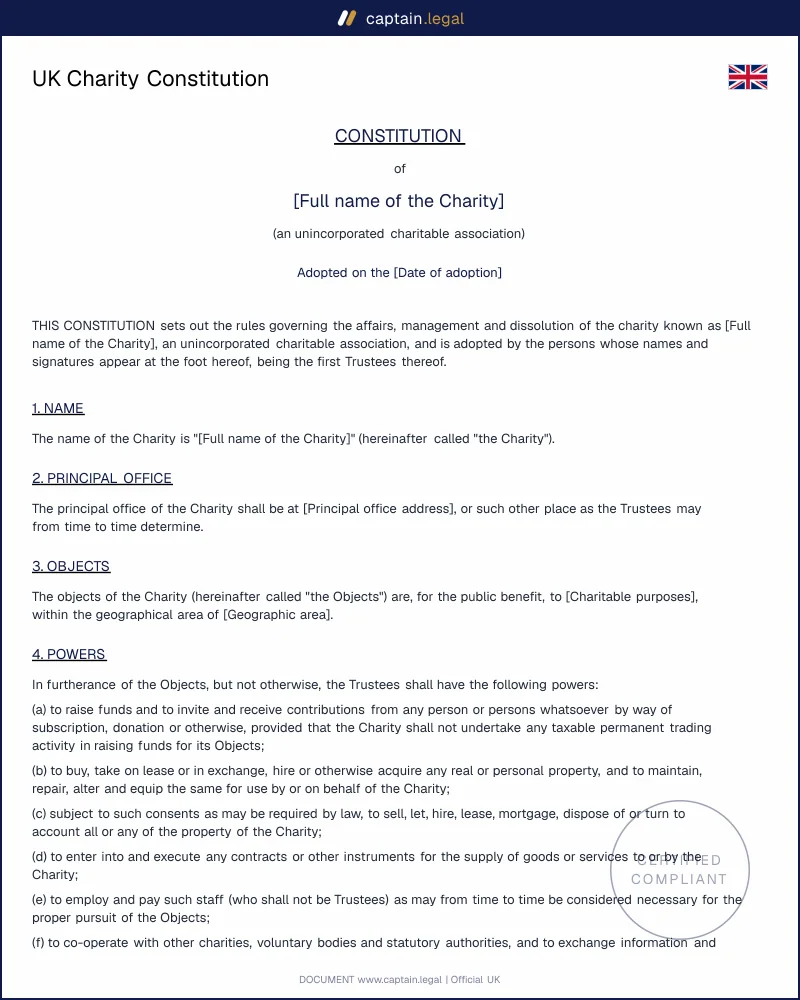
- The objects clause is the legal heart of the constitution. We draft it to track the statutory language of section 3 of the Charities Act 2011, with a specific geographic area of benefit and a clear public-benefit statement. Vague phrasing and aspirational verbs are replaced with operative purposes the Commission can register on the first pass.
- The powers clause sets out what the charity can do to further its objects, including holding property, employing staff, raising funds, investing reserves, and accepting gifts. Trustees who plan to hold land or sign a lease should review our property and tenancy templates alongside the constitution, because an unincorporated charity cannot hold land in its own name and must use holding trustees or the Official Custodian.
- Membership provisions define who can join, how applications are decided, how subscriptions are set, and on what grounds membership can be terminated. The drafting is Equality Act 2010-compliant by default and avoids the closed-shop wording that has tripped up many older constitutions.
- The trustee provisions cover number (a minimum of three is recommended, never fewer), eligibility, election, retirement by rotation, removal, conflicts of interest, and the trustee indemnity permitted under section 189 of the Charities Act 2011.
- The meetings clause distinguishes the AGM, special general meetings, and trustees' meetings, with quorum, notice periods, voting rules, and provision for written resolutions and electronic attendance.
- The finances clause requires a separate bank account, double signatures on payments above a threshold, the keeping of proper records, and the annual examination of accounts.
- The alteration and dissolution clauses lock in two non-negotiable principles : changes affecting objects, dissolution, or trustee benefits require Commission consent ; and remaining assets on winding-up must pass to another charity with similar purposes.
How to fill out this unincorporated charity constitution
The Captain.Legal builder opens with the charity's working name and the area of benefit (a single county, a region of England, the whole of England and Wales, or international). The form then asks for the objects, offering a guided list of section 3 charitable purposes with editable wording so the founders can sharpen the phrasing without straying outside the statute. Once the objects are settled, the configurator turns to membership : who can join, what subscription if any, voting rights, and the procedure for terminating membership.
The next stage is trustee architecture. You enter the founding trustees' names and addresses, set the minimum and maximum numbers, choose the retirement-by-rotation cycle, and indicate whether co-option mid-year will be allowed. The system then generates the meetings and finances clauses based on the size of the body, with quorum and notice periods scaled accordingly.
The final screen handles the belt-and-braces provisions every Commission caseworker looks for : the alteration clause requiring Commission consent for changes to objects or trustee benefits, the dissolution clause directing residual assets to another charity with similar purposes, and the optional dispute-resolution clause. A live preview updates as you go, and once you are satisfied you download the executed Word version, the editable text, and a PDF copy ready for signature at the founding meeting.
Common mistakes to avoid
Most rejections at the Charity Commission registration stage trace back to the objects clause. Founders write what they want to do rather than the legal purpose they pursue, ending up with phrases like "to support the community" that mean everything and nothing. The fix is to anchor the wording in one of the thirteen heads of section 3 and add a specific delivery method. A second recurring error is the missing or defective dissolution clause : forgetting to direct residual assets to another charity with similar purposes converts the body into a non-charity overnight, with severe tax consequences.
Trustees of small unincorporated charities also underestimate the scope of personal liability. Without a corporate veil, trustees can be pursued personally for debts and contractual obligations entered into in the charity's name. Anyone considering signing a building lease, a bank loan, or a long employment contract on behalf of the charity should pause and reconsider incorporation. Trustee indemnity insurance is sensible, and the personal legal documents for trustees section covers the wider personal-risk picture. A related error is hiring staff without a Charities Act-compliant employment contract ; the UK employment contracts catalogue covers PAYE, pensions, and the rights every worker is owed from day one. Finally, failing to update the constitution after a Charities Act 2022 change is now a common audit point : the new rules on trustee payments, ex gratia payments, and amendment procedures all warrant a clause refresh.
Frequently Asked Questions
31 verified reviews · 50 000+ downloads
- Immediate access to the document
- PDF + Word download
- Compliant with 2026 legislation
- Reviewed by lawyers
You might also like