Setting up a charity in England and Wales without exposing your trustees to personal liability used to require a charitable company limited by guarantee, with dual registration at both Companies House and the Charity Commission. The Charitable Incorporated Organisation (CIO) changed that. It is a corporate structure created specifically for charities, with a single regulator and a single set of accounts. The CIO constitution is its founding document: a deed that declares the charitable objects, names the trustees, sets the governance rules, and binds the charity to the legal framework of the Charities Act 2011. Our template covers both Association and Foundation CIOs, drafted on the Charity Commission's model and adapted to the realities of trustee practice.
Compliant
2026 Legislation
50,000+ clients
trust us
Affordable
From $4.90 / doc
Secure payment
Instant download
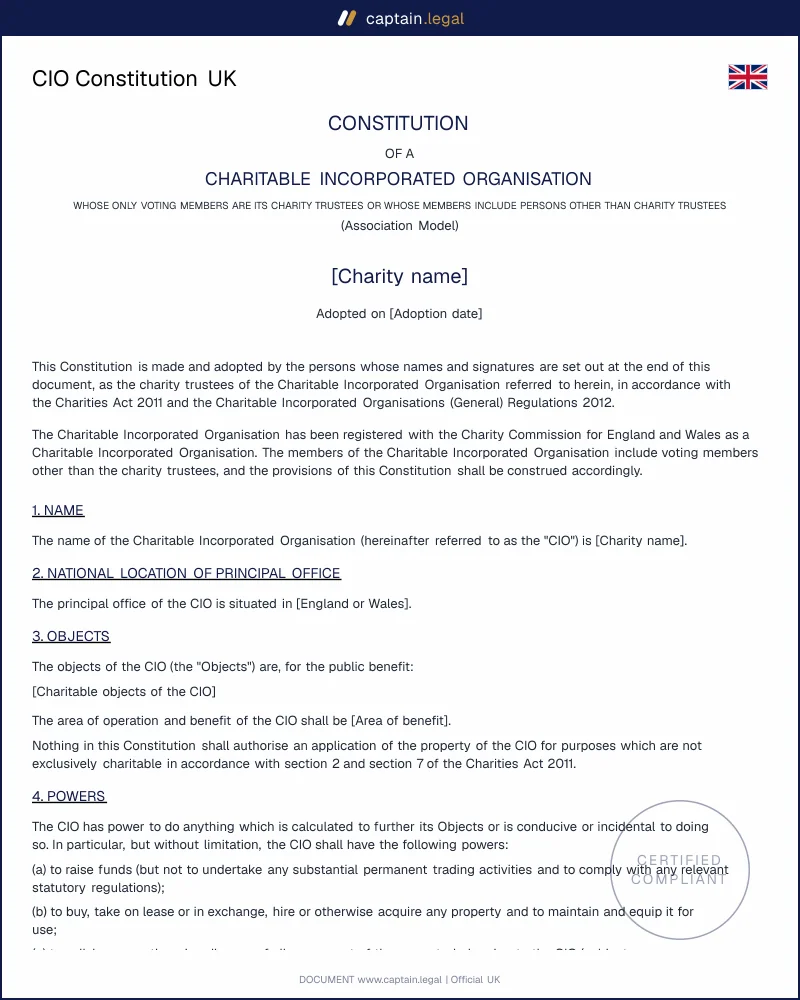
CIO Constitution UK, Charity Commission Compliant
Secure payment
What is a CIO constitution?
A CIO constitution is the governing document of a Charitable Incorporated Organisation, the legal form introduced for charities under Part 11 of the Charities Act 2011 and brought into operational use by the Charitable Incorporated Organisations (General) Regulations 2012. Unlike a charitable trust deed or unincorporated association rules, the CIO constitution does more than allocate duties between volunteers: it constitutes a separate legal person, distinct from its trustees and members, capable of holding property, entering contracts and litigating in its own name. This separation is the practical reason most modern charities choose the CIO form, since trustees enjoy limited liability for the charity's debts save where they have acted dishonestly or in breach of their fiduciary duty.
The constitution exists in two model versions issued by the Charity Commission, reflecting the two CIO structures permitted by the regulations. The Association CIO has a wider membership separate from its trustees, suitable for community groups, faith organisations and member-led charities. The Foundation CIO treats trustees as the only members, suitable for grant-makers, family trusts and quieter governance structures. Whichever model you adopt, the constitution must be filed with the Commission as part of the registration application, alongside the broader range of UK charity governance templates we maintain for trustee resolutions and AGM minutes. Any subsequent amendment is itself subject to regulatory consent before it takes effect.
Legal framework
The constitutional law of CIOs sits primarily in Part 11 of the Charities Act 2011 (sections 204 to 250), supplemented by the Charitable Incorporated Organisations (General) Regulations 2012 and the Charitable Incorporated Organisations (Insolvency and Dissolution) Regulations 2012. Section 204 of the 2011 Act defines a CIO as a corporate body with charitable purposes and at least one member. Section 207 sets the mandatory contents of every constitution: the name, the principal office address in England or Wales, the charitable purposes, the powers, the rules concerning members, the appointment and removal of trustees, the application of property on dissolution, and the procedure for amendment. A constitution that fails to address any of these heads is not a valid CIO constitution and the Commission will refuse registration.
The regulator is the Charity Commission for England and Wales, whose authority extends both to registration and to ongoing supervision. Trustees owe the fiduciary duties codified in the 2011 Act, including the duty to act in the interests of the charity, to use reasonable care and skill, and to avoid conflicts of interest. Amendments to the constitution require trustee resolution and, for changes affecting the charitable purposes, dissolution provisions, or trustee benefits, the Commission's prior written consent under section 224. The Charities Act 2022 introduced procedural simplifications to amendment and disposal of land, most of which came into force in stages between 2022 and 2024, but the consent regime for regulated alterations remains intact. The authoritative starting point for trustees drafting their first document is the Charity Commission's model governing documents on GOV.UK, updated regularly with revised templates and commentary on common drafting errors.
When do you need this document?
The most common scenario is the formation of a new charity whose founders want corporate personality from day one. Setting up a CIO from scratch lets you avoid the dual filing burden of a charitable company at Companies House and the Charity Commission, and gives you one regulator, one annual return, and one consolidated set of trustees' accounts. The second frequent case is the conversion of an existing unincorporated charity to a CIO, typically because trustees have grown uncomfortable with personal liability for staff contracts, leases or grant obligations. The Commission permits this conversion under the Charities Act 2011, and the new CIO must adopt a fresh constitution rather than reuse the old trust deed verbatim.
Third, charitable companies limited by guarantee sometimes convert to CIOs to escape Companies House filings. Sections 228 to 233 of the 2011 Act set out the procedure: the existing company resolves to convert, drafts a CIO constitution, applies to the Commission, and is then struck off the companies register on the same day the CIO is registered. The members of the company become the members of the CIO automatically, which catches some trustees off guard when they have an inactive membership list inherited from a previous era. Founders who run a parallel trading arm should also review our suite of UK business and company formation documents for the subsidiary, since the CIO cannot itself trade non-incidentally to its objects. Finally, you will need a fresh constitution if the regulator orders a substantial amendment that touches the objects clause, the dissolution clause or the trustee benefits provision, since these are regulated alterations and the Commission expects a clean redraft rather than a marked-up patchwork.
Key clauses included in our template
A CIO constitution drawn from our template addresses every requirement of section 207 of the Charities Act 2011 and follows the layout the Commission expects in its registration review.
- The name of the CIO and its principal office opens the document and triggers the Commission's name-clearance check. Two CIOs cannot share a name, and certain sensitive words such as "royal", "chartered" or "national" require prior consent from the relevant authority. The principal office must sit in England or Wales for the CIO to exist as such.
- The charitable objects clause is the heart of the constitution. It must describe purposes that are exclusively charitable within the thirteen heads of charity listed in section 3 of the 2011 Act and that demonstrably benefit the public. A clause that mixes a charitable purpose with a non-charitable purpose is fatal; the Commission will reject the application outright and the trustees will need to redraft from scratch.
- The powers clause sets out what the CIO may do to pursue its objects: hold property, employ staff, enter contracts, borrow money, accept gifts, and trade in furtherance of its objects. Our template draws on the Commission's model powers list and includes the standard employment-related provisions that interlock with our UK employment contracts compliant with statutory law when a CIO hires its first paid staff.
- The trustee provisions govern eligibility, appointment, retirement and disqualification. Our template excludes anyone disqualified under section 178 of the Charities Act 2011 or under the Charities (Protection and Social Investment) Act 2016, and incorporates the automatic disqualification regime updated in 2018.
- The members' provisions differ markedly between Association and Foundation CIOs; the template flags the choice at the outset and adjusts the membership clauses, the convening of general meetings and the quorum rules accordingly.
- The dissolution clause directs surplus assets to a charity with similar objects on winding up, a requirement that the Commission scrutinises closely because it protects the assets from being recycled to founders or members.
Regional considerations
The CIO is a creature of English and Welsh law: a charity whose principal office sits in Cumbria or Powys registers as a CIO with the Commission in London under the Charities Act 2011. The vast majority of our template's users fall in this category. The Charity Commission processes the application, allocates a charity number, and publishes the constitution on the public register. Cross-border charities operating in Scotland or Northern Ireland still register their CIO in England and Wales, but must also register with the Scottish or Northern Irish regulator if they hold property or fundraise there.
Scotland uses a separate form, the Scottish Charitable Incorporated Organisation (SCIO), governed by the Charities and Trustee Investment (Scotland) Act 2005 and the Scottish Charitable Incorporated Organisations Regulations 2011. The SCIO regulator is the Office of the Scottish Charity Regulator (OSCR), not the Charity Commission. A Scottish charity cannot register as a CIO; it must register as a SCIO. The two constitutions look similar on paper but the statutory references, the membership rules and the trustee disqualification regime differ in detail. Our template addresses the English and Welsh CIO, and we publish a separate SCIO constitution for charities north of the border.
Northern Ireland operates its own CIO under the Charities Act (Northern Ireland) 2008, regulated by the Charity Commission for Northern Ireland. The Northern Irish regulator opened to new applications in stages and remains a separate jurisdiction with its own register. A charity with its principal office in Belfast or Derry must use the Northern Irish CIO route and not the English template, even though the structures resemble each other in outline.
Welsh-language CIOs are entitled to file their constitution in Welsh under the Welsh Language (Wales) Measure 2011, and the Commission accepts bilingual documents. Our template can be adapted for Welsh-medium charities, with a parallel translation service available where the trustees prefer to appear in Welsh on the public register.
How to fill out this CIO constitution
You start by selecting whether the CIO will follow the Association or Foundation model. Our form asks the question in plain terms: do you want members other than the trustees, or do you want trustees and members to be the same people. From there the questionnaire branches, adjusting the membership clauses, the convening rules for general meetings, and the quorum provisions accordingly. The charitable objects clause comes next, with a free-text field and a guidance panel that flags wording the Charity Commission has historically rejected, such as vague references to "community wellbeing" without specifying activities or beneficiary classes.
You then enter the trustees' names, dates of birth and home addresses, all of which the Commission requires for its eligibility checks. The form will warn you if you list fewer than three trustees, since the Commission expects a minimum of three for most CIOs even though the Act sets the absolute floor at one. The closing screens cover the dissolution clause, conflict-of-interest declarations, and the model articles for trustee meetings. Once submitted, the form generates a Word and PDF document, ready for the trustees' signatures and the registration application on the Commission portal. The questionnaire takes most users between fifteen and twenty-five minutes when their objects are already clear.
Common mistakes to avoid
The single most frequent error is a defective objects clause. Trustees write something like "to promote the welfare of our local community" without specifying activities, beneficiaries or geographic scope, and the Commission returns the application with a request for redrafting. The cure is to anchor every object in one of the thirteen statutory heads, name the beneficiary class, and list two or three illustrative activities. The second recurring mistake is conflating Association and Foundation structures, drafting a constitution with separate members and then listing only the trustees on the application form. The Commission spots this immediately and the inconsistency stalls registration for weeks.
A third error involves property and contracts signed before registration. Trustees who sign a lease or a grant agreement in their personal names rather than the CIO's name expose themselves to personal liability that the CIO form was designed to eliminate; the cure is to use one of our UK real estate and tenancy templates drafted to name the corporate body as contracting party, and to date the lease after the registration certificate has issued. The fourth mistake is the omission of the conflict-of-interest provisions required by the 2011 Act; the Commission treats this as a registration blocker. Finally, trustees sometimes copy a dissolution clause from a US 501(c)(3) template found online; the destination charity language must mirror the Charities Act 2011 requirements or the document will be rejected on review.
Frequently Asked Questions
20 verified reviews · 50 000+ downloads
- Immediate access to the document
- PDF + Word download
- Compliant with 2026 legislation
- Reviewed by lawyers
You might also like