A trustee appointment letter is the formal document by which a UK charity records the appointment of a new trustee, sets out the terms of office, and confirms that the appointee understands the fiduciary duties accepted under English charity law. Whether your organisation is a CIO, a charitable company limited by guarantee, or an unincorporated association on the Charity Commission's register, the letter is what turns a board resolution into a properly documented appointment. It serves three purposes at once: it confirms eligibility against the statutory disqualification grounds, it triggers the trustee declaration, and it gives the appointee a written reminder of their legal exposure before signing.
Compliant
2026 Legislation
50,000+ clients
trust us
Affordable
From $4.90 / doc
Secure payment
Instant download
Trustee Appointment Letter UK, Charity Law
Secure payment
What is a trustee appointment letter?
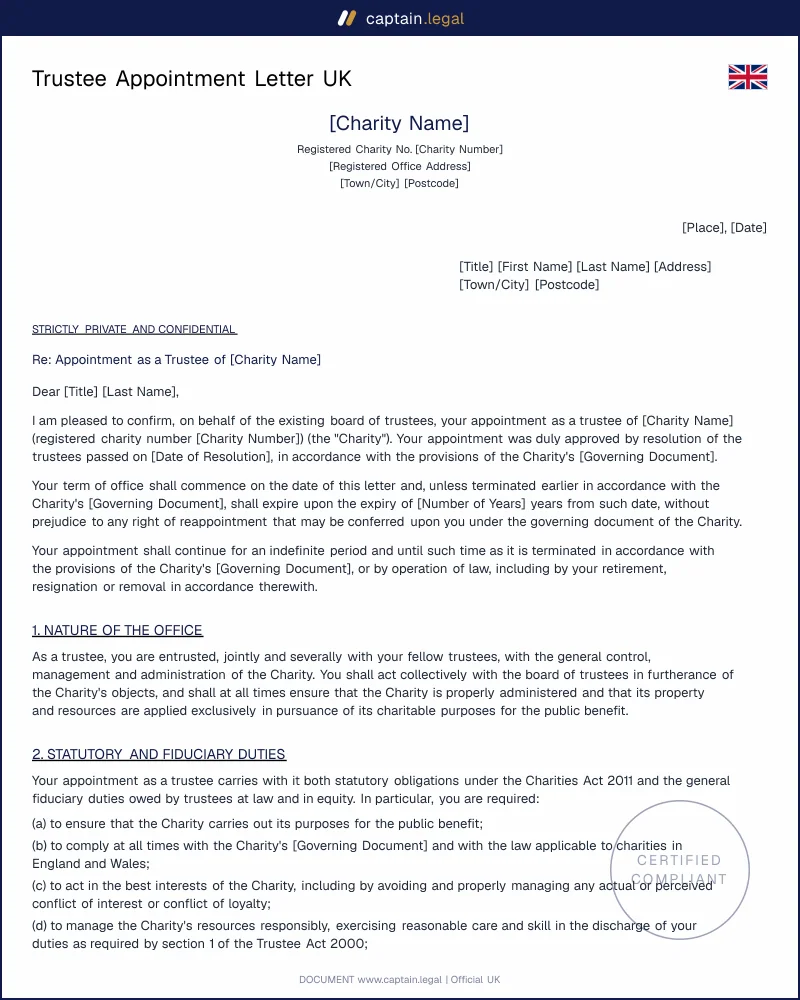
A trustee appointment letter is a written communication from the chair, secretary, or board of a UK charity to an individual, confirming their formal appointment as a charity trustee. In legal terms it sits at the intersection of corporate governance and fiduciary law. The letter records the decision of the board or the members under the charity's governing document, references the duties owed under the Charities Act 2011, and creates a paper trail that the Charity Commission, your auditor, or a future grant funder can rely on if the appointment is ever questioned.
It is sometimes confused with the trustee declaration form, but the two are different. The declaration is a regulatory document signed by the trustee themselves, confirming they are not disqualified and consenting to act, which the Commission expects to be held on file. The appointment letter is the charity's record of the offer and its terms. Both should sit together in the trustee's induction pack.
The letter is also distinct from an employment letter or a volunteer agreement. A trustee is neither employed nor a volunteer in the ordinary sense, but a fiduciary, with a wholly different set of legal obligations. Confusing the two is a frequent source of grief, particularly where a trustee later takes on a paid role or where remuneration questions arise. Treating a trustee as if they were a member of staff is one of the fastest ways to land in front of the Commission with a serious incident report on your desk.
Legal framework
The starting point is the Charities Act 2011, the consolidating statute that governs charities in England and Wales. Section 177 defines a charity trustee as a person having the general control and management of the administration of a charity, which is why this document matters: appointing someone informally and letting them sit on a board does not protect anyone, because the law looks at function, not labels. The 2011 Act sets out the regulator's powers, the registration regime, and the framework for trustee disqualification. Sections 178 to 184 contain the automatic disqualification provisions, widened by the Charities (Protection and Social Investment) Act 2016, which is why a candidate's eligibility must be confirmed before the appointment is finalised.
Fiduciary duties sit on top of the statute. Trustees must act in the charity's best interests, manage the charity's resources responsibly, exercise reasonable care and skill, and ensure the charity carries out its purposes for the public benefit. The Commission's guidance document CC3, The Essential Trustee, distils these obligations into a working framework and is the single document every new trustee should read before signing (see the Charity Commission guidance CC3 on essential trustee duties). For trustees of charitable companies, the Companies Act 2006 applies in parallel, layering directors' duties from sections 170 to 177 on top of the charity law obligations.
Form matters too. The appointment letter does not need to be notarised or witnessed, but it must be in writing, dated, signed by an authorised officer of the charity, and counter-signed by the appointee to evidence acceptance. The charity must also notify Companies House where applicable, update its trustees' register, and submit the change to the Commission through the Update Charity Details service within statutory timescales. Skipping any of these steps does not invalidate the appointment, but it creates an audit gap that grant-makers and auditors spot immediately. The wider catalogue of UK charity and non-profit governance templates on Captain.Legal is built to plug into that compliance rhythm.
When do you need this document?
The classic moment is the routine succession appointment: a trustee reaches the end of their term, the nominations committee proposes a replacement, the board resolves the appointment at a quorate meeting, and the letter follows within days. Small charities sometimes treat it as a formality and skip the paperwork; that is the precise moment a grant funder asks for proof of appointment and finds nothing on file.
The second scenario is the founding board appointment when a new charity is being set up. Whether you are registering a CIO, incorporating a charitable company, or constituting an unincorporated association, the first trustees are usually named in the governing document, but each of them still needs an individual letter to record the start date, the term, and the acceptance of fiduciary duties. This matters in particular if you are working from a CIO constitution drafted to the Charities Act 2011, where the Commission expects clear evidence of each founding trustee's consent.
A third trigger is the co-option of a trustee outside the normal nomination cycle, often because the board has identified a skills gap in finance, safeguarding, or digital, and wants to bring in expertise quickly. Co-opted trustees carry the same duties as elected ones, and the letter should reflect any limits on tenure or voting rights set by the constitution. The final scenario is the conversion of an advisor or observer into a full trustee. People sometimes drift onto boards informally, attending meetings, contributing to decisions, and discover years later that the Commission considers them de facto trustees with retrospective duties. If someone is acting like a trustee, they are a trustee in law, and the letter should be issued the moment that becomes apparent.
Key clauses included in our template
The template runs through six clauses, each drafted to a recognised charity-law format and each carrying a clear evidential purpose.
- The identification of the parties opens the letter with the registered name and charity number of the appointing body, alongside the full legal name and address of the appointee. Where the charity is also a company limited by guarantee, the Companies House number sits next to the charity number; missing either is the single most common drafting error flagged in grant funder due diligence.
- The statement of the resolution records the date and forum of the decision: a trustees' resolution at a quorate board meeting, a written resolution between meetings, or an election at the AGM, with reference to the relevant clause of the governing document. The wording mirrors the constitution so the appointment cannot later be challenged for procedural irregularity.
- The term of office and renewal mechanics spell out the start date, the length of the initial term, and whether the trustee is eligible for re-appointment. For charities with rotation clauses, the letter notes which "class" of trustees the appointee joins, so retirement dates are predictable years in advance.
- The summary of fiduciary duties restates the core obligations under the Charities Act 2011 and the CC3 guidance: acting in the charity's best interests, managing resources responsibly, exercising reasonable care and skill, and ensuring the charity pursues its objects for the public benefit. This is the part the appointee signs back, which evidentially protects the charity if a duty is later breached.
- The disqualification confirmation asks the appointee to confirm they are not disqualified under sections 178 to 184 of the Charities Act 2011, including the automatic disqualifications added by the Charities (Protection and Social Investment) Act 2016. The letter cross-refers to the official Trustee Declaration form, which must also be signed and retained.
- The conflicts of interest undertaking requires the appointee to disclose existing conflicts before signing and to declare new ones promptly. Trustees on charitable companies see a parallel duty under section 177 of the Companies Act 2006, which is why boards often pair this letter with their wider UK business and corporate governance templates for connected-party paperwork.
Regional considerations
The United Kingdom is three separate charity-law jurisdictions, and the appointment letter changes with each one.
England and Wales is the largest jurisdiction by registered numbers and is regulated by the Charity Commission for England and Wales. The Charities Act 2011 and Charities Act 2022 (commenced in stages) form the operative statutory framework, with detailed Commission guidance filling out the practical expectations. Appointment letters for charities in this jurisdiction reference these Acts by name, and the trustee declaration filed with the Commission must use the latest version of the form available on gov.uk. The 2022 Act expanded permitted ex-gratia payments and clarified rules on land disposals, with knock-on effects for trustees who handle charity property. Older templates that pre-date its commencement should be reviewed before reuse, especially where the charity sits on freehold premises (see Captain.Legal's UK real estate and property legal templates for the related documents).
Scotland is the most commonly missed differentiator. Scottish charities, including charities operating north of the border but with English registration, fall under the Charities and Trustee Investment (Scotland) Act 2005 and are regulated by the Office of the Scottish Charity Regulator (OSCR). The trustee duty framework is similar in substance, but the statutory references in the appointment letter must change, and the trustee declaration is the OSCR version, not the Commission one. Cross-border charities operating in both jurisdictions need dual registration and dual paperwork; running a single-jurisdiction letter against a cross-border charity is a recurring drafting fault.
Northern Ireland operates under the Charities Act (Northern Ireland) 2008 and is regulated by the Charity Commission for Northern Ireland (CCNI). The registration regime was reset by the Court of Appeal's McKee decision in 2019 and reinstated through the Charities Act (Northern Ireland) 2022. Appointment letters for NI charities reference the 2008 Act and use CCNI's trustee declaration template; the equivalent of CC3 is CCNI's Running Your Charity series.
For charitable companies and CIOs, the regional analysis layers further. A charitable company limited by guarantee registered in England with a Scottish operating arm needs to consider Companies Act filings alongside dual charity registrations, and the letter should make clear which trustees also sit as directors. CIOs and SCIOs (Scottish charitable incorporated organisations) sit in their own regimes and cannot be assumed equivalent; the SCIO registers with OSCR under the 2005 Act, not with the Commission. Using an English-style appointment letter for an SCIO trustee is an unforced error that turns up regularly in OSCR reviews.
How to fill out this trustee appointment letter
You start by selecting your charity's legal form on Captain.Legal, because that single choice drives everything else in the letter: the governing document referenced, the statutory citations, the disqualification provisions, and whether parallel directors' duties under the Companies Act 2006 need to appear. The form then asks for the charity's registered name, charity number, principal office address, and the Companies House number if you operate as a charitable company or as a CIO with a corporate footprint.
The next section gathers the appointee's details: full legal name, residential address, date of birth (held confidentially, not printed on the letter itself), and the personal email used for board correspondence. The letter automatically inserts the standard fiduciary duty wording, but the platform invites you to tailor the term of office, the voting rights for co-opted trustees, and any sub-committee allocations, because constitutions vary widely on these points.
You then enter the resolution date and forum, picking from a board minute, a written resolution, or an AGM election. The letter cross-references the relevant clause of your governing document, and you can paste the clause text directly into the form so the citation is exact. A final review screen lets you check the disqualification list and conflict of interest declarations before the document is generated. The output comes in both Word and PDF, ready for signature and for filing alongside the trustee declaration form.
Common mistakes to avoid
The first damaging mistake is issuing the letter before checking eligibility. The disqualification regime in sections 178 to 184 of the Charities Act 2011 is automatic, and the Commission takes a dim view of charities that appoint disqualified trustees because nobody bothered to ask. A short pre-appointment checklist, run by the secretary or chair before the letter goes out, prevents the embarrassment of having to rescind days later. The second recurring fault is drafting the letter to a template that does not match the charity's structure. CIO trustees, charitable company directors who are also trustees, and trustees of unincorporated associations are all "charity trustees" in Commission shorthand, but the statutory background differs. A letter that cites the Companies Act 2006 to an unincorporated trustee, or omits it entirely for a director-trustee, signals to grant funders and auditors that the governance is unread.
A third mistake is treating the appointment letter as an employment letter. Trustees are fiduciaries, not employees. Wording borrowed from a junior staff offer, references to probation periods, performance management, or salary expectations all leak into letters drafted by HR teams unfamiliar with the third sector. The cleanest fix is to keep a dedicated trustee letter on file and to use the separate UK employment law and HR templates for any paid roles a trustee may later take on. The fourth fault is forgetting the counter-signature: an unsigned acceptance is a draft, not a binding appointment, and the Commission's own forms presume mutuality. The fifth is never refreshing the letter; trustee terms expire, conflicts of interest evolve, and successive Charities Acts have changed the disqualification thresholds. Refresh the letter at each re-appointment, not as a courtesy but as a matter of legal hygiene.
Frequently Asked Questions
41 verified reviews · 50 000+ downloads
- Immediate access to the document
- PDF + Word download
- Compliant with 2026 legislation
- Reviewed by lawyers
You might also like