A trustee resignation letter is the formal written notice by which a charity trustee steps down from the board of a UK charity or non-profit. It records the date the resignation takes effect, the reason where the trustee wishes to give one, and any handover arrangements, so the charity can update its registers, notify the Charity Commission, and protect itself against later disputes about authority. Drafting one properly is not a formality. A casual email saying "I am out" creates ambiguity about effective dates, ongoing trustee duties, and personal liability for decisions already taken. This template gives charity trustees, company secretaries and CIO administrators a clean, regulator-friendly document that fits both small unincorporated groups and incorporated charitable structures.
Compliant
2026 Legislation
50,000+ clients
trust us
Affordable
From $4.90 / doc
Secure payment
Instant download
Charity Trustee Resignation Letter UK | Charities Act 2011
Secure payment
What is a trustee resignation letter?
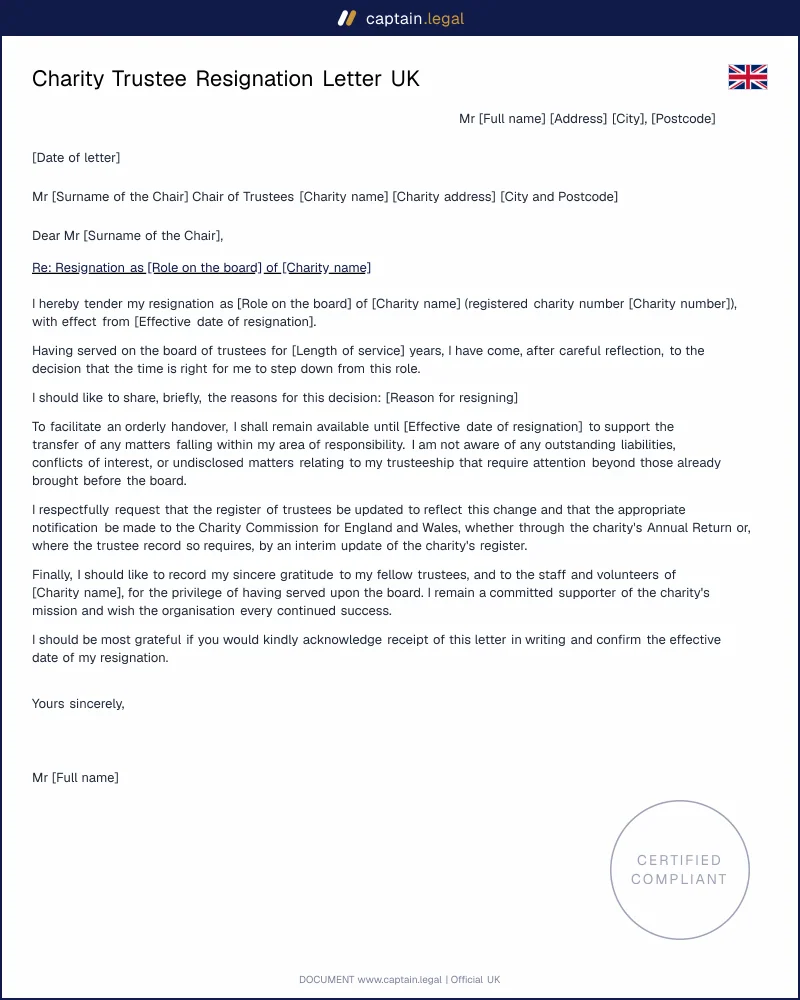
A trustee resignation letter is a signed, dated written instrument by which a person holding office as a trustee of a UK charity tenders their resignation to the board. It functions both as evidence of the trustee's decision and as the trigger for the charity's internal and external administrative obligations. The document is addressed to the chair of trustees, or to the secretary depending on the governing document, names the trustee, identifies the charity and its registration number, and sets a clear effective date. English charity law treats the trustee office as a fiduciary position, not a casual volunteer role, so the way the resignation is recorded matters as much as the fact of it.
The letter should not be confused with two adjacent processes. Removal by the Charity Commission under the Charities Act 2011 is a regulator-driven mechanism reserved for misconduct or incapacity; automatic disqualification under section 178 prevents someone from acting as a trustee at all. A resignation, by contrast, is the trustee's own choice and takes effect on the date stated in the letter, subject to any notice period set out in the constitution or articles. Resigning by email or by silence is technically possible if your governing document permits it, but it produces a thin paper trail. The Charity Commission expects a clear, dated written record of every trustee change, and grant-makers will ask for it as part of due diligence.
Legal framework
The starting point is the Charities Act 2011, the principal statute governing charities in England and Wales. It defines trustee duties, sets out registration obligations with the Charity Commission, and gives the regulator its compliance and inquiry powers. Resignation itself is not regulated by a single section, but the surrounding architecture of trustee duties is, and that architecture survives the moment of departure. A trustee who resigns remains accountable for breaches of duty committed while in office. The Trustee Act 2000 adds the statutory duty of care that applies to investment, delegation and insurance decisions taken before the effective date.
For a charitable incorporated organisation, the Charitable Incorporated Organisations (General) Regulations 2012 require the CIO to maintain an up-to-date register of trustees and to notify the Commission of changes through the online charity update service. The same regulations that govern the formation of a CIO, mirrored in our CIO constitution template for UK charities, set out the body's own internal rules on resignation timing and quorum. For a charitable company limited by guarantee, the Companies Act 2006 runs in parallel: a trustee who is also a director must be removed from the Companies House register by filing form TM01 promptly after cessation, and the company's own statutory register of directors must be updated without delay.
The Charity Commission's guidance document CC3 The Essential Trustee sets out the practical expectations on incoming and outgoing trustees, including handover and continuity of records. You can read the official Charity Commission guidance on essential trustee duties on gov.uk, which carries the regulator's view on what good governance looks like at the point of departure.
When do you need this document?
The most frequent trigger is the end of a defined term of office. Most modern UK charity constitutions cap trustee terms at three years, renewable once or twice, after which retirement by rotation is automatic and the outgoing trustee submits a short letter confirming the date and any handover. Term-limited resignations are the cleanest scenario: the constitution sets the timing, AGM minutes record the rotation, and the letter closes the loop. Voluntary resignation mid-term covers everything else, and it is where letters most often go wrong because the trustee underestimates how administrative the process actually is. An unincorporated charity constitution drafted to the Charities Act 2011 will typically include the notice period and procedural steps that the resignation letter must respect.
Beyond the routine, the letter is the right instrument when a trustee discovers a persistent conflict of interest that cannot be managed by recusal alone, for instance after taking a paid role with a connected supplier or after joining a competing charity. It is also used when personal circumstances change in a way that makes the role impractical: a move overseas, ill-health, or new caring responsibilities. Resignation does not erase liability for decisions already taken, so trustees facing a brewing dispute should resign with legal advice rather than vanish.
One edge case worth flagging. A trustee who suspects another trustee of misconduct sometimes resigns first and reports second. The Charity Commission's serious incident reporting framework still applies after departure, and a former trustee who fails to flag a known issue can be criticised for it.
Key clauses included in our template
- The identification of the trustee and charity opens the letter and ties the resignation to a specific person and entity. Full legal name of the trustee, position held (trustee, chair, treasurer, secretary), full registered name of the charity, registration number from the Charity Commission, and where relevant the Companies House number, leave no room for confusion when the charity later updates its registers or files form TM01.
- The effective date of resignation is stated unambiguously. The clause distinguishes between an immediate resignation and one that takes effect at the next board meeting, on a specific calendar date, or at the end of any notice period required by the constitution. English principles on the revocation of a unilateral declaration mean that once accepted, a resignation cannot generally be withdrawn without board consent.
- The statement of reasons is optional but recommended for routine cases. The template offers neutral wording for term expiry, personal circumstances or relocation, and a separate form of words for resignations linked to a conflict of interest. Where the reason is sensitive, the template suggests a private cover letter to the chair alongside the formal record.
- The compliance confirmation reassures the board that no constitutional notice step has been skipped. This matters when the resignation is mid-term and the constitution sets a minimum notice period or requires the resignation to be tabled at a board meeting.
- The handover and return-of-property clause lists charity records, devices, keys and bank cards that will be returned, and identifies the colleague who will pick up any chair, treasurer or signatory functions on an interim basis. Where the trustee also held a paid role, the parallel HR paperwork sits in our UK employment documents library.
- The continuing duties acknowledgement records that the trustee remains bound by confidentiality and post-office fiduciary duties regarding information acquired in office, and that liability for prior acts is not extinguished by resignation. This is the clause that protects the charity if a problem surfaces months later.
Regional considerations
The Charity Commission for England and Wales is not the only regulator at work across the UK, and a trustee resignation letter must be adapted to the jurisdiction in which the charity is registered. The drafting is broadly similar, but the supervising authority and the filing route differ in ways that affect when and how the letter takes effect.
England and Wales. A trustee of a charity registered with the Charity Commission must ensure that the charity updates its trustee register through the Commission's online service after cessation. For a CIO, the Charitable Incorporated Organisations (General) Regulations 2012 set out the formal change-of-trustee process, and the resignation letter is the supporting document the board minutes will reference. For a charitable company, the parallel TM01 filing at Companies House sits alongside the charity update. If the trustee is the sole signatory on a charity bank account, the bank will require sight of both the resignation letter and a board minute appointing a replacement signatory before processing any further payment. Charitable companies with trading subsidiaries often also need to refresh their commercial paperwork, and our UK business documents catalogue covers the standard director and shareholder forms.
Scotland. Scottish charities are regulated by the Office of the Scottish Charity Regulator (OSCR), not the Charity Commission, under the Charities and Trustee Investment (Scotland) Act 2005. Resignation of a charity trustee must be notified to OSCR through the OSCR Online portal, and the timing is governed by the 2005 Act together with the body's own governing document. Where the charity is a SCIO, falling below the statutory minimum of three trustees threatens its continuing eligibility, and the board must move quickly to recruit before the resignation takes effect.
Northern Ireland. Northern Irish charities fall under the Charities Act (Northern Ireland) 2008 and are supervised by the Charity Commission for Northern Ireland (CCNI). The CCNI online services portal handles the trustee change notification, with broadly similar timing expectations. The 2008 Act applies the same fiduciary standards as the English statute, so the substantive content of the resignation letter does not need to change; only the filing route does.
How to fill out this trustee resignation letter
The Captain.Legal questionnaire walks the trustee through the document one decision at a time, in plain English, so the final letter reflects the actual governance arrangements of the charity rather than a generic template. You begin by indicating the structure of the organisation, choosing between an unincorporated association, a CIO, a charitable company limited by guarantee, or a SCIO for Scottish charities. The form then adjusts the references and filing reminders accordingly. You enter the full registered name of the charity, the registration number, and your role on the board, with prompts that match the wording of the Charities Act 2011 register fields.
The questionnaire next asks about the effective date and any notice period set out in your constitution, and offers tailored language for an immediate resignation, a resignation effective at the next board meeting, or a future-dated departure. You then select the reason, with neutral pre-drafted options for routine departures and a more careful set of templates for resignations tied to a conflict of interest or to a governance dispute.
A short handover module captures the property and records you will return, the colleague who will take over your duties on an interim basis, and any bank or signatory authorities that must be revoked. The system produces a finished Word and PDF letter, ready to sign, copy to the chair and secretary, and store with the next set of board minutes.
Common mistakes to avoid
The first and most damaging mistake is treating the resignation as an internal matter and skipping the regulator filing. A trustee whose name remains on the Charity Commission register after they have stepped down can be contacted by funders, banks and the regulator about decisions they no longer make. The fix is short: the resigning trustee should send a copy of the signed letter to the secretary the same day, and the charity should update its register without delay. The second mistake is leaving the effective date vague. Phrases like "with effect from the end of the year" or "after the AGM" create real ambiguity if a decision is taken in the interim and someone later asks whether the trustee was still in office.
A third recurring problem is the resignation that doubles as a public protest. Trustees sometimes use the letter to vent frustrations and copy in third parties, including journalists or major donors. Beyond the reputational damage, this can breach the confidentiality duty that survives departure and expose the former trustee to a personal claim. A short, neutral letter with a separate private note to the chair is almost always the right structure. A fourth mistake is forgetting to revoke bank mandates and IT access. Banks have refused to process payments because a former trustee was still listed as a signatory; cloud accounts have been compromised because old credentials were never deactivated. The day a trustee resigns is the day to close every access route they held in office, not the day after the next meeting. The full set of supporting resolutions and minutes sits in our UK charity governance documents catalogue.
Frequently Asked Questions
23 verified reviews · 50 000+ downloads
- Immediate access to the document
- PDF + Word download
- Compliant with 2026 legislation
- Reviewed by lawyers
You might also like