A UK redundancy consultation pack is the full set of documents an employer needs to run a fair, defensible redundancy process from start to finish, not just the final letter. It includes the at-risk notification, individual consultation invitations, a scored selection matrix, and outcome letters confirming redundancy, redeployment, or retention. Built around the definition of redundancy in section 139 of the Employment Rights Act 1996 and the consultation standards drawn from Williams v Compair Maxam Ltd, this pack lets a small or mid-sized employer evidence every stage of the decision. It is written for businesses making fewer than 20 redundancies at one establishment, where individual consultation, rather than collective consultation, is the legal spine of the exercise.
Most employers do not lose redundancy claims on the underlying business case. They lose on process: a missing consultation meeting, a selection score nobody can explain, an at-risk letter that reads like a foregone conclusion. This pack is built to close those gaps.
Compliant
2026 Legislation
50,000+ clients
trust us
Affordable
From $4.90 / doc
Secure payment
Instant download
Redundancy Consultation Pack UK | Letters & Matrix
Secure payment
What is a UK redundancy consultation pack?
A redundancy consultation pack is a sequenced bundle of letters and a scoring tool that together document a fair process under section 98(4) of the Employment Rights Act 1996. A single redundancy notice letter confirms the outcome; a consultation pack covers everything that must legally happen before that letter can be sent. The distinction matters because a redundancy dismissal is only fair if the employer both had a genuine redundancy situation and acted reasonably in carrying it out. The reasonableness limb is almost entirely about the paper trail.
The pack typically opens with a collective or group announcement explaining the business rationale, moves to an individual at-risk letter placing the named employee in a pool, then runs through at least two or three consultation meeting invitations with accompanying minutes prompts. The selection matrix scores everyone in the pool against objective criteria. Finally, outcome letters confirm whether each employee is dismissed for redundancy, offered suitable alternative employment, or retained.
What separates this from a generic HR template is sequencing and statutory anchoring. Each letter is timed to a defensible process: warning first, consultation while decisions can still change, scoring after consultation on the criteria, and dismissal only at the end. An employer who serves these documents out of order, or who scores the matrix before consulting on it, undermines the fairness the pack is designed to protect. You can pair this with our UK dismissal letter template covering the five fair reasons under section 98 where the redundancy sits alongside other potential grounds.
Legal framework
Redundancy in the UK is governed primarily by the Employment Rights Act 1996. Section 139 defines redundancy narrowly: a dismissal counts as redundancy only where it is attributable wholly or mainly to the employer ceasing business at the workplace, or to the requirements of the business for employees to carry out work of a particular kind having ceased or diminished. The House of Lords settled the test in Murray v Foyle Meats Ltd [1999] UKHL 29, confirming it is purely functional: the question is simply whether the business needs fewer people to do the relevant work, not what an employee's contract or job title says. An employer who labels a personality clash or a performance problem as "redundancy" is exposed the moment that label is tested.
Once a genuine redundancy situation exists, fairness is judged under section 98(4). There is no statutory ACAS Code of Practice for redundancy in the way there is for discipline and grievance, so the standard comes from case law. The leading authority remains Williams v Compair Maxam Ltd [1982] IRLR 83, where the Employment Appeal Tribunal set out the principles a tribunal expects: maximum warning, consultation with representatives or affected individuals, selection against criteria that can be objectively checked rather than personal opinion, consistent application of those criteria, and a genuine search for alternative employment. The ACAS non-statutory guidance on redundancy fleshes these out in practice, and the official ACAS guidance on collective consultation for redundancy is the reference point for employers near the 20-employee threshold.
Two further rules bite directly. Section 86 ERA 1996 sets statutory minimum notice at one week per year of service up to twelve weeks, or the contractual period if longer. Section 138 gives an employee who accepts suitable alternative employment a four-week statutory trial period before redundancy pay is affected. Where 20 or more dismissals are proposed at one establishment within 90 days, sections 188 and 193 of the Trade Union and Labour Relations (Consolidation) Act 1992 impose collective consultation and a Form HR1 notification to the Secretary of State, with a 30-day minimum consultation window. The Employment Rights Act 2025 will add an organisation-wide trigger from 2027, but the establishment test survives. This pack covers the sub-20 individual route, where collective duties do not apply but the Williams standard does.
When do you need this document?
The most common trigger is a genuine reduction in headcount within a single role or department: the business needs fewer people doing work of a particular kind, and more than one person does that work. That is the classic pooling scenario, and it is where a selection matrix becomes non-negotiable. A hotel with three back-office administrators that needs only two must pool all three and score them, because each could perform the others' role. Picking one on the manager's gut feeling is exactly the conduct Williams v Compair Maxam found unfair.
The second trigger is a workplace closure or relocation under limb (a) of section 139, where a site shuts and the question becomes whether suitable alternative work exists elsewhere in the business. Here the consultation focus shifts from selection to redeployment, and the outcome letters in this pack carry that weight. A third, increasingly frequent scenario is restructuring after a downturn or a lost contract, where roles are merged or removed and the employer must consult on the proposed new structure before confirming who is at risk.
A "pool of one" is the edge case worth flagging. Even where only a single role disappears, you must still consult that individual before deciding, and you should consult on the pool itself. The EAT in Mogane v Bradford Teaching Hospitals NHS Foundation Trust held that choosing a pool of one on an arbitrary basis, before any consultation, made the dismissal unfair. The lesson is that consultation must happen while it can still change the decision, not as a formality after the outcome is fixed. Employers managing parallel exits on agreed terms often run this process alongside our UK settlement agreement template built to section 203 ERA 1996.
Key clauses included in our template
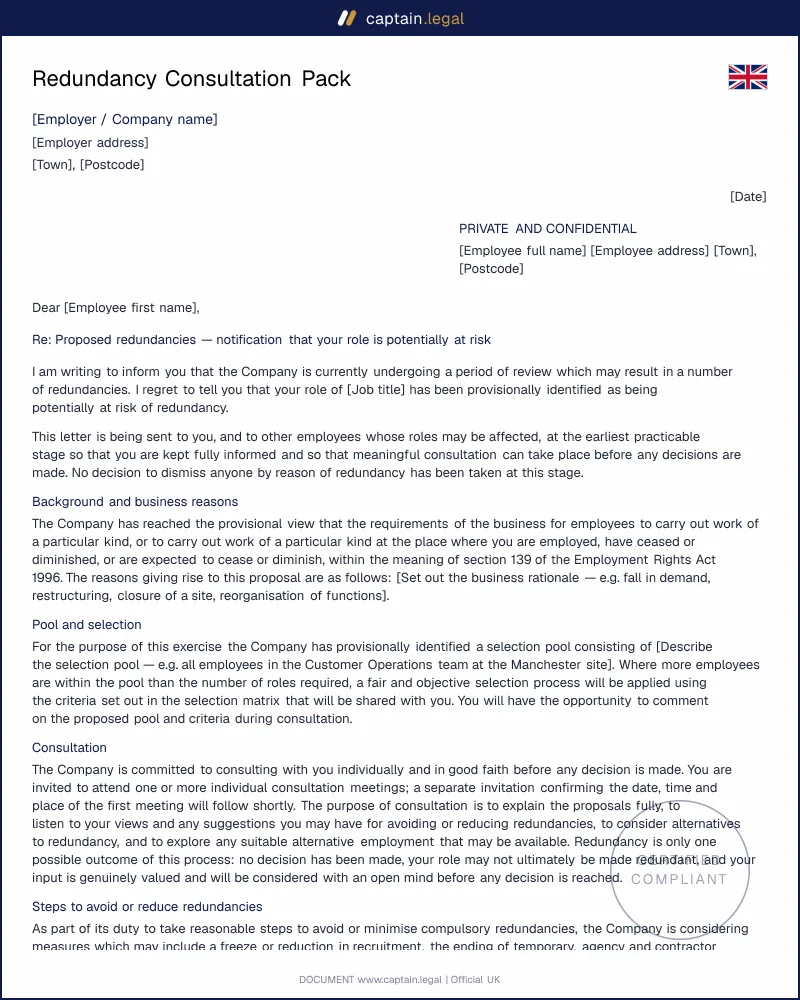
- The at-risk letter opens the process by naming the affected role, explaining the business rationale in plain terms, and confirming that no decision has been taken. This wording matters because a tribunal reads an at-risk letter that announces the outcome as evidence the consultation was a sham. The letter also confirms the pool, the proposed criteria, and the date of the first consultation meeting.
- The individual consultation invitation sets out the employee's right to attend, to ask questions, to propose alternatives to redundancy, and to comment on the selection criteria before scoring. It is drafted to demonstrate genuine consultation under Williams, with prompts for the employer to record what was discussed at each meeting rather than just that a meeting occurred.
- The selection matrix scores every employee in the pool against objective, measurable criteria such as skills, qualifications, relevant experience, and verifiable attendance or disciplinary records. Each criterion is weighted and the methodology is documented, so the scoring can be defended if challenged. Subjective criteria that cannot be independently verified are the single biggest source of successful unfair dismissal claims in redundancy.
- The outcome letters come in three versions: confirmation of redundancy with notice and statutory pay calculation, an offer of suitable alternative employment triggering the section 138 four-week trial, and a retention letter for employees who scored above the cut. The redundancy outcome letter includes the right of appeal, time-off-to-seek-work provisions, and the precise notice date.
Regional considerations
England and Wales share a single redundancy framework under the Employment Rights Act 1996 and TULRCA 1992, so the substantive law in this pack applies identically across both. The selection principles from Williams v Compair Maxam, the section 139 definition, and the individual consultation expectations do not vary between an employer in Cardiff and one in Manchester. Where Welsh-medium workplaces are involved, employers should be alive to language access during consultation meetings, but the legal standard itself is unchanged. The pack is drafted for England and Welsh law throughout.
Scotland operates under the same statutes, since employment law is reserved to Westminster rather than devolved to Holyrood. TULRCA 1992, the Employment Rights Act 1996, and the Williams line of authority all apply north of the border. The practical difference is procedural: a Scottish employee who wishes to challenge a redundancy dismissal brings the claim in the Employment Tribunal (Scotland), and any associated civil litigation runs through the Sheriff Court or Court of Session rather than the county court. The consultation documents themselves require no adaptation.
Northern Ireland is the genuine outlier and this pack should not be used there without modification. Northern Ireland has its own legislation, principally the Employment Rights (Northern Ireland) Order 1996 and the Industrial Relations (Northern Ireland) Order 1992, and claims are heard by the Industrial Tribunal and Fair Employment Tribunal rather than the GB Employment Tribunal. The substance is broadly parallel, but the statutory references in this pack point to Great Britain provisions that do not apply in Northern Ireland. Employers with Northern Irish staff should treat the structure as a model only and substitute the correct local citations. For wider workforce documentation across the UK, our UK employee handbook aligned to the ACAS Code and Equality Act 2010 sits well alongside a redundancy pack.
How to fill out this redundancy consultation pack
You start by confirming the redundancy situation against section 139: is the requirement for work of a particular kind genuinely ceasing or diminishing, or is something else being relabelled? From there you define the pool, identifying everyone who does the same or interchangeable work, and you draft the at-risk letter naming that pool and the proposed selection criteria. The form prompts you to set out the business rationale and to confirm explicitly that no decision has been taken, which is the wording that protects the consultation's integrity.
Next you schedule the consultation meetings, sending the individual invitation and leaving room for the employee to respond to the criteria before any scoring happens. After meaningful consultation you complete the selection matrix, applying each criterion consistently across the pool and recording the evidence behind every score. Only once scoring is done and final consultation has taken place do you generate the outcome letters, selecting the redundancy, alternative-employment, or retention version for each person. The pack calculates statutory notice under section 86 and prompts the statutory redundancy pay figures based on age and service. If you are formalising surrounding contractual changes, our UK full-time employment contract drafted to section 1 ERA 1996 covers the retained staff whose terms may shift after a restructure.
Common mistakes to avoid
The error that ends most redundancy exercises in a tribunal is consulting too late. Employers frequently decide who is going, then hold a "consultation" meeting to break the news. Mogane v Bradford Teaching Hospitals NHS Foundation Trust is the warning: consultation must happen while the decision can still be influenced, including consultation on the pool and the criteria, not just the result. A close second is the subjective scoring matrix. Criteria like "attitude" or "flexibility" that rest on a manager's opinion rather than verifiable records are routinely struck down, because Williams v Compair Maxam requires criteria that can be objectively checked against things like attendance and experience. If you cannot show the evidence behind a score, the score is indefensible.
The third trap is botching the pool, either drawing it too narrowly to engineer a particular outcome or treating a "pool of one" as exempt from consultation. A fourth is forgetting the alternative-employment duty: an employer who makes no genuine effort to redeploy, or who fails to offer the section 138 four-week trial on a suitable role, undermines the whole process. Finally, employers often miscalculate notice or omit the right of appeal from the dismissal letter. Statutory notice under section 86 is a floor, not a target, and a redundancy that skips the appeal stage looks procedurally thin. For other process-driven dismissals, the same discipline applies in our UK disciplinary procedure and warning letter pack built on the ACAS Code.
Frequently Asked Questions
25 verified reviews · 50 000+ downloads
- Immediate access to the document
- PDF + Word download
- Compliant with 2026 legislation
- Reviewed by lawyers
You might also like