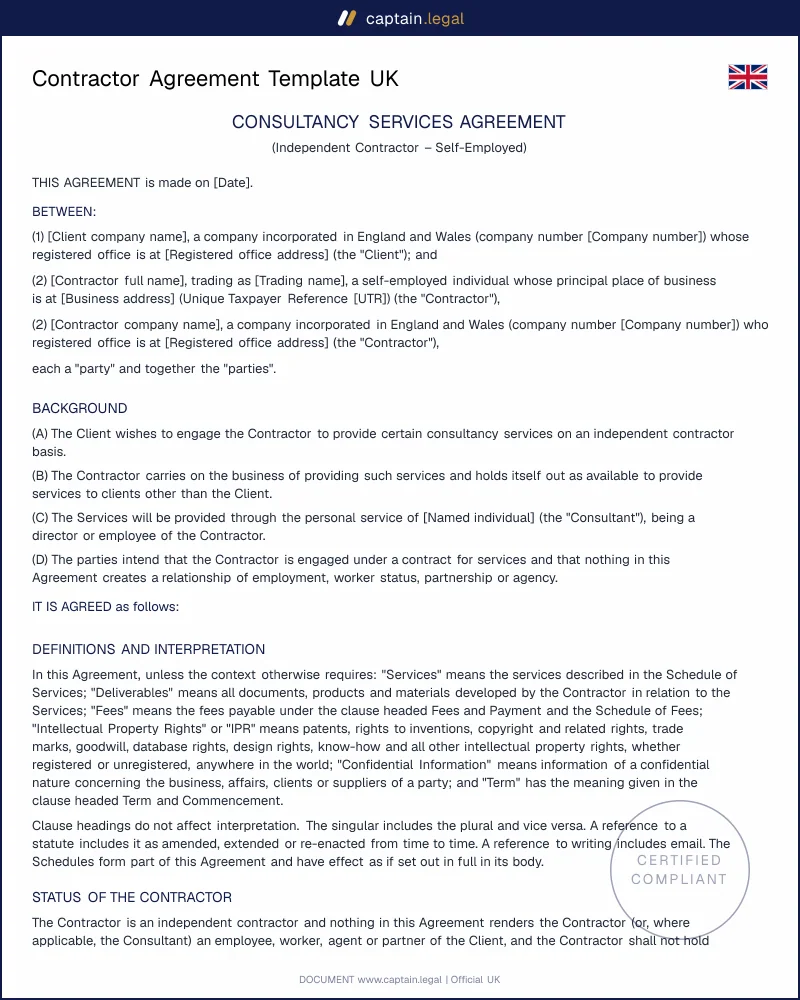
A contractor agreement is a contract for services, not a contract of service. That distinction is the entire game. An employee works under a contract of service and accrues statutory rights: holiday pay, sick pay, protection from unfair dismissal, redundancy entitlement. A genuine contractor works under a contract for services, is in business on their own account, and carries their own tax, insurance and commercial risk. The label you put at the top of the page is close to irrelevant; what matters is the substance of the relationship and how it operates day to day.
Two further terms get muddled in practice. A self-employed agreement usually describes a client engaging a sole trader directly, who is personally responsible for their own Income Tax and National Insurance through Self Assessment. A consultancy or off-payroll contract typically involves the contractor supplying services through their own limited company, the personal service company (PSC) that sits at the heart of the IR35 rules. Our template covers both structures and flexes the tax and status wording accordingly.
The drafting goal is consistency. A document that promises independence in clause 2 but then imposes fixed office hours, line-management reporting and an exclusivity obligation in clause 7 is internally contradictory, and that contradiction is precisely what a tribunal or HMRC inspector will seize on. The agreement reads as a coherent picture of someone genuinely running their own business, supplying a client among other clients, rather than a disguised employee in all but name.