A zero-hours contract is a worker's contract under which the employer makes no commitment to provide a minimum number of hours, and the worker takes shifts as and when they are offered. It sits at the flexible end of the UK employment spectrum, used by hospitality groups, care providers, retailers with seasonal peaks, and any business that needs trained staff on standby without the cost of guaranteed wages. The arrangement is lawful in England, Wales, Scotland and Northern Ireland, but it has been tightened considerably since 2015. The single most important rule to remember: an exclusivity clause stopping the worker from taking other jobs is unenforceable, and a dismissal triggered by a breach of such a clause is automatically unfair from day one of employment.
This template is drafted for businesses that genuinely need fluctuating cover and want a contract that holds up against an Employment Tribunal challenge. It is not suitable for staff working regular weekly hours over a continuous period, where a part-time or fixed-term contract is the correct legal vehicle.
Compliant
2026 Legislation
50,000+ clients
trust us
Affordable
From $4.90 / doc
Secure payment
Instant download
Zero-Hours Contract UK : Lawyer-Drafted Template (Word, PDF)
Secure payment
What is a zero-hours contract?
A zero-hours contract is defined at section 27A(1) of the Employment Rights Act 1996 as a contract under which the undertaking to perform work is conditional on the employer making work available, and there is no certainty that any work will in fact be made available. The statutory definition was inserted by section 153 of the Small Business, Enterprise and Employment Act 2015. Two features distinguish it from any other employment document on the market: the absence of mutuality of obligation at the offer-and-acceptance stage, and the prohibition on exclusivity. Everything else, including notice periods, holiday pay, statutory sick pay eligibility and the right to a written statement of particulars, follows ordinary employment law.
The label causes regular confusion. A zero-hours contract is not a casual worker agreement, although the two are often conflated. Casual or bank workers may be engaged on a series of separate contracts each time they take a shift ; a zero-hours contract is a single, continuing contract. The distinction matters because continuity of employment under section 212 of the 1996 Act drives access to redundancy pay, unfair dismissal protection after the qualifying period, and the right to request flexible working. Drafting the contract as a single overarching agreement, rather than a string of one-off engagements, is what protects the worker's accrued rights and the employer's audit trail. A well-drafted clause confirming that each shift forms part of the same continuing contract closes the door on later arguments about employment status. For a broader picture of the documents that frame a UK workforce, our UK employment law document library lists every template aligned with the Employment Rights Act 1996.
Legal framework
The governing instrument is the Employment Rights Act 1996, as amended by section 153 of the Small Business, Enterprise and Employment Act 2015. Section 27A(3) renders any provision of a zero-hours contract that prohibits the worker from doing work under another contract, or that requires the employer's consent before doing so, unenforceable against the worker. The redress mechanism sits in the Exclusivity Terms in Zero Hours Contracts (Redress) Regulations 2015 (SI 2015/2021), which give the worker a day-one right not to be unfairly dismissed and a right not to be subjected to detriment for ignoring an exclusivity clause. There is no qualifying period, and a tribunal claim must be lodged within three months of the act complained of. The official position is set out in the Department for Business guidance confirming that the Small Business, Enterprise and Employment Act prohibits the use of exclusivity clauses or terms in any zero hours contract, meaning an employer cannot stop an individual from looking for work or accepting work from another employer , available in the gov.uk guidance for employers on zero hours contracts.
Beyond the exclusivity ban, three statutory regimes apply in full. The National Minimum Wage Act 1998 and the underlying regulations require payment of at least the National Minimum Wage for every hour worked, including stand-by, on-call and downtime where the worker is required to be at the workplace. The Working Time Regulations 1998 deliver 5.6 weeks of paid annual leave on a pro-rata basis, calculated on average earnings over the relevant reference period set by the Employment Rights (Employment Particulars and Paid Annual Leave) (Amendment) Regulations 2018. The Equality Act 2010 prohibits discrimination, harassment and victimisation in the same way as for any other employment relationship.
A point still missed by many employers : since April 2020, every worker (not just employees) must receive a written statement of particulars on or before the first day of engagement. For a zero-hours arrangement, the statement must explicitly describe the variable hours, the method of offering shifts, and the absence of any guaranteed minimum. A failure to provide that day-one statement supports a stand-alone tribunal award of two to four weeks' pay under section 38 of the Employment Act 2002.
When do you need this document?
The most common scenario is hospitality and retail running a bank of trained staff for weekend services, weddings, festivals and Christmas trading. A pub group with 20 venues across the South East will keep two to three times more staff on its books than its average weekly demand, calling in named individuals when reservations spike. The contract carries the relationship between peaks and lets the operator skip the cost of guaranteed wages during quiet weeks. Care providers use the same model for ad hoc cover when a permanent carer is off sick or on annual leave, and the Care Quality Commission expects the substitution to be documented through a continuing contract rather than a series of agency placements.
Seasonal employers fall squarely within the appropriate use of zero-hours arrangements. A garden centre needing 30 extra staff between March and June, a stadium hospitality team scaling for the Premier League fixtures list, an exam invigilation service, and a wedding venue booking events twelve months in advance all fit the model. New ventures testing market demand also rely on the format, because the gov.uk guidance specifically endorses its use while a business builds its customer base and verifies steady-state staffing needs.
Two edge cases warrant a closer look. First, a worker who has in practice been called in for the same regular hours over many months may be re-classified by a tribunal as an employee on an implied permanent contract, with full statutory rights and a potential unfair dismissal claim. This is particularly common in care and cleaning. Second, the document is unsuitable for roles requiring sponsorship under the Skilled Worker visa route, because the Home Office requires a confirmed minimum salary tied to guaranteed hours. The full range of British workforce templates is grouped in our UK employment contracts and HR letters catalogue.
Key clauses included in our template
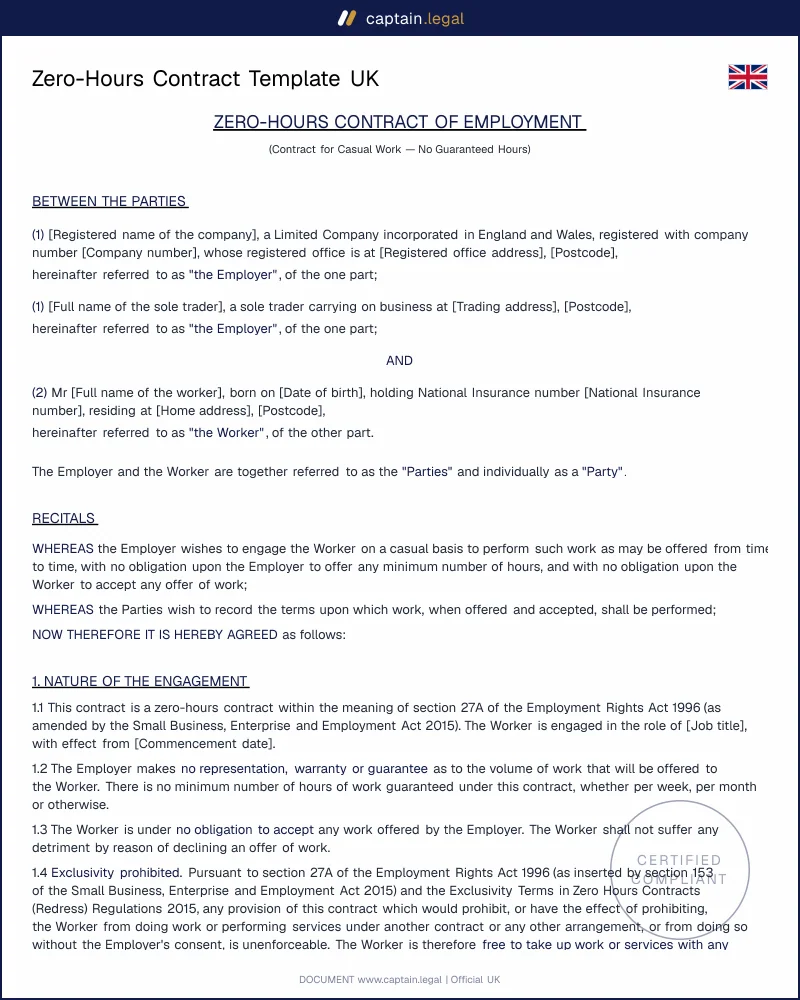
The template is drafted by UK employment lawyers and structured around the requirements of section 1 of the Employment Rights Act 1996, the 2018 amendments, and the case law on mutuality of obligation. Each clause is editable to your sector and named worker, and the document outputs in Word and PDF format ready for signature.
- The identification of the parties sets out the employer's registered name, company number, registered office, and the worker's full name and address. The clause confirms the worker's status (worker or employee), which directly governs access to unfair dismissal, statutory redundancy and parental rights, and references the HMRC PAYE arrangement applicable to the engagement.
- The nature of the engagement clause states explicitly that there is no obligation on the employer to offer work and no obligation on the worker to accept it, while confirming that each accepted shift forms part of one continuing contract for the purposes of section 212 of the 1996 Act. This wording is the firewall against later disputes about implied mutuality.
- The exclusivity carve-out confirms in plain English that the worker is free to take work from any other employer at any time, in line with section 27A(3) of the Employment Rights Act 1996. The clause is drafted positively rather than as a denial, because tribunals look at substance ; an anti-exclusivity clause is the only safe drafting position.
- The pay clause sets the hourly rate, confirms it meets or exceeds the National Minimum Wage for the worker's age band, and details how stand-by, travel between assignments and training time are remunerated. The clause refers to the relevant reference period for holiday pay calculation under the 2018 regulations.
- The shift offer and acceptance mechanism records how shifts will be communicated (app, SMS, rota platform), the minimum notice the employer will give where reasonably possible, and the cancellation policy. Tribunals increasingly award compensation when last-minute cancellations follow a worker raising a protected concern.
- The disciplinary, grievance, confidentiality and data protection clauses mirror a standard contract of employment, with explicit reference to the Acas Code of Practice on Disciplinary and Grievance Procedures and to UK GDPR obligations for handling worker data.
Regional considerations
England and Wales apply the full statutory framework outlined above without local variation. The Employment Tribunal in Croydon, Reading or Manchester will hear an exclusivity-related claim under the same rules. Where the worker is engaged through a service company, the off-payroll working rules (IR35) under the Finance Act 2020 must be assessed before classifying the engagement as a zero-hours contract rather than a contract for services.
Scotland runs a parallel system through the Employment Tribunals (Scotland), with the same statutory rights but distinct procedural rules under the Employment Tribunals (Constitution and Rules of Procedure) (Scotland) Regulations 2013. Scottish contract law also recognises the prescription periods of the Prescription and Limitation (Scotland) Act 1973, which can affect contractual claims for unpaid wages once the three-month tribunal window has closed. Employers operating north of the border should reflect Scottish jurisdiction in the governing law clause, not adopt the England and Wales default by reflex.
Northern Ireland operates under a separate but largely parallel statute, the Employment Rights (Northern Ireland) Order 1996, with the equivalent ban on exclusivity introduced by the Employment Act (Northern Ireland) 2016. Claims go to the Industrial Tribunal in Belfast rather than to an English or Scottish tribunal. The substantive employment rights are identical, but the citation in the contract must follow the Northern Ireland Order rather than the 1996 Act. Employers running cross-border operations should issue jurisdiction-specific versions of the contract rather than a single UK-wide document, because the wrong statutory citation in a written statement of particulars is itself a basis for tribunal compensation.
How to fill out this zero-hours contract
You begin by selecting the jurisdiction (England and Wales, Scotland, or Northern Ireland), and the form adjusts the statutory citations and tribunal references automatically. The next stage captures the employer's full corporate identity from Companies House, the worker's personal details, and the start date of the engagement. You then specify the hourly rate, the worker's age band for National Minimum Wage compliance, and the reference period for holiday pay accrual. The interface flags any rate below the current statutory floor before the document is generated. Sector-specific clauses can be toggled on for hospitality (tronc and tip allocation under the Employment (Allocation of Tips) Act 2023), care (CQC recordkeeping), or retail (uniform deductions and Truck Acts compliance). The shift-offer mechanism is configurable: app, SMS, written rota, or in-person notification, with the minimum notice period you commit to. A confidentiality clause and a post-termination working clause are available as opt-ins where the role gives access to commercial information. Once the form is complete, the document is generated in Word and PDF format, ready for signature by both parties. For the upstream HR documents that often accompany this contract, see our UK business and corporate templates collection.
Common mistakes to avoid
The single most damaging error is recycling an old offer letter that contains an exclusivity clause and ticking the zero-hours box on top. The clause is unenforceable, the contract still binds the parties on every other point, and the employer who later refuses shifts to a worker taking outside work walks straight into a day-one unfair dismissal claim under regulation 2 of the Exclusivity Terms (Redress) Regulations 2015. A second frequent slip is the absence of a written statement of particulars on the worker's first day, in breach of section 1 of the Employment Rights Act 1996 as amended by the 2018 Regulations. The tribunal sanction sits at two to four weeks' pay even when no other claim is brought.
The third mistake is treating a worker who has settled into regular weekly hours as a permanent zero-hours fixture. After several months of consistent work, the contract may be re-characterised as one with an implied minimum hours obligation, with continuity of employment kicking in for redundancy and unfair dismissal purposes. The fourth is failing to align the holiday pay calculation with the 52-week reference period required by the 2018 regulations ; the old 12-week formula has been illegal for years, and tribunal awards on this point are rising. Finally, employers regularly forget that travel time between assignments counts as working time for National Minimum Wage purposes when the worker is at the employer's disposal, exposing them to back-pay claims and HMRC penalties of up to 200% of the underpayment. Other corporate and contractual templates that reduce these risks are listed in our UK real estate and commercial documents directory where commercial leases and supplier contracts are accessible.
Frequently Asked Questions
39 verified reviews · 50 000+ downloads
- Immediate access to the document
- PDF + Word download
- Compliant with 2026 legislation
- Reviewed by lawyers
You might also like