A fixed-term employment contract is a written agreement that ties an employee to a defined end-point: a specific date, the completion of a particular task, or the occurrence of a clearly identified event such as the return of a colleague from maternity leave. UK employers reach for it when the work has a known horizon and a permanent appointment would be neither honest nor commercially sensible. The template offered here is drafted to meet section 1 of the Employment Rights Act 1996 on written particulars and to align with the Fixed-term Employees (Prevention of Less Favourable Treatment) Regulations 2002, which guarantee parity of treatment with comparable permanent staff. It suits short-term cover, project hires, seasonal demand and grant-funded positions across England, Wales and Scotland.
Most disputes around fixed-term hiring start with sloppy drafting at the front end, not bad faith later on. A contract that names the wrong terminating event, omits the objective justification for repeated renewals, or quietly contracts out of redundancy rights will not survive scrutiny at the Employment Tribunal. The pages that follow walk through what the law actually requires, the clauses our template builds in by default, and the operational mistakes employers keep making when they assume a "temporary" hire is somehow lighter on paperwork than a permanent one.
Compliant
2026 Legislation
50,000+ clients
trust us
Affordable
From $4.90 / doc
Secure payment
Instant download
UK Fixed-Term Contract Template — Maternity Cover, Projects
Secure payment
What is a fixed-term employment contract?
A fixed-term employment contract is, in plain language, a contract of employment that will end automatically by reference to something other than dismissal or resignation. Regulation 1(2) of the Fixed-term Employees Regulations 2002 defines it as a contract that terminates on the expiry of a specific term, on the completion of a particular task, or on the occurrence or non-occurrence of any other specific event other than the employee reaching normal retirement age. That definition is broader than many HR teams realise: it captures classic time-limited contracts ("twelve months from 1 April"), task contracts ("until the Phoenix migration goes live") and event contracts ("until Ms Patel returns from maternity leave").
The label matters less than the legal status it carries. A fixed-term employee is a full employee, not a worker or a consultant. They accrue continuous service from day one, qualify for statutory sick pay and holiday pay on the same basis as permanent staff, and after two years' service can bring an unfair dismissal claim if their contract is not renewed without good reason. The contract does not need to be in writing to exist, but the Employment Rights Act 1996 requires a written statement of particulars on or before the first day of work, and a fixed-term contract that is not properly papered exposes the employer to a default Tribunal award of two to four weeks' pay under section 38 of the Employment Act 2002. Practitioners therefore treat the written contract as non-negotiable, even for a six-week summer hire. See our employment law document hub for UK businesses for related templates that pair naturally with this one.
Legal framework
UK fixed-term hiring sits at the intersection of three statutory layers. The Employment Rights Act 1996 sets the floor: written particulars under section 1, protection from unlawful deductions, statutory notice under section 86, and the right to claim unfair dismissal after the qualifying period (currently two years, with the Employment Rights Bill progressing through Parliament expected to recalibrate that threshold in the medium term). On top of that floor, the Fixed-term Employees (Prevention of Less Favourable Treatment) Regulations 2002 (SI 2002/2034) impose the equal-treatment principle that gives this contract its distinctive character: a fixed-term employee must not be treated less favourably than a comparable permanent employee in respect of pay, pensions, training access, sickness benefits or any other contractual term, unless the difference is objectively justified. The third layer is the Equality Act 2010, which applies to the recruitment, treatment and termination of fixed-term staff in exactly the same way as it applies to permanent appointments.
Two specific points deserve attention because they are where employers most often slip. First, regulation 8 of the 2002 Regulations transforms a fixed-term contract into a permanent one by operation of law once the employee has been continuously employed on successive fixed-term contracts for four years or more, unless the renewal beyond that point can be objectively justified. The transformation is automatic, and the employee may request a written statement under regulation 9 confirming permanent status within twenty-one days. Second, the 2002 Regulations abolished the practice of requiring fixed-term employees to waive their right to a statutory redundancy payment: a waiver clause inserted today is void and unenforceable, and a tribunal will read past it.
For the official text of the regulations and the explanatory note, the legislation.gov.uk record of the Fixed-term Employees Regulations 2002 is the authoritative source and should be consulted whenever a borderline justification question arises. Counsel preparing a defence on objective grounds will also want to consider the European authority in Adeneler v Ellinikos Organismos Galaktos on the use of successive fixed terms, which continues to inform how UK tribunals read regulation 8.
When do you need this document?
The textbook scenario is maternity, paternity or adoption leave cover. The returning employee has a statutory right to come back to her job, and the only honest way to engage a replacement is through a contract that ends on her return. A well-drafted template names the absent colleague (or, where confidentiality is a concern, the role) and ties termination to the date she resumes duties rather than to a fixed calendar date that may overshoot or fall short. The same logic applies to long-term sickness cover and secondment backfill, where the end-point is genuinely event-driven rather than time-driven.
Project work is the second large bucket. Grant-funded research posts, fixed-budget IT migrations, construction site engineers tied to a build schedule and consultants embedded for a regulatory programme all fit naturally into a fixed-term frame, provided the project itself has identifiable boundaries. Vague references to "the duration of the project" without a defined deliverable are a recurring drafting fault, because they invite the tribunal to read the contract as effectively indefinite when the project drifts. Our UK business and HR templates library supports this kind of arrangement with the surrounding paperwork (statements of work, IP assignments, confidentiality undertakings).
The third bucket is seasonal and peak-demand hiring in retail, hospitality, agriculture and logistics. A nine-month fixed-term contract for a Christmas-and-sale-season retail assistant is perfectly lawful and frequently the cleanest commercial solution. The fourth, slightly less obvious, is probationary or trial appointments dressed as fixed terms: this is a misuse the Tribunal sees regularly and tends to penalise, because a true probation belongs inside a permanent contract with a probationary clause, not inside a six-month fixed term that the employer hopes to convert. One genuine edge case worth flagging is the apprenticeship-adjacent role funded under a government scheme, where the funding agreement itself drives the end-date and the contract must mirror the funding window precisely.
Key clauses included in our template
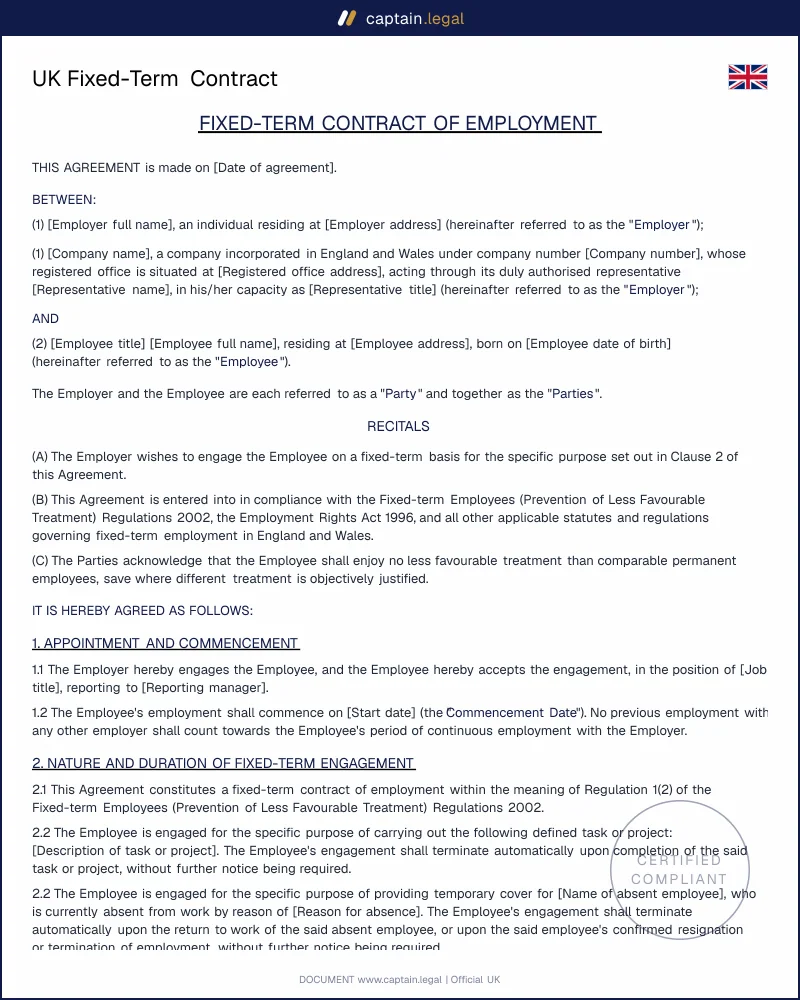
Our fixed-term employment contract template is drafted to a senior-counsel standard and built around the following operative clauses, each tested against current UK case law before release:
The identification of the parties and the engaging entity opens the contract and is more important than HR teams realise. A fixed-term employee engaged "by the group" rather than by a specific UK company creates avoidable confusion at termination, particularly where TUPE may be triggered. Our template names the employing entity by registered number and registered office, in line with section 1(3) of the Employment Rights Act 1996.
The termination trigger clause is the single most important provision in the contract. It identifies, with precision, whether the contract ends on a date, on completion of a defined task, or on the occurrence of a specific event, and it pairs that trigger with the objective justification required under regulation 3 of the Fixed-term Employees Regulations 2002. Vague triggers are replaced by drafted alternatives keyed to the role.
The equal treatment statement is included expressly, both as a record of compliance and as a drafting prompt. It confirms that the employee's pay, pension auto-enrolment, holiday accrual, sick pay and access to training are no less favourable than those of a comparable permanent colleague, and it identifies the comparator role. This clause is what protects the employer if the employee later raises a regulation 5 written-statement request.
The notice and early termination clause sets out the notice each party must give if the contract is terminated before the trigger event. Without this clause the contract is, in theory, only terminable for repudiatory breach until the end of the term, which is rarely what either party intends.
The redundancy and continuity clause acknowledges that the employee accrues continuous service from day one, that any redundancy waiver is void under the 2002 Regulations, and that the employee qualifies for a statutory redundancy payment after the relevant qualifying period if the contract is not renewed in genuine redundancy circumstances.
The renewal and conversion clause captures the regulation 8 four-year rule explicitly, putting the parties on notice that successive renewals beyond four years convert the contract to a permanent one unless the further renewal is objectively justified. Pair this contract with the appropriate severance paperwork from our UK personal and HR letter templates at the end of the term.
Regional considerations
UK employment law is largely uniform across England, Wales and Scotland, but the procedural overlay differs in ways that matter once a dispute reaches a tribunal. England and Wales share the same Employment Tribunals system and the same ACAS Early Conciliation requirement under section 18A of the Employment Tribunals Act 1996: a prospective claimant must notify ACAS before issuing a claim, and the three-month time limit under regulation 7 of the Fixed-term Employees Regulations 2002 is paused during the conciliation period. Welsh-language employers in the public sector should also note their duties under the Welsh Language (Wales) Measure 2011, which can require contracts and HR documentation to be available bilingually.
Scotland runs the same statutory regime but through Scottish Employment Tribunals, with appeals to the Employment Appeal Tribunal sitting in Edinburgh. Practitioners drafting for a Scottish workforce should note the divergent approach to prescription and limitation under the Prescription and Limitation (Scotland) Act 1973 for any contractual claim that proceeds in the ordinary courts rather than the tribunal, and the slightly different terminology around redundancy consultation. The substantive rights under the 2002 Regulations are identical.
Northern Ireland is a separate jurisdiction with its own statutory instrument: the Fixed-term Employees (Prevention of Less Favourable Treatment) Regulations (Northern Ireland) 2002 mirrors the Great Britain regulations but routes claims through the Industrial Tribunal in Belfast under the Employment Rights (Northern Ireland) Order 1996. An employer with staff on both sides of the Irish Sea cannot rely on a single set of contracts without a jurisdictional review, because the time limits, conciliation procedures and tribunal rules diverge in detail. London-headquartered groups with Belfast offices regularly trip over this point, particularly when a fixed-term researcher is recruited from a Northern Ireland university.
A practical drafting note across all four nations: where the employee will work from home in a different jurisdiction from the registered office, the contract should specify the governing law and the applicable tribunal expressly rather than leave it to inference. Browse the full catalogue of UK legal document templates for the supplementary forms most often paired with cross-border fixed-term hires.
How to fill out this fixed-term employment contract
Drafting on Captain.Legal begins with a single decision: the nature of the terminating event. You select between a date-based, task-based or event-based trigger, and the form rebuilds itself around your choice. A date-based contract asks for the start and end dates and surfaces a holiday pro-rating calculator. A task-based contract opens fields for the project description and the deliverable that signals completion. An event-based contract, typically used for maternity cover, asks you to name the absent colleague (kept confidential in the final document if you prefer the role title) and the trigger that ends the engagement.
From there the form walks you through pay, hours, place of work, pension auto-enrolment, holiday entitlement and notice, with default values that match Working Time Regulations 1998 minima and the Employment Rights Act 1996 statutory notice ladder. The equal-treatment comparator is selected from a dropdown of permanent role families, and the objective justification section opens automatically if you indicate that the contract will run beyond four years or repeats a previous fixed term with the same employee. Confidentiality, IP assignment, restrictive covenants and probation language can be enabled per role. Once every section is green, the contract generates as both Word and PDF for in-house counsel review and signature; the Word file is the working draft, the PDF is what most employers send for DocuSign execution. Allied trustee and committee templates for the charity sector live in our UK charity and nonprofit template suite when the engaging entity is a CIO or registered charity.
Common mistakes to avoid
The single most common mistake in UK practice is stacking successive fixed-term contracts past the four-year mark without recording an objective justification at the time of each renewal. The Tribunal does not accept after-the-fact rationalisation; if the renewal was driven by inertia, the contract has already become permanent by operation of regulation 8, and the employer who later "ends" it without a fair reason and a fair procedure faces a straightforward unfair dismissal claim. A close cousin is the rolling one-year contract signed every January for the same researcher on the same grant: at year five, that researcher is permanent, and the funding cliff at the end of the grant cycle is not an objective justification on its own.
A second cluster of errors sits in the termination clause. Employers routinely confuse non-renewal of a fixed term with dismissal and assume the former carries no procedural obligations. It does: non-renewal is a dismissal in law, and after two years' service the employee can claim unfair dismissal if there is no fair reason or fair procedure. The third recurring mistake is the inclusion of a redundancy waiver, which has been void since 1 October 2002 but still appears in templates copied from older precedents. The fourth is the misuse of fixed terms as extended probation, which the Tribunal will see through and which exposes the employer to both contractual and statutory claims. A final operational error worth flagging is the failure to provide the written statement of particulars on day one, which under the Employment Rights Act 1996 (as amended in 2020) now applies from the first day of employment rather than after two months as under the previous regime. Companies engaging seasonal property staff often pair fixed-term contracts with the documents in our UK real estate and property documents library and miss this deadline because the property paperwork goes out before the employment paperwork.
Frequently Asked Questions
24 verified reviews · 50 000+ downloads
- Immediate access to the document
- PDF + Word download
- Compliant with 2026 legislation
- Reviewed by lawyers
You might also like