A full-time employment contract is the written agreement that binds an employer and an employee in an open-ended, full-hours working relationship under English law. It sets out the rate of pay, the hours of work, the holiday entitlement and the notice each side must give, and it doubles as the section 1 statement that every employer is legally required to hand over on day one. For most UK businesses, this single document is the cornerstone of the entire HR file : it shapes what a tribunal will look at if anything ever goes wrong, and it tells the employee, in plain terms, what has been promised.
Captain.Legal generates a full-time contract of employment tailored to the Employment Rights Act 1996 and aligned with current ACAS guidance. The template covers permanent roles working the standard working week, includes every particular required by section 1 and adapts the wording to the employer's industry, location in England, Wales, Scotland or Northern Ireland, and choice of probation, sick pay and confidentiality clauses.
Compliant
2026 Legislation
50,000+ clients
trust us
Affordable
From $4.90 / doc
Secure payment
Instant download
Full-time contract of employment UK | Permanent staff template (Word, PDF)
Secure payment
What is a full-time employment contract?
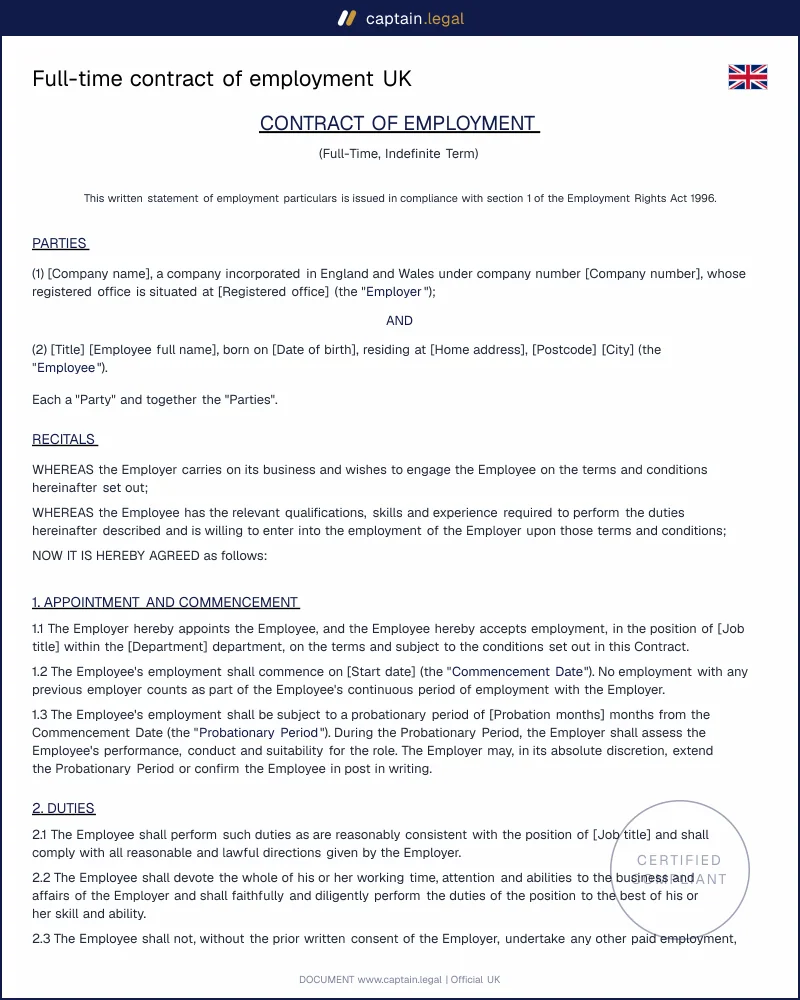
A full-time employment contract is a legally binding agreement governing a permanent, full-hours employment relationship. Under English law the contract has two layers that often confuse first-time employers. The first is the contract itself, which can be verbal, written, or implied through conduct ; the second is the written statement of particulars required by section 1 of the Employment Rights Act 1996, which must be given to the worker on or before the first day of employment. In practice, the sensible thing to do, and the standard market practice, is to combine the two into a single signed document that satisfies both functions. That is what our UK employment contract templates are designed to do.
The contract is "full-time" when the agreed weekly hours match what the employer treats as a standard working week, typically between 35 and 40 hours. There is no statutory definition of full-time work in the UK, which makes the contract itself the only authoritative reference point. Compare this with a part-time contract, where the Part-time Workers (Prevention of Less Favourable Treatment) Regulations 2000 attach specific protections, or with a fixed-term contract regulated by the Fixed-term Employees Regulations 2002. A full-time, indefinite contract sits outside both regimes and gives the employee the broadest set of statutory rights, including unfair dismissal protection after two years of continuous service under section 94 ERA 1996.
Legal framework
The backbone of every UK employment contract is the Employment Rights Act 1996, which consolidates the rules previously scattered across the Contracts of Employment Act 1963, the Redundancy Payments Act 1965 and the Employment Protection Act 1975. Section 1 ERA 1996 sets out the famous list of particulars an employer must give in writing : names of the parties, start date, continuous service date, scale of remuneration and intervals of payment, hours, holiday entitlement, sick-pay arrangements, pension scheme, notice periods, job title, place of work, and any collective agreements that apply. Since the Employment Rights (Employment Particulars and Paid Annual Leave) (Amendment) Regulations 2018 took effect on 6 April 2020, this is a day-one right, no longer subject to the previous two-month grace period, and it now extends beyond employees to most workers.
A compliant contract also needs to absorb a stack of intersecting statutes. The National Minimum Wage Act 1998 fixes the floor under remuneration. The Working Time Regulations 1998 cap the average working week at 48 hours, regulate rest breaks and set the statutory minimum of 5.6 weeks' paid annual leave. The Equality Act 2010 prohibits discrimination on protected characteristics throughout recruitment, contract terms and termination. The Pensions Act 2008 makes auto-enrolment compulsory for any employee earning above the threshold. An employer who issues a contract that omits any of the section 1 particulars exposes the business to a separate tribunal claim under section 11 ERA 1996, with awards of two to four additional weeks' pay where the employee succeeds on a substantive claim such as unfair dismissal.
The most recent layer is the Employment Rights Act 2025, which brings unfair dismissal protection forward to day one (subject to a statutory probation regime), extends statutory sick pay from the first day of absence and tightens the rules on zero-hours and "fire and rehire" practices. The phased commencement of these reforms is set out in detail by the GOV.UK guidance on written statements of employment particulars, which remains the official reference for employers updating their templates.
When do you need this document?
The most common trigger is a permanent hire onto a standard working week, whether for a graduate joining a London accountancy practice or a manager stepping into a manufacturing site in the West Midlands. The contract has to be ready before the new starter walks through the door, because section 1 ERA 1996 makes the written statement a day-one obligation. Many employers still operate on the old two-month rule and discover the change the hard way, usually after a tribunal award has been added to an unfair dismissal claim.
The second scenario covers the conversion of an existing relationship into permanent full-time employment. A worker who has been engaged on a fixed-term contract reaching its third anniversary, or on consecutive renewals exceeding four years, becomes a permanent employee by operation of the Fixed-term Employees Regulations 2002. Issuing a fresh full-time contract at that point clarifies continuity of service, which itself anchors redundancy pay and unfair dismissal rights. The same logic applies when an agency worker is taken on directly by the end client : the UK business and HR templates catalogue includes the full set of agreements that typically circulate around such transitions.
A third use case is the renegotiation of an existing contract. Material changes to remuneration, hours, place of work or role do not just need an addendum ; they require a written statement of change under section 4 ERA 1996 within one month. Imposing a unilateral change without consultation is the textbook route to a constructive unfair dismissal claim. Edge case worth flagging : senior executives whose total weekly hours regularly exceed 48 should be invited to opt out of the Working Time Regulations through a separate signed waiver, kept in the file alongside the contract. Another edge case is the cross-border hire of an employee based in Scotland or Northern Ireland, where devolved tribunal procedures and certain statutory presumptions differ subtly from the position in England and Wales.
Key clauses included in our template
Our full-time contract is built around the section 1 particulars, then layered with the protective clauses a serious employer expects to see in a market-standard agreement.
- The identification of the parties and start date opens the contract and establishes continuity of employment, the figure that drives notice, redundancy pay and unfair dismissal eligibility under section 211 ERA 1996. The clause distinguishes the date employment began from the date continuous service began, a distinction that matters whenever a previous engagement counts towards continuous service through a TUPE transfer.
- The remuneration and payment intervals clause captures the gross annual salary, the payment frequency, the bank-transfer mechanism and any bonus or commission arrangement. We anchor the wording to section 13 ERA 1996 on unlawful deductions, which protects the employee against any deduction not authorised in writing.
- The hours of work clause sets the contractual weekly hours and the working pattern, references the Working Time Regulations 1998 and includes, where appropriate, an opt-out from the 48-hour week. The opt-out must be signed separately and can be withdrawn by the employee on seven days' notice, a point employers regularly forget to record.
- The holiday entitlement clause allocates the statutory minimum of 5.6 weeks of paid leave, sets the leave year, and addresses accrual on termination. The wording follows the Harpur Trust v Brazel line of authority for irregular-hours staff who later move to a regular pattern.
- The probationary period clause typically runs three to six months, with a shortened notice during probation. Under the new statutory probation regime introduced by the Employment Rights Act 2025, this clause has become the central tool for managing the transition to full unfair dismissal protection.
- The confidentiality, IP and post-termination restrictions protect the employer's commercial interests, with restrictive covenants drafted to be reasonable in scope, geography and duration in line with Tillman v Egon Zehnder Ltd.
Regional considerations
England and Wales form the default jurisdiction for the template. Employment tribunals sit in regional centres, the Employment Tribunals Rules of Procedure 2024 govern claims, and the standard ACAS Code of Practice on Disciplinary and Grievance Procedures applies in full. Most market-standard restrictive covenants are drafted to the Tillman test as developed by the Court of Appeal of England and Wales, and the contract usually nominates the courts of England as the chosen forum.
Scotland runs its own employment tribunal system through the Scottish Tribunals. The substantive law of the Employment Rights Act 1996 applies uniformly, but procedure and certain remedies follow Scottish civil procedure. The contract should reference Scots law for any clause governed by the law of contract, including restrictive covenants, where the Bluebell Apparel v Dickinson line of Court of Session authority is the relevant test rather than the Tillman approach used south of the border. Place of jurisdiction should be specified as "the Sheriff Court at the place of the employee's normal place of work" or the Scottish Court of Session for higher-value disputes.
Northern Ireland sits outside the Employment Rights Act 1996 and is governed by the Employment Rights (Northern Ireland) Order 1996, which mirrors the Great Britain regime closely but is not identical. Tribunals are called Industrial Tribunals and the Labour Relations Agency Code of Practice replaces the ACAS code. Public-holiday entitlement differs because of the additional bank holidays observed locally, and the contract template flags the points where the wording switches reference to the Northern Irish equivalents. Employers operating across all three jurisdictions usually maintain three parallel templates rather than a single hybrid contract.
How to fill out this employment contract
The configurator on Captain.Legal walks you through the contract in the order a UK HR director would assemble it. You start by selecting the jurisdiction, since that choice rewires several clauses, including the governing law, the tribunal procedure and the public holiday list. From there, the form asks for the legal identity of the employer, the registered address and the company number that will appear in the parties block.
Next comes the employee block, with the full legal name, the home address that establishes residence for tax and tribunal purposes, and the agreed start date. The salary section accepts gross annual remuneration, payment frequency, and any variable element, and the form automatically generates the corresponding clause language. The hours block captures the agreed weekly hours, the working pattern, and offers the optional 48-hour opt-out as a separate signature block.
Holiday entitlement is calculated against the chosen leave year and the full-time threshold. Probation, sick pay above statutory levels, pension contributions above the auto-enrolment minimum, and post-termination restrictions are presented as toggle clauses you can switch on or off. The configurator finishes with the signature block, generates the final contract in Word and PDF, and stores a copy in your dashboard alongside the rest of your UK personal and HR documents for re-use on the next hire.
Common mistakes to avoid
The single most frequent mistake is treating the written statement and the contract as separate documents, then only producing the contract within the old two-month window. Since section 1 ERA 1996 became a day-one right, that delay is no longer compliant, and the tribunal compensation under section 38 of the Employment Act 2002 now attaches mechanically to any successful substantive claim. The fix is to issue a combined contract on day one and have it signed before the employee logs in for the first time. The second classic error is omitting the place of work or the relocation clause, then trying to redeploy the employee to a different site months later. Without a mobility clause, the employer is asking for consent it has no contractual right to receive, and a refusal can crystallise as constructive dismissal.
A third mistake is borrowing restrictive covenants from a US or generic online template. UK courts assess covenants strictly under the Tillman v Egon Zehnder Ltd framework, and an over-broad non-compete clause is often struck out in its entirety rather than read down. The fourth recurring problem is the failure to reflect the statutory pension auto-enrolment under the Pensions Act 2008 in the remuneration clause, particularly for higher earners where contractual contributions sit above the statutory minimum. The fifth is the forgotten 48-hour opt-out, where the employer assumes silence equals consent ; the Working Time Regulations 1998 require an active, signed waiver. Each of these errors is straightforward to avoid when the template is drafted to current legislation, which is why our UK contract templates catalogue is reviewed against every statutory change before publication.
Frequently Asked Questions
40 verified reviews · 50 000+ downloads
- Immediate access to the document
- PDF + Word download
- Compliant with 2026 legislation
- Reviewed by lawyers
You might also like