Create my document
Login

Choose country

FranceBelgiqueEspañaUnited StatesUnited KingdomMarocDeutschlandItaliaSchweiz
Employment

Settlement Agreement Template UK | s.203 ERA 1996

Lawyer-grade settlement agreement built to s.203 ERA 1996: independent adviser certificate, s.402D PENP tax split, precise waiver of statutory claims.
4.8/521 reviews50 000+ downloadsInstant download
Share

A UK settlement agreement is a legally binding contract that ends an employment relationship on agreed terms, with the employee waiving specified tribunal and contractual claims in exchange for a negotiated payment. It is the standard route for a clean, dignified exit when neither side wants the cost, delay and exposure of a tribunal. Employers reach for it during conduct or capability problems, restructures, or where a relationship has simply broken down, while employees use it to secure compensation, an agreed reference and certainty about tax. This template is built around the statutory machinery that makes such an agreement enforceable: a section 111A protected conversation to open negotiations, an independent adviser certificate, a precise schedule of waived claims, and proper tax apportionment between notice pay and the compensation sum.

Used correctly, a settlement agreement is the most controlled way to part company in England, Wales, Scotland and Northern Ireland. Used carelessly, it is a void document that settles nothing and leaves the employer fully exposed at tribunal.

Compliant

2026 Legislation

50,000+ clients

trust us

Affordable

From $4.90 / doc

Secure payment

Instant download

Settlement Agreement Template UK | s.203 ERA 1996

Secure payment · No subscription

Fill in the template

What is a UK settlement agreement?

A settlement agreement is a statutory contract under which an employee gives up the right to bring particular claims against their employer, almost always in return for a payment. It was called a compromise agreement until 2013, and you will still hear older practitioners use that term. The legal substance is the same: a written waiver of identified statutory and contractual claims, made binding only because Parliament created a narrow exception to the rule that you cannot contract out of employment rights.

That rule lives in section 203 of the Employment Rights Act 1996, which voids any attempt to exclude or limit a statutory claim. The settlement agreement is one of the few permitted gateways through it, and the gateway only opens when every statutory condition is met. Miss one condition and the entire waiver collapses, leaving the employee free to bring the very claims the employer thought it had bought off.

People often confuse a settlement agreement with a COT3. Both end a dispute, but a COT3 is brokered through Acas conciliation and needs no independent legal advice, whereas a settlement agreement is negotiated privately and is invalid without it. Where a tribunal claim is already on foot, a COT3 is frequently faster; for a pre-emptive exit before any claim exists, the settlement agreement is the right instrument. Our UK dismissal letter template under section 98 ERA 1996 covers the alternative route where no agreed exit is possible.

2

When do you need a settlement agreement?

The most frequent trigger is a performance or conduct situation that both sides would rather resolve quietly than push through a full disciplinary or capability process. Rather than risk an unfair dismissal claim after two years' service, the employer offers a protected conversation under section 111A and proposes terms. The employee gets a payment and an agreed reference; the employer gets finality and confidentiality. A second common scenario is redundancy, particularly where the selection process is vulnerable or where the employer wants to enhance the statutory package in return for a clean waiver. Here the settlement agreement sits alongside, not instead of, a proper consultation.

Restructures that fall short of formal redundancy are a third trigger. When a role is reshaped, a reporting line changes, or a senior hire simply is not working out, a negotiated exit avoids a messy and contestable dismissal. Discrimination and whistleblowing allegations form a more delicate fourth category. Because section 111A does not protect these conversations, the employer must rely on the without prejudice rule, which means there has to be a genuine existing dispute before the discussion is shielded at all.

Two edge cases deserve flagging. The first is the employee who is on long-term sick leave: a settlement can resolve a looming disability discrimination risk, but the agreement should be timed and worded so it does not look like pressure on a vulnerable person. The second is the director or shareholder who is also an employee, where the settlement must dovetail with separate corporate documents. Our UK full-time employment contract template under section 1 ERA 1996 is the natural starting point when the underlying contract terms themselves are in dispute.

3

Key clauses included in our template

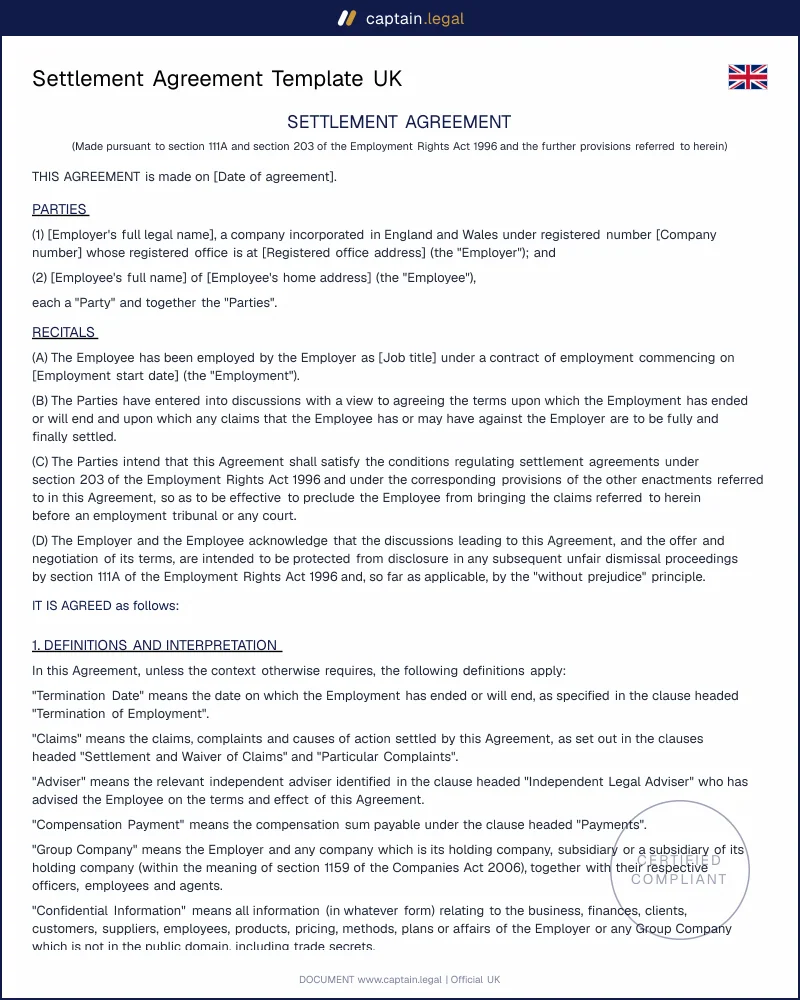
  • The recitals and reason for termination open the agreement by naming the parties, the employment dates and the agreed termination date. They record whether the exit is by resignation, dismissal or mutual agreement, because that characterisation feeds directly into the tax treatment and the reference wording later in the document.
  • The schedule of settled claims is the operative heart of the agreement. It lists each statutory and contractual claim being waived by reference to the relevant provision, from unfair dismissal under ERA 1996 to discrimination under the Equality Act 2010. Vague blanket waivers are routinely struck down, so the template names each claim type rather than relying on a sweep-up phrase, while carving out accrued pension rights and personal injury claims unknown at signing.
  • The termination payment and tax apportionment splits the money into its proper components: contractual sums and post-employment notice pay taxed as earnings, and the compensatory ex gratia element sheltered up to £30,000 under section 403 ITEPA 2003. It includes a tax indemnity from the employee in favour of the employer for any further liability HMRC later assesses.
  • The independent adviser certificate is the clause that makes the waiver bite. The adviser signs to confirm they advised the employee on the terms and effect of the agreement and that they hold current professional indemnity insurance, and the agreement states that the section 203 conditions are met.
  • The confidentiality, references and restrictive covenants clauses close the loop, fixing an agreed reference, mutual non-derogatory terms, and the survival or release of any post-termination restrictions from the original contract.
4

Regional considerations

England and Wales form the core jurisdiction for this template. The Employment Rights Act 1996, the Equality Act 2010 and the Acas Code apply in full, and any tribunal claim is heard in the Employment Tribunals of England and Wales. The £30,000 tax exemption and the section 402D PENP rules are UK-wide because tax is not devolved, so the apportionment clauses operate identically here. Most reported settlement case law, including the tax decisions on the £30,000 threshold, comes from this jurisdiction.

Scotland applies the same primary employment statutes, because employment law is reserved to Westminster, but the surrounding court structure differs. Enforcement of the contractual elements of a settlement, as opposed to the statutory waiver, may engage the Scottish courts and their distinct procedure, and the relevant independent adviser will usually be a Scottish solicitor. The substantive section 203 conditions are unchanged, so the agreement reads almost identically; what shifts is the litigation backdrop if the deal later unravels.

Northern Ireland is the genuine divergence. It has its own statute, the Employment Rights (Northern Ireland) Order 1996, and its own tribunal system, and the Acas equivalent there is the Labour Relations Agency rather than Acas. A settlement intended to bind a Northern Ireland employee must reference the Northern Ireland legislation, not the ERA 1996, or the waiver may be ineffective. Employers operating across the Irish Sea should treat Northern Ireland agreements as a separate document rather than a light edit of the GB version. For wider governance paperwork our UK articles of association template supports the corporate side of a director exit.

5

How to fill out this settlement agreement

You begin by selecting the jurisdiction, since the template adjusts its statutory references depending on whether the employee works in Great Britain or Northern Ireland. From there you enter the parties' details, the employment start date and the agreed termination date, and the document populates the recitals and characterises the exit as resignation, dismissal or mutual agreement. The next stage is the financial breakdown, where you separate contractual notice and post-employment notice pay from the compensatory sum, and the template flags the £30,000 sheltered band and prompts you to confirm the figures with payroll. You then build the schedule of waived claims by ticking the statutory rights in play, and the template assembles the precise waiver language with the appropriate carve-outs. Finally you complete the adviser section, recording the adviser's name, firm and insurance position so the section 203 certificate is valid. The form leaves a clear space for the ten-day consideration period recommended by the Acas Code, and produces a clean Word file for negotiation and a signature-ready PDF. If the underlying relationship has not yet ended, our UK statement of written particulars under section 1 ERA 1996 helps confirm the contractual baseline first.

6

Common mistakes to avoid

The most damaging error is treating the independent adviser requirement as a formality. An agreement signed without genuine advice from a properly insured adviser, or one that fails to name the adviser, does not waive statutory claims at all, and employers discover this only when the employee turns up at tribunal months later. Equally common is the over-broad waiver: drafters reach for a sweeping phrase that purports to settle everything, when section 203 requires the particular complaints to be identified, with the result that the unidentified claims survive. Rushing the employee is another classic failure, because pressure that breaches the Acas Code on improper behaviour can strip away the section 111A protection and make the whole protected conversation admissible.

Tax mistakes run a close fourth. Labelling a payment as compensation does not make it tax-free, since HMRC looks behind the labels and taxes post-employment notice pay in full regardless of wording, leaving the employer exposed under the tax indemnity if the apportionment was wrong. Finally, employers operating in Northern Ireland too often reuse a Great Britain template without swapping in the Employment Rights (Northern Ireland) Order 1996, producing an agreement that cites the wrong statute and may not bind the employee at all.

Key takeaways

ENFORCEABILITY

Miss a condition and the waiver fails

A settlement agreement only works because it fits the narrow exception in section 203 ERA 1996. The conditions are cumulative: it must be in writing, tied to a particular complaint or proceedings, and it must expressly confirm the statutory requirements are met. Leave one element out and the statutory waiver collapses, so the employee can still bring tribunal claims the employer thought were settled.

LEGAL ADVICE

Independent adviser certificate is non-negotiable

Unlike a COT3, a settlement agreement is invalid without independent legal advice. The adviser must be identified in the document and must have current professional indemnity insurance covering the advice, and the employee must be advised on the terms and their effect on tribunal rights. If the adviser piece is missing or defective, the agreement may settle nothing even if both sides sign.

NEGOTIATIONS

Use protected conversations and get tax right

This template assumes you open talks in a way that can stay out of evidence: without prejudice only helps when a dispute already exists, while section 111A ERA 1996 can protect pre-termination negotiations in the right circumstances. It also flags tax apportionment, including splitting notice pay and compensation with a s.402D PENP approach, so the payment structure matches how HMRC expects it to be treated.

Frequently Asked Questions

It is binding only if it satisfies every statutory condition in section 203 of the Employment Rights Act 1996. The agreement must be in writing, identify the particular claims being settled, be signed after the employee has taken advice from a named independent adviser carrying professional indemnity insurance, and state that the statutory conditions are met. A template gives you the correct structure and waiver language, but the agreement only becomes enforceable once the employee actually receives that independent advice. Without it, the waiver of statutory rights is void and the employee can still bring the claims it appeared to settle.

Yes, and there is no workaround. Independent advice from a relevant adviser is a mandatory condition under section 203 ERA 1996, not a courtesy. The adviser must be a qualified person such as a solicitor, a barrister, or a certified trade union official, must advise specifically on the terms and effect of the agreement, and must be identified in the document with valid professional indemnity insurance. Employers commonly contribute towards the cost of this advice and record the contribution in the agreement. If the advice is missing or comes from someone outside the statutory definition, the agreement fails to waive any statutory claim.

The Acas statutory Code of Practice recommends a minimum of ten calendar days for the employee to consider the written offer and take legal advice, unless both sides agree to vary that. This is guidance rather than a strict legal deadline, but ignoring it carries real risk. Pressuring an employee into a quick signature can amount to improper behaviour, which removes the section 111A protection and makes the entire pre-termination negotiation admissible in a later unfair dismissal claim. Giving the full period is the cheapest insurance an employer can buy against the deal being unpicked.

A settlement agreement cannot waive every right. Accrued pension rights and personal injury claims that are unknown to the employee at the time of signing are typically excluded and survive the agreement. The right to enforce the settlement agreement itself is also preserved. In addition, section 111A protection does not extend to automatically unfair dismissals, discrimination, or whistleblowing claims, which means those conversations need a genuine existing dispute to be shielded by the without prejudice rule instead. The schedule of claims should list each waived right explicitly, since blanket exclusions of unidentified claims are unenforceable.

The first £30,000 of a genuine termination payment can usually be paid free of income tax and National Insurance under sections 401 to 403 ITEPA 2003. The critical exception is post-employment notice pay, which represents the basic pay the employee would have earned during any unworked notice. PENP is calculated using the statutory formula in section 402D and is taxed in full as earnings, outside the £30,000 band, whatever the agreement calls it. Because HMRC examines the substance of each sum, the agreement must apportion the money accurately between taxable and exempt elements, and it normally includes a tax indemnity protecting the employer against any later assessment.

The template is supplied in editable Word and clean PDF formats. The Word version lets you adapt the recitals, the schedule of waived claims, the payment apportionment and the adviser certificate to the specific exit, then circulate the draft for negotiation between the parties and their advisers. The PDF version gives you a tidy, signature-ready document once terms are agreed. Having both formats matters in practice, because a settlement agreement is almost always amended at least once during negotiation before the final version is signed by the employee, the employer and the independent adviser.

Both end an employment dispute, but they work through different machinery. A settlement agreement is a private statutory contract under section 203 ERA 1996 that requires the employee to take independent legal advice to be valid. A COT3 is reached through Acas conciliation and does not require independent advice, because the Acas conciliator provides the safeguard instead. A COT3 is often quicker where a tribunal claim has already been issued or is imminent, while a settlement agreement is the usual choice for a pre-emptive, confidential exit before any claim exists. The two are not interchangeable, and the right one depends on whether litigation is already under way.

4.8/5

21 verified reviews · 50 000+ downloads

Settlement Agreement Template UK | s.203 ERA 1996
  • Immediate access to the document
  • PDF + Word download
  • Compliant with 2026 legislation
  • Reviewed by lawyers
Fill in the template
Secure payment · No subscription
Updated on June 7, 2026

You might also like

Performance Improvement Plan Template UK
Dismissal Letter UK