Create my document
Login

Choose country

FranceBelgiqueEspañaUnited StatesUnited KingdomالمغربDeutschlandItalia
Leave Request

UK Paternity Leave Request Form | 2 Weeks, Split or Single

Request your two weeks of statutory paternity leave in writing: confirm dates, notice and SPP eligibility on one compliant form. Editable Word and PDF, ready in minutes.
4.8/511 reviews50 000+ downloadsInstant download
Share

A Paternity Leave Request Form is the written notice an employee gives an employer to take statutory paternity leave around the birth or adoption of a child. It records who is taking the leave, confirms eligibility, and sets out the dates requested, so payroll and line managers work from one agreed document rather than a half-remembered conversation. Most new fathers and partners qualify for up to two weeks of paid leave, and the law now lets that time be split and taken at any point in the child's first year. The point of the form is simple. It turns a statutory right into a clean, dated record that survives a change of manager, a busy handover, and the payroll cut-off.

Compliant

2026 Legislation

50,000+ clients

trust us

Affordable

From $4.90 / doc

Secure payment

Instant download

UK Paternity Leave Request Form | 2 Weeks, Split or Single

Secure payment · No subscription

Fill in the template

What is a paternity leave request form?

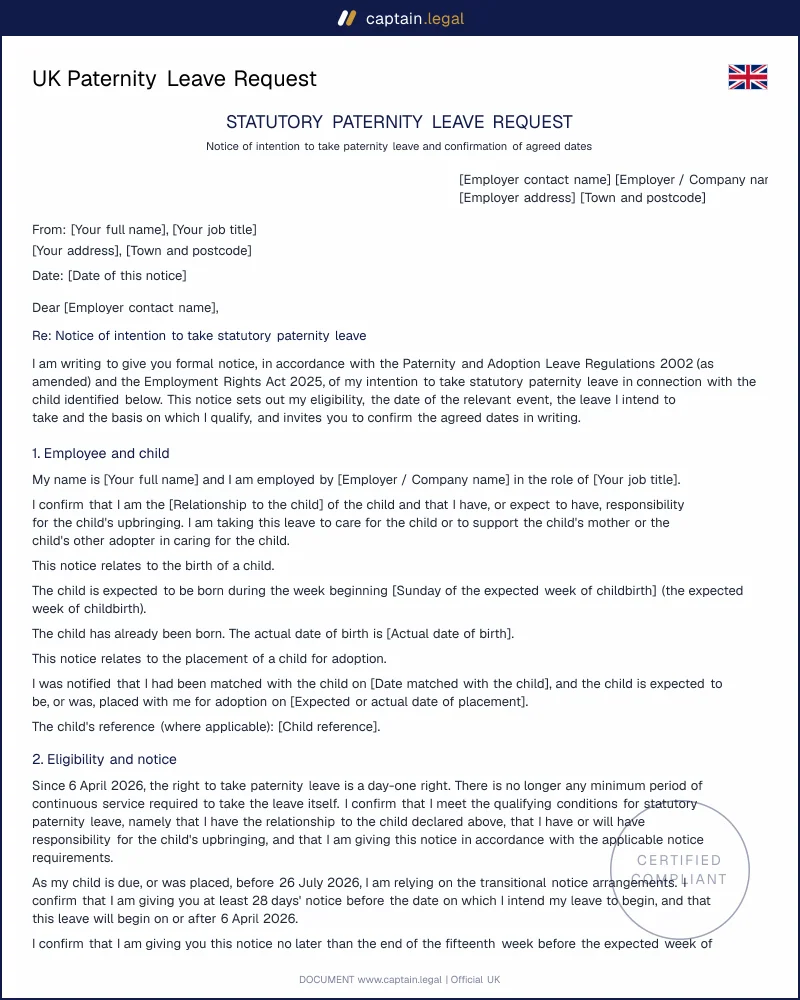
A paternity leave request form is not a contract and not an application the employer can freely decline. It is a notice. Statutory paternity leave is a right under the Paternity and Adoption Leave Regulations 2002, and an eligible employee who gives proper notice is entitled to take it. The form exists to capture that notice in writing, with the dates, the chosen pattern of leave, and the declarations the employer needs before processing Statutory Paternity Pay (SPP).

People often confuse this document with a holiday request or a shared parental leave notice, and the distinction matters. Annual leave is discretionary and the employer can refuse it with counter-notice. Paternity leave is a qualifying right that cannot be refused if the conditions are met, though the employer can ask for the notice in a particular format. Shared parental leave is a separate, more complex scheme that lets parents divide a larger pool of leave between them. This form deals only with the core two-week statutory paternity entitlement, which keeps it short and predictable.

For the employee, the value is protection. A signed, dated request is the difference between leave that is agreed and leave that someone later claims was never approved. For the employer, it is the evidence trail that supports the payroll run and any HMRC query about SPP. You can pair it with a broader process for capturing time off using our UK leave request templates for annual, parental and sick leave, which keep every category consistent across the business.

2

When do you need this document?

The obvious trigger is an expected birth, where a father or partner wants to book their two weeks and needs the employer to plan cover. In practice the most reliable moment to use the form is early, around the qualifying week, because that is when the 15-week entitlement notice falls due and missing it can complicate the later pay claim. A second common scenario is adoption, where the partner of the main adopter takes paternity leave and the notice runs from the matching date rather than a due date. The mechanics are the same, only the trigger event changes.

The form also earns its place when leave is split. Since the 2024 reforms an employee might take one week at the birth and a second week three months later, and each block needs its own 28-day notice. Without a written request per block, employers lose track of which week has been taken and which is still owed. A third situation is the late or variable due date, where the baby arrives early or weeks shift. A clear form lets the employee re-notify dates without anyone arguing about what was originally agreed.

Two edge cases legitimately call for extra care. Where a baby is admitted to neonatal care, separate neonatal care leave and pay rights may apply on top of paternity leave, and the standard form should not be treated as covering them. And where the employee has less than 26 weeks' service, they can now take the leave from day one but may not yet qualify for SPP, so the request should record that the leave is taken unpaid or partly paid. Employers handling several family-leave types in parallel often standardise the paperwork using a section 1 statement of written particulars template so leave entitlements are documented from the start of employment.

3

Key clauses included in our template

  • The eligibility declaration asks the employee to confirm their relationship to the child and their responsibility for its upbringing, which is the statutory basis for the right. It also flags the 15-week qualifying week notice and the separate 26-week service test for pay, so neither side assumes SPP is automatic when it is not.
  • The chosen leave dates and pattern record whether the employee is taking one week or two, and whether the two weeks are consecutive or split into separate blocks. Each block carries its own start date and its own 28-day notice reference, which protects the employee if the second week is challenged months later.
  • The expected week of childbirth or placement date anchors the request to the statutory window, confirming the leave falls within the 52 weeks now permitted. For adoption it captures the matching date instead, because the clock runs differently.
  • The pay and SPP section states the employee's average weekly earnings position and notes that pay is the lower of 90% of earnings or the statutory weekly rate. It avoids promising a figure the payroll system has not yet verified, which is where disputes start.
  • The employer confirmation block is the part that turns a request into an agreement. It gives a dated space to approve the dates, confirm cover arrangements, and note any SPP eligibility check, so the document doubles as the payroll instruction.
4

Regional considerations

England, Wales and Scotland operate the same statutory paternity scheme, so the dates, the two-week entitlement, and the 2024 flexibility rules read identically across Great Britain. The practical differences tend to be administrative rather than legal. Northern Ireland runs a parallel but separately legislated regime, and several 2026 changes, including bereavement and miscarriage provisions, were introduced on its own timetable, so an employer with staff in Belfast should not assume the GB factsheet covers every Northern Irish detail.

The bigger variation is contractual rather than territorial. Many employers offer enhanced paternity pay above the statutory rate, and where they do, the request form should record whether the employee is claiming statutory pay, enhanced pay, or a mix, because the eligibility tests can differ. Public sector and larger private employers frequently top up the first one or two weeks to full salary, while smaller businesses stay at the statutory minimum. A second point worth checking is local handover practice in specialised roles, where a one-week notice culture has grown up informally despite the statutory 28-day standard. Aligning the form with the statutory notice protects the employer if a request is later disputed. Businesses formalising these internal standards often anchor them in their core staff documents, such as a full-time UK contract of employment template that sets out family-leave entitlements clearly from the outset.

5

How to fill out this paternity leave request form

You start by entering the employee's details and their relationship to the child, because that relationship is what grounds the statutory right. From there the form asks for the expected week of childbirth or the adoption matching date, which fixes the request inside the 52-week window. You then choose the leave pattern: one week, two consecutive weeks, or two separate one-week blocks, and the form opens a dated field for each block so the 28-day notice is captured per period rather than once for the whole leave.

Next you record the pay position. The form prompts for the SPP eligibility points, the 26-week service check and the earnings threshold, without committing to a payment figure that payroll has not confirmed. Once the employee signs and dates the declaration, the document passes to the manager, who uses the employer confirmation block to approve the dates, note cover, and log the SPP check. The completed form then sits with payroll and HR as a single source of truth. If you manage other absence categories the same way, our annual and parental leave request templates keep the process uniform across the team.

6

Common mistakes to avoid

The most frequent error is treating the form as a holiday request the employer can refuse or amend at will. Statutory paternity leave is a qualifying right, and an employer who blocks an eligible, properly notified request risks an employment tribunal claim. The mirror-image mistake is the employee assuming pay follows automatically. Leave became a day-one right from 6 April 2026, but SPP still needs 26 weeks' service and the earnings threshold, so a new joiner can be entitled to the time off and not the pay. Recording the pay position on the form at the outset prevents a nasty surprise on payday.

Notice timing causes the rest of the trouble. People forget the two-stage structure: the 15-week entitlement notice before the qualifying week, then 28 days before each block of leave. A split-leave request that captures only the first week and never re-notifies the second is the classic gap, and it surfaces months later when the second week is queried. Another quiet error is ignoring the neonatal care position, where extra leave and pay may run alongside paternity leave and the standard form simply does not reach it. Finally, employers sometimes file the request without completing the confirmation block, leaving the dates agreed verbally and unrecorded. That is precisely the "agreed in the corridor" dispute the document is meant to kill. For ending arrangements rather than starting them, a properly structured letter such as our UK redundancy notice letter template shows the same discipline of writing decisions down.

Key takeaways

STATUTORY RIGHT

This form is notice, not permission

A paternity leave request form is written notice of a statutory entitlement, not a holiday request your employer can simply decline. It captures eligibility declarations, the leave pattern and agreed dates so there is a clear, dated record for you, your manager and payroll. That paper trail also supports any later query about Statutory Paternity Pay and avoids disputes after a handover or manager change.

DATES & NOTICE

Two weeks, split, within 52 weeks

Most eligible fathers and partners can take up to two weeks, either as one block or two separate one-week blocks. Since the 2024 reforms, leave can be taken at any point within 52 weeks of birth or placement, and you only need to give 28 days’ notice for each period. The form should clearly state the chosen dates and whether you are splitting the leave.

ELIGIBILITY

Day-one leave, but pay still qualifies

From 6 April 2026, paternity leave itself becomes a day-one right, so you do not need 26 weeks’ service to take the time off. Pay is different: the 26-week service test still applies for Statutory Paternity Pay, alongside the average weekly earnings threshold at or above the lower earnings limit. The form helps separate the leave right from the pay conditions.

Frequently Asked Questions

The form itself is a notice rather than a contract, but it has real legal weight. Statutory paternity leave is a right under the Paternity and Adoption Leave Regulations 2002, so a completed and properly served request triggers an entitlement the employer cannot simply refuse where the conditions are met. The employer confirmation block then records the approved dates and any pay arrangement, which makes the document strong evidence in a payroll query or tribunal dispute. To be effective it needs accurate dates, the eligibility declaration signed, and the correct notice periods observed. Filled in correctly, it does exactly what a compliant statutory notice should do.

There are two notice points and both matter. First, you must tell your employer that you intend to take paternity leave by the 15th week before the expected week of childbirth, the qualifying week. Second, since the 2024 reforms you must give at least 28 days' notice before each period of leave you actually take. If you split your two weeks into separate blocks, each block needs its own 28-day notice. For adoption the timing runs from the matching date instead. The form captures both points so you do not satisfy one notice rule and accidentally miss the other.

Yes. Since 6 April 2024 you can take your statutory paternity leave as two separate one-week blocks rather than a single period, and you can take it at any time within 52 weeks of the birth or placement. Before the reform, leave had to be taken in one go and within eight weeks. The total entitlement is still two weeks, but the flexibility lets you take one week at the birth and a second week later, perhaps when a partner's maternity leave ends. Each separate week needs its own 28-day notice, which the request form records block by block.

You receive the completed paternity leave request form in editable Word format and as a clean PDF. The Word version lets you adapt the wording to your own handbook, add an enhanced-pay clause, or insert a company logo before circulating it. The PDF is the version most employers keep on the personnel file and pass to payroll, because it locks the agreed dates and signatures in a stable layout. Having both means you customise once and reuse the same document across the workforce, which is far cleaner than rebuilding a request from scratch for every new arrival.

Possibly for the leave but not necessarily for the pay. From 6 April 2026 paternity leave is a day-one right, so you can take the time off from your first day. Statutory Paternity Pay, however, still requires 26 weeks' continuous service up to the qualifying week and average weekly earnings at or above the lower earnings limit. So a recent joiner can be entitled to two weeks off and receive no SPP, or only contractual pay if the employer offers it. The request form prompts you to record your service and earnings position so the pay question is settled in writing before the leave starts.

For statutory paternity leave, no, provided you meet the eligibility conditions and give the correct notice. It is a qualifying statutory right, not a discretionary holiday, so an employer who refuses a valid, properly notified request risks an employment tribunal claim for detriment or unlawful refusal. What an employer can do is ask you to use a particular form, query genuine doubts about eligibility, or discuss the exact dates for operational cover, as long as the two-week entitlement is honoured. The form helps here too: a clear written request makes it much harder for a dispute about dates to escalate, and it gives both sides the same record to work from.

Births rarely match the predicted date, and the rules allow for that. Your 15-week entitlement notice is tied to the expected week of childbirth, but the actual leave is taken around the real birth and within the 52-week window, so an early or late arrival does not cancel your right. If your planned dates no longer work, you re-notify the new dates, ideally observing the 28-day notice where you still can. When a premature birth or early arrival makes the standard notice impossible, employers are generally expected to act reasonably. Using the request form to log the revised dates protects you if anyone later questions when the leave was actually agreed.

4.8/5

11 verified reviews · 50 000+ downloads

UK Paternity Leave Request Form | 2 Weeks, Split or Single
  • Immediate access to the document
  • PDF + Word download
  • Compliant with 2026 legislation
  • Reviewed by lawyers
Fill in the template
Secure payment · No subscription
Updated on May 30, 2026

You might also like

Maternity Leave Request
SSP Decision Letter Template UK