Create my document
Login

Choose country

FranceBelgiqueEspañaUnited StatesUnited KingdomالمغربDeutschlandItalia
Leave Request

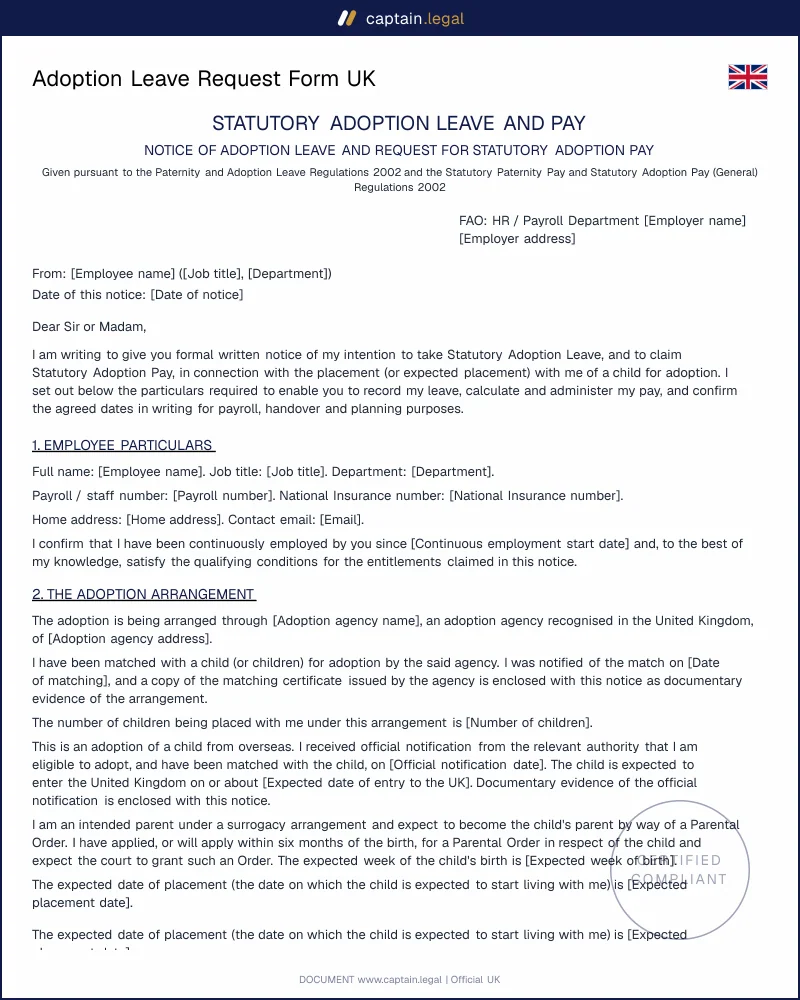
Statutory Adoption Leave Request Form UK | Lawyer-Reviewed Template

Employee adoption leave form aligned with the Paternity and Adoption Leave Regulations 2002. Capture 7-day notice, 28-day pay notice and matching certificate. Word & PDF.
4.7/510 reviews50 000+ downloadsInstant download
Share

A statutory adoption leave request form is the written instrument an employee uses to notify their employer that they intend to take Statutory Adoption Leave and claim Statutory Adoption Pay, capturing the matching certificate details, the chosen leave start date, and the notice an employer needs to set up payroll. It is built for the moment a UK employee has been matched with a child by an approved adoption agency and has to convert a verbal "I'll be off in spring" into a dated, evidenced record. The form gives HR everything the statutory test requires in one place, and it protects the employee by fixing the agreed dates in writing rather than leaving them to memory. Confirm those dates in writing before payroll cut-off, because the most common adoption-leave dispute is the one that started as a conversation in the corridor and was never written down.

Compliant

2026 Legislation

50,000+ clients

trust us

Affordable

From $4.90 / doc

Secure payment

Instant download

Statutory Adoption Leave Request Form UK | Lawyer-Reviewed Template

Secure payment · No subscription

Fill in the template

What is a statutory adoption leave request form?

A statutory adoption leave request form is not a piece of legislation, it is the documentary trigger that puts an employer on formal notice. UK employees acquire the right to adoption leave under the Employment Rights Act 1996 and the Paternity and Adoption Leave Regulations 2002, but that right only crystallises once the employee gives proper notice and proof. The form is how the notice and the proof arrive together.

It is worth being precise about what this document is and is not. It is not a maternity form, even though the leave structure mirrors maternity leave closely, and it is not the same as a shared parental leave notice, which is a later election an adopter can make to split the balance of leave with a partner. A single adopter, or one member of an adopting couple, uses the adoption leave form; the other partner typically uses a statutory paternity leave request instead, since only one person in a couple can take adoption leave. The form records who is the main adopter, the date the employee was notified of the match, the expected placement date, and the date the employee wants leave to begin. Getting the main-adopter designation right at this stage matters, because it determines which statutory regime each partner falls under and which evidence each must supply. Employers reviewing the completed form should treat it as the foundation document for the whole absence, from the first payroll instruction to the eventual return-to-work date.

2

When do you need this form?

The everyday trigger is the domestic UK adoption, where an employee has just received a matching certificate from a local-authority or voluntary adoption agency and needs to lock in a leave start date around the expected placement. This is the case the form is built for, and it is also the one where the 7-day notification window catches people out, because the matching news is emotional and paperwork is the last thing on anyone's mind. A close cousin is the fostering-for-adoption or early-permanence placement, where an approved adopter who is also an approved foster carer takes a child first on a fostering basis with adoption intended; the leave can still apply, but the evidence and timing need careful handling.

The form also earns its place in overseas adoptions, which run on a different clock. Leave there cannot begin until the child enters Great Britain, the relevant evidence is the certificate of eligibility rather than a domestic matching certificate, and the employee must tell the employer the date of entry within 28 days. Surrogacy arrangements are another use case worth flagging, since a parental order parent can qualify for adoption leave with leave starting on the day the child is born or the day after, which compresses the usual notice timeline dramatically. Two edge cases legitimately test the form. The first is the agency worker or zero-hours adopter who is not entitled to adoption leave but may still qualify for Statutory Adoption Pay, where the form becomes a pay-and-agreed-time-off record rather than a leave notice. The second is the couple deciding at the last minute to swap which partner takes adoption leave, which means re-issuing the form so the main-adopter designation matches the pay claims being filed.

3

Key clauses included in our template

  • The main adopter declaration identifies which member of an adopting couple is taking adoption leave, because only one can, and confirms the other partner is claiming statutory paternity leave instead. This single field prevents the most common payroll error, where both partners are processed under the wrong regime and HMRC reclaim figures have to be unwound months later.
  • The matching and placement details capture the date the employee was notified of the match, the name of the approved adoption agency, and the expected or actual placement date. These are the facts that establish the matching week used to test the 26-week service condition for pay, so the form prompts for them explicitly rather than leaving them to a covering email.
  • The chosen leave start date records whether leave begins on the placement date or up to 14 days before it, and ties that date to the 28-day pay-notice requirement. The template flags the deadline so neither side can later claim surprise about when the absence and payroll instruction take effect.
  • The evidence section confirms which document is attached, the matching certificate for UK adoptions or the certificate of eligibility for overseas placements, giving the employer the statutory proof of adoption in the same submission rather than a chase weeks later.
  • The employer response and confirmation block lets HR record the approved dates, the Statutory Adoption Pay eligibility decision, and any company-scheme enhancement, then return a signed copy. That written confirmation is the part that closes off the "we never agreed those dates" argument and feeds clean data straight into payroll and rota planning.
4

Regional considerations

Statutory adoption leave and pay operate identically across England, Wales and Scotland, because the Paternity and Adoption Leave Regulations 2002 and the SAP regulations are reserved employment-law matters rather than devolved ones. An employee in Cardiff, Glasgow or Manchester reads the same 52-week entitlement, the same 7-day notification rule, and the same matching-certificate requirement, so a single Great Britain form serves all three nations without amendment.

Northern Ireland is the genuine exception and the one HR teams most often miss. Employment law there is devolved, and adoption leave runs under separate Northern Ireland regulations administered through a parallel framework, with the same broad shape but its own statutory references and guidance routes. The practical rates track the GB figures, yet the underlying legal citations differ, so a form drafted for Employment Rights Act 1996 mechanics should be checked against the Northern Ireland position before it is relied on for a Belfast-based employee. Beyond the home-nations split, the adoption agency approval requirement has a regional flavour: the matching certificate must come from an agency approved within the relevant UK jurisdiction, which matters for cross-border placements. Employers running operations in more than one nation should keep their leave documentation aligned with the wider set of UK employment contract and HR templates so that the adoption form, the contract, and the staff handbook all point to the same notice and evidence standards rather than contradicting each other.

5

How to fill out this adoption leave request form

You start by confirming the route, a UK domestic adoption, an overseas adoption, or a surrogacy parental order, because that single choice sets the evidence you attach and the date your leave can begin. From there you enter the date the agency notified you of the match, which fixes the matching week the form uses to check your service and pay eligibility, then the expected placement date. The form then asks you to choose your leave start date, either the placement day itself or a date up to 14 days earlier, and it checks that date against the 28-day pay-notice deadline so you are not caught short. You confirm whether you are the main adopter and, if you have a partner, note that they will claim paternity leave separately. Next you attach the matching certificate or, for overseas cases, the certificate of eligibility, and the form records that the statutory proof has been supplied. The final step hands the document to your employer for the response section, where HR sets out the approved dates and the pay decision and returns a signed copy. The whole sequence is built so the employee files complete, evidenced notice in one pass, and the employer holds everything needed for a clean record of the agreed absence without a second round of emails.

6

Common mistakes to avoid

The single most damaging error is missing the 7-day notification window after the match, then assuming the leave is automatically secured. The leave right survives a late notification in practice, but the Statutory Adoption Pay claim and the employer's payroll set-up depend on timely, evidenced notice, and a vague verbal mention does not count as the statutory notification. Almost as common is treating the matching certificate as optional or "to follow"; without the certificate the employer has no statutory proof of adoption, and a request that arrives certificate-free is incomplete however sincere it is. Couples regularly trip over the one-adopter rule, with both partners applying for adoption leave when only one can take it and the other should be claiming paternity leave, an error that surfaces painfully when HMRC reclaim figures do not reconcile.

The other cluster of mistakes lands on the employer side. Confirming dates verbally and never issuing written confirmation is the corridor-agreement trap that turns a smooth absence into a dispute when memories diverge at payroll time. Refusing Statutory Adoption Pay without issuing form SAP1 leaves the employee unable to seek alternative support and exposes the employer to a complaint, so a refusal must always be documented with the statutory reason. Never treat adoption leave as discretionary the way casual time off might be, because it is a statutory entitlement and a rigid or dismissive response risks an automatic-unfair-dismissal or detriment claim. Reviewing the request alongside the business's wider statutory leave and HR documents keeps the decision consistent and defensible. Finally, employers sometimes ask for far more personal detail than the statutory test needs; keep the form proportionate and request only the match date, placement date, and certificate.

Key takeaways

NOTICE

Meet the 7-day and 28-day rules

This form is the formal trigger for adoption leave and pay, not a casual heads-up. You must notify your employer within 7 days of being told you have been matched that you intend to take Statutory Adoption Leave, and give at least 28 days’ notice of when you want Statutory Adoption Pay to start. Missing either deadline can cause payroll delays and avoidable disputes.

EVIDENCE

Attach the matching certificate details

Your employer needs proof as well as dates. The statutory evidence is the matching certificate from the approved adoption agency, and the form captures its key details alongside the match notification date and expected placement date. Without that evidence, HR cannot confidently apply the statutory test or set up PAYE correctly, and you risk your leave and pay being treated as unconfirmed.

ELIGIBILITY

Know who can take adoption leave

Only one person in an adopting couple can take Statutory Adoption Leave, so the form must clearly identify the main adopter. The other partner will usually use a statutory paternity leave request instead. Adoption leave itself is a day-one right and runs for up to 52 weeks (26 weeks ordinary plus 26 weeks additional), but Statutory Adoption Pay has separate qualifying conditions.

Frequently Asked Questions

The form itself is a notice and record rather than a contract, so it does not create rights on its own, but it carries real legal weight. Once you submit it with a valid matching certificate and the correct notice, it satisfies the statutory notification requirements under the Paternity and Adoption Leave Regulations 2002, and the employer's signed confirmation of dates becomes binding evidence of what was agreed. That written confirmation is exactly what a tribunal would look for if a dispute arose over approved dates or pay. The template is drafted to current Great Britain law and is suitable for self-service use, though employees with unusual circumstances, such as overseas adoptions, may want a quick check against the agency's own guidance. You can see how it fits alongside other lawyer-reviewed UK leave and HR documents on the platform.

The form is delivered in editable Microsoft Word format and as a clean PDF, so you can adapt the wording to your own HR house style and then keep a fixed, signed version for the file. The Word version is useful when you want to add a company-scheme enhancement clause or fold the form into an existing staff handbook, because the statutory prompts stay intact while the surrounding language flexes. The PDF is the version you circulate for signature and store as the record of the agreed dates. Both contain the same statutory fields, the match date, placement date, evidence section, and employer response block, so whichever you use, the legal substance of the notice is identical.

Two deadlines matter and they are easy to confuse. You must tell your employer that you intend to take adoption leave within 7 days of being notified that you have been matched with a child, unless that is not reasonably practicable. Separately, you must give at least 28 days' notice of the date you want your Statutory Adoption Pay to start. If you later want to change your leave start date, you generally need to give 28 days' notice of the new date. Hitting the 7-day window protects your pay claim and gives payroll time to set you up correctly, so treat it as the harder of the two deadlines even though the leave right itself is a day-one entitlement.

Statutory adoption leave runs for up to 52 weeks, made up of 26 weeks of Ordinary Adoption Leave followed by 26 weeks of Additional Adoption Leave, and you can take it whether you stay for two weeks or the full year. Statutory Adoption Pay is payable for up to 39 weeks: the first 6 weeks at 90% of your average weekly earnings, then the remaining 33 weeks at the flat statutory rate of £194.32 per week or 90% of average weekly earnings if that figure is lower. To qualify for the pay you need 26 weeks of continuous service by the matching week and average earnings at or above the lower earnings limit. The leave is a day-one right, but the pay is not, which is the distinction most adopters find surprising.

Yes, for a UK domestic adoption the matching certificate from your approved adoption agency is the statutory proof of adoption your employer needs, and a request without it is incomplete. The certificate confirms the match date that sets your eligibility for pay, so it does real work beyond being a formality. For an overseas adoption the equivalent evidence is a certificate of eligibility and suitability, and you must also tell your employer the date the child entered Great Britain, normally within 28 days. Attach the document at the point you submit the form rather than promising to send it later, because the clock on your pay claim and your employer's payroll set-up depends on the evidence being in their hands.

No. Where a couple adopts, only one of you can take Statutory Adoption Leave, and that person is recorded on the form as the main adopter. The other partner can usually take statutory paternity leave of up to two weeks, and the couple can decide between them who takes which. If you both want to share the longer leave, the route is to elect into shared parental leave after the adoption leave has begun, which lets the main adopter curtail their leave and split the balance with the partner. Designating the main adopter correctly on the form at the outset prevents the payroll and HMRC reclaim problems that follow when both partners are processed under the wrong scheme.

An employer cannot refuse the leave itself to a qualifying employee, but it can decide you do not meet the conditions for Statutory Adoption Pay, for example if your average weekly earnings fall below the lower earnings limit or you lack the 26 weeks of service. If the employer reaches that decision it must give you form SAP1 within a set period, setting out why the pay is not payable, so you can seek alternative support such as Universal Credit. A refusal communicated only verbally, with no SAP1, is not handled correctly. If you think the decision is wrong you can ask for a written statement of the reasons and, failing agreement, refer the matter onward, but the SAP1 is the document that should arrive first.

Yes, the dates are not locked once notified. You can bring your leave start date forward or push it back, but you normally need to give your employer 28 days' notice of the change unless it was not reasonably practicable to do so, for instance where the placement date itself moves at short notice. This flexibility is built in because adoption timelines genuinely shift, placements get delayed, and the law does not expect you to predict the exact day months ahead. The practical advice is to tell your employer as soon as you know, update the form, and get a fresh written confirmation of the revised dates so payroll and your rota reflect the change cleanly rather than running on the superseded figures.

4.7/5

10 verified reviews · 50 000+ downloads

Statutory Adoption Leave Request Form UK | Lawyer-Reviewed Template
  • Immediate access to the document
  • PDF + Word download
  • Compliant with 2026 legislation
  • Reviewed by lawyers
Fill in the template
Secure payment · No subscription
Updated on May 30, 2026

You might also like

SSP Decision Letter Template UK
Annual Leave Request Form UK