Create my document
Login

Choose country

FranceBelgiqueEspañaUnited StatesUnited KingdomالمغربDeutschlandItalia
Leave Request

UK Unpaid Parental Leave Form | Track Weeks & Confirm Dates

Day-one parental leave form built for the April 2026 rules: 18 weeks per child, 4-week annual cap, 21-day notice. Lawyer-drafted, editable Word and PDF.
4.9/517 reviews50 000+ downloadsInstant download
Share

A parental leave request form is the document a working parent uses to formally ask for time off to care for a child's welfare, and the record an employer keeps to confirm the dates, count the weeks taken, and protect everyone if memory later fails. In UK practice it sits at the awkward intersection of a statutory right and a discretionary conversation, which is precisely why getting it in writing matters. This template captures each request per child, builds in the annual and lifetime limits, prompts for the correct notice period, and gives line managers and payroll a single approved record instead of a half-remembered chat by the kettle. It works for both the existing rules and the day-one entitlement that took effect on 6 April 2026.

Most absence disputes are not about the leave itself. They are about whether it was agreed, for which dates, and on what terms. A clean unpaid parental leave request form removes that ambiguity at the source.

Compliant

2026 Legislation

50,000+ clients

trust us

Affordable

From $4.90 / doc

Secure payment

Instant download

UK Unpaid Parental Leave Form | Track Weeks & Confirm Dates

Secure payment · No subscription

Fill in the template

What is an unpaid parental leave request form?

An unpaid parental leave request form is a written application by an employee to take statutory unpaid parental leave, together with the employer's confirmation of approval, postponement, or the dates actually agreed. It is not a contract and it is not a policy document. It is the operational record that turns a statutory right into a logged, dated, auditable event. The form names the child, states the weeks requested, confirms the employee's parental responsibility, and records the decision.

People often confuse this with three quite different things. Maternity, paternity, and adoption leave are separate statutory schemes with their own pay, notice, and eligibility tests. Shared parental leave lets parents split a pooled entitlement and carries heavier administration. Time off for dependants is the short, usually unpaid emergency right you use when a childminder cancels at 7am, not a planned block of leave. Unpaid parental leave is the deliberate, planned right to take whole weeks off to look after a child's welfare, capped per child and spread across the years until the child turns 18. A form that blurs these categories is worse than no form at all, because it invites the wrong notice period and the wrong eligibility check. If you need the emergency route instead, the UK leave request templates for every type of absence cover dependants and sickness separately.

2

When do you need this document?

The everyday use is a parent planning a block of time around a predictable event: settling a child into a new school in September, covering the gap when a nursery place falls through, or simply spending concentrated time with a young child during a quiet period at work. In each case the employee gives notice, the manager checks the running total of weeks, and the decision is logged. The form earns its place by forcing that check before the leave is approved rather than after payroll has already paid for it.

A second common scenario is bolting parental leave onto another family leave entitlement. A father who has taken his two weeks of paternity leave may want to add a couple of weeks of unpaid parental leave immediately afterwards, extending his time with a newborn. The form should capture that sequence cleanly so the two entitlements are not accidentally conflated. Our UK full-time employment contract template sets out the underlying terms that the leave request then varies temporarily.

The edge cases are where expertise shows. A grandparent with a significant parenting role, or a step-parent with parental responsibility, may qualify, and the form should prompt for proof of that responsibility rather than assume it. The 4-week annual cap resets per child, not per family, so a parent of three children under 18 can in principle take up to 12 weeks in one leave year, which catches many small employers by surprise. And because the right is now day-one, a brand-new hire can lawfully request leave in their first week, something the old form simply could not accommodate.

3

Key clauses included in our template

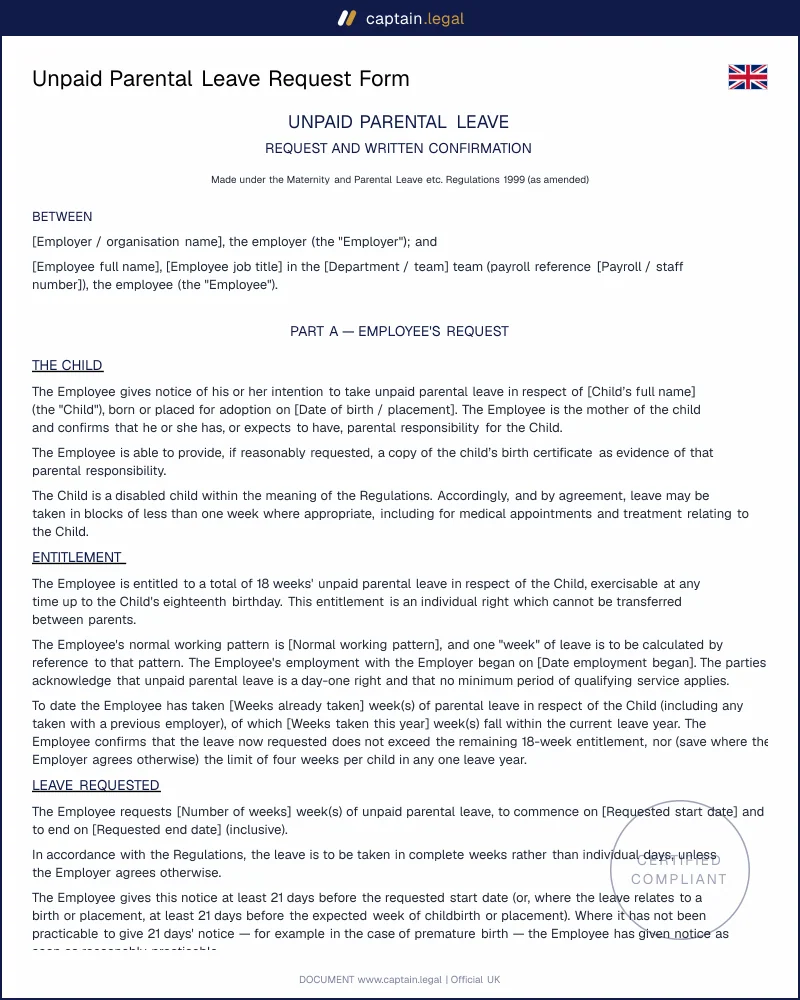
  • The child identification and parental responsibility statement names each child the request relates to and confirms the legal basis for the employee's responsibility. Because the entitlement is per child, a request that lumps two children together cannot be tracked against the right caps, so the form keeps them separate and dated.
  • The weeks requested and running balance records how many weeks are being taken now and how many of the 18-week-per-child entitlement remain. This single field prevents the most common dispute, where neither side can say later how much leave has actually been used across years and jobs.
  • The notice and start date confirmation captures the date notice was given and the intended start date, so the 21-day statutory notice can be evidenced if questioned. It also flags where leave is intended to follow a birth or adoption, because that block cannot be postponed.
  • The employer decision section lets the manager approve, propose a postponement with the new dates, or confirm agreed alternative scheduling, always in writing and within the statutory seven-day window. Vague verbal approval is replaced by a signed, dated outcome.
  • The payroll and handover note confirms the leave is unpaid, sets out the return date, and records cover arrangements, so the absence flows straight into rota planning rather than surfacing as a surprise on the payroll run.
4

How to fill out this unpaid parental leave request form

You start with the employee section, where the parent names the child or children, states the weeks they want and the proposed start date, and confirms their parental responsibility. The form then prompts for the notice date so the 21-day period is visible on the face of the document. From there it moves to the running balance, where you enter how many of the 18 weeks for that child have already been taken, including any used with a previous employer, and the form makes clear how many remain and whether the 4-week annual cap is in play.

The request then passes to the manager, who records the decision. If the dates work, approval is confirmed with a signature and date. If the timing genuinely disrupts the business, the manager uses the postponement section to propose new dates within the six-month window, except where the leave follows a birth or adoption. Finally the payroll and handover note is completed so the absence is costed correctly and cover is arranged. Each field is editable, so you can adapt the wording to your own policy without losing the statutory prompts. If you also need to vary working patterns longer term, pair this with the UK fixed-term contract template for cover and project roles.

5

Common mistakes to avoid

The most frequent error is treating the request as a favour rather than a right. Managers sometimes refuse outright, which they cannot lawfully do for a qualifying employee who has given proper notice; the only options are to agree the dates or postpone for up to six months on genuine business grounds. A flat refusal, or a postponement dressed up as a refusal, is precisely the conduct that turns a routine request into a grievance. Equally damaging is the corridor approval that never gets written down. When payroll queries an unpaid week three months later and no one can produce a dated decision, the employer carries the risk, not the employee. A second cluster of mistakes sits around the numbers. Employers forget the 4-week annual cap is per child, miscount weeks carried over from a previous job, or fail to record that leave was taken in whole weeks rather than odd days. Some still apply the old one-year service test after 6 April 2026, refusing a new joiner who now has a day-one right. Others ask for intrusive evidence about the child or the reason for the leave, which is disproportionate and risks a data protection complaint. Keep the form proportionate: name the child, confirm responsibility, count the weeks, log the decision. For dismissal-related paperwork that must never be confused with leave administration, see the ACAS-compliant UK dismissal letter template.

Key takeaways

ENTITLEMENT

18 weeks per child, with limits

Unpaid parental leave is a statutory right worth up to 18 weeks per child, usable up to the child’s 18th birthday. You are normally limited to 4 weeks per child in any single year unless your employer agrees otherwise. The entitlement is personal and cannot be shared between parents, and the same cap applies for adopted children. Track weeks per child, not per job.

NOTICE

Give 21 days’ notice, in writing

The notice rule stays the same: you give 21 days’ notice before the intended start date. A written request form pins down the dates requested, the weeks to be counted, and the employer’s response, so there is a clear record if a dispute later turns on what was agreed. It also helps line managers and payroll work from one approved version, not a corridor conversation.

APRIL 2026

Day-one right from 6 April 2026

From 6 April 2026, unpaid parental leave becomes a day-one right, so new starters no longer need a year’s continuous service. The form should reflect that change while still applying the existing caps and notice mechanics. It also matters because unused leave carries across employers: if you have already used part of your 18 weeks elsewhere, only the remaining balance is available in your new role.

Frequently Asked Questions

The template itself is an administrative record, not a contract, so it does not create rights on its own. What makes it legally effective is that it documents a statutory right under the Maternity and Parental Leave etc. Regulations 1999 and the employer's response to it. Once both sections are completed and signed, it becomes strong evidence of the dates requested, the notice given, and the decision reached. That evidential value is exactly what protects an employer if an employee later claims leave was refused, or protects an employee if the employer disputes how many weeks were taken. Used properly alongside the employment contract, it sits comfortably within UK employment law.

The statutory rule is 21 days' notice before the intended start date of the leave. The employee should specify the dates they want, and for leave intended to start immediately after a birth or adoption, the notice is given before the expected week of childbirth or placement. The employer can ask for the request in writing, which is where this form earns its keep. The 21-day period was not changed by the April 2026 reform; what changed was the removal of the one-year service requirement, so the notice mechanics remain the familiar three weeks.

An employer cannot simply refuse a valid request from a qualifying employee. The only lawful response other than agreement is postponement: the employer may delay the leave by up to six months where granting it on the requested dates would cause undue disruption, and must confirm that postponement in writing within seven days, suggesting alternative dates. Crucially, leave intended to be taken straight after the birth or adoption of a child cannot be postponed at all. So if a manager says no, what they really mean, lawfully, is "not these exact dates", and the form's postponement section is how that gets recorded properly.

You receive the form in editable Word format and as a clean PDF. The Word version lets you add your company name, adjust the wording to match your own leave policy, and reuse the template across the business without starting from scratch each time. The PDF gives you a tidy, print-ready version for signing and filing. Most employers customise the Word file once, save it as their house template, and export to PDF for the signed copy that goes into the personnel record.

Each qualifying parent is entitled to 18 weeks of unpaid leave per child, available until the child's 18th birthday, with a limit of 4 weeks per child in any single leave year unless the employer agrees to more. Because the entitlement is per child, a parent of two children under 18 could take up to 8 weeks in a year, and 36 weeks in total over time. The leave is normally taken in whole weeks, though parents of a disabled child may take it in shorter blocks. The form's running balance field is designed to keep this count accurate across years and even across different employers.

It changes who qualifies, not how the form works. From 6 April 2026, under the Employment Rights Act 2025, unpaid parental leave became a day-one right, so the old requirement of one year's continuous service no longer applies. In practice this means a new employee can make a valid request in their first week, and the form should no longer screen anyone out on length of service. Everything else, the 18-week cap, the 4-week annual limit, the 21-day notice, and the parental responsibility test, stays the same. If your existing form still asks for service length as an eligibility gate, replace it.

Yes, and this is one of the most useful planning tools available to parents. Unpaid parental leave can run immediately after maternity, adoption, paternity, or shared parental leave to extend the total time off with a child. A father might take his two weeks of paternity leave and follow it with two weeks of unpaid parental leave for a continuous month at home. The form captures that sequence so the entitlements are logged separately and counted correctly, which matters because each scheme has its own rules and you do not want the weeks bleeding into one another on the record.

4.9/5

17 verified reviews · 50 000+ downloads

UK Unpaid Parental Leave Form | Track Weeks & Confirm Dates
  • Immediate access to the document
  • PDF + Word download
  • Compliant with 2026 legislation
  • Reviewed by lawyers
Fill in the template
Secure payment · No subscription
Updated on May 30, 2026

You might also like

UK Bereavement Leave Request
Study/Training Leave Request Form UK