Create my document
Login

Choose country

FranceBelgiqueEspañaUnited StatesUnited KingdomMarocDeutschlandItaliaSchweiz
Real Estate

Tenancy Inventory UK: Win Your Deposit Dispute

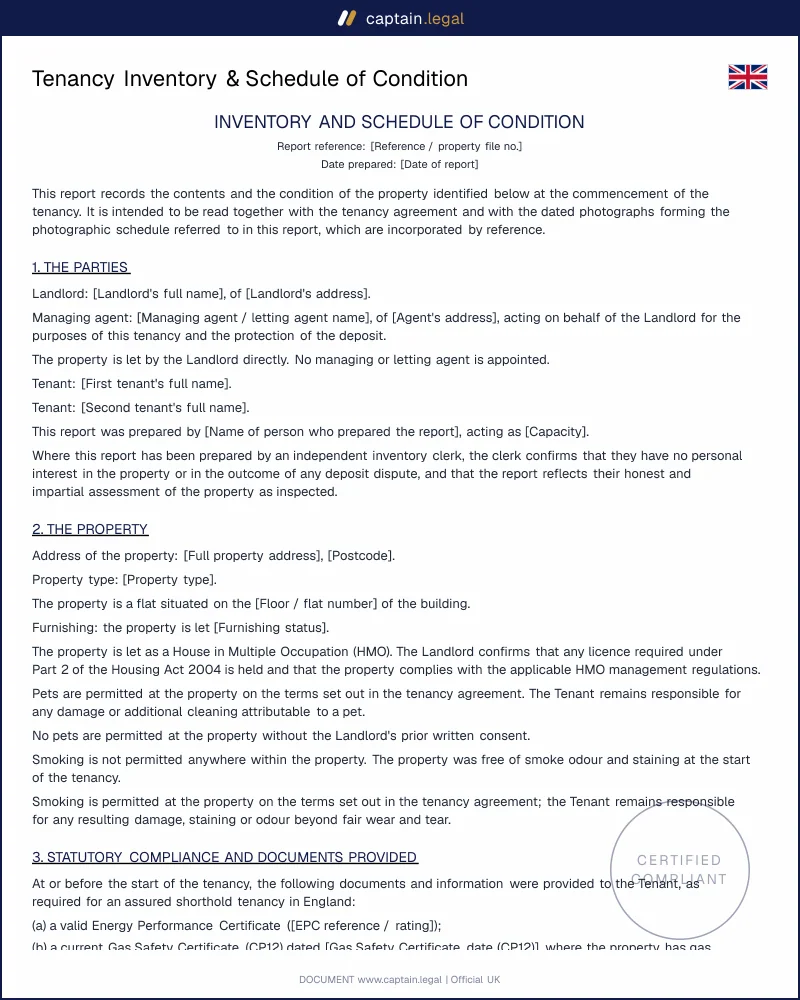
Solicitor-grade tenancy inventory and check-in/check-out report. Discharge your burden of proof under the Housing Act 2004 deposit rules. Word, PDF.
4.8/512 reviews50 000+ downloadsInstant download
Share

A tenancy inventory and schedule of condition is the single document that decides who keeps the deposit when the keys come back. It records, room by room, the exact state of a rented property at the start of a let, supported by dated photographs, so that any damage claimed at the end can be measured against an agreed baseline. Landlords, letting agents and self-managing property owners across England and Wales use this check-in and check-out report to win deposit disputes, defend deduction claims, and keep their possession files clean. Get the inventory wrong and you carry the burden of proof with nothing to discharge it. Get it right and the adjudicator has no reason to find against you.

Compliant

2026 Legislation

50,000+ clients

trust us

Affordable

From $4.90 / doc

Secure payment

Instant download

Tenancy Inventory UK: Win Your Deposit Dispute

Secure payment · No subscription

Fill in the template

What is a tenancy inventory and schedule of condition?

A tenancy inventory is a written and photographic record of the contents and condition of a property at the point a tenant takes possession. The schedule of condition is the qualitative half of that record: it describes the state of each surface, fitting and item, room by room, in plain language a stranger could verify. Together they form the agreed baseline against which the property is judged when the tenancy ends. The companion document, the check-out report, repeats the exercise on the way out and sits beside the original so the two can be compared like for like.

People confuse the inventory with the tenancy agreement, but they do different jobs. The agreement sets the legal relationship, the rent and the obligations; the inventory proves what the property actually looked like. A clause in your Assured Shorthold Tenancy Agreement requiring the tenant to return the property in good order is worth very little without an inventory to show what "good order" meant on day one. Without a signed check-in record, an adjudicator has no fixed point to compare against, and the deposit goes back to the tenant by default. The schedule of condition is also distinct from a survey or a gas safety record. It is evidence of condition for deposit purposes, not a statement of structural soundness or statutory compliance.

2

When do you need this document?

The obvious moment is the start of every new let, before the tenant moves a single box in. A check-in inventory completed and signed on or just before the move-in date is the foundation of everything that follows, and the closer it sits to the handover of keys the harder it is to challenge. The second moment is the end of the tenancy, when you prepare the matching check-out report as near to the final day as possible, ideally with the same camera angles and the same lighting so the comparison is genuinely like for like.

There are less obvious triggers worth flagging. When a tenant changes mid-tenancy, say one joint tenant leaves and another is added, you record the condition again so that responsibility is clearly allocated; this often pairs with a fresh look at your assured shorthold tenancy agreement and its joint tenant clauses. Periodic interim inspections during a long let are another sensible use, creating a dated trail that shows when damage actually appeared rather than leaving a two-year gap an adjudicator cannot fill.

Two edge cases legitimately complicate the picture. A furnished let needs an itemised contents list with makes, ages and conditions, because adjudicators apply betterment to each item and an undated "good condition sofa" entry is nearly worthless. And where you let a room in your own home, the position shifts entirely: a resident landlord arrangement runs on a lodger agreement under an excluded licence, where there is usually no protected deposit, though a condition record still helps avoid arguments.

3

Key clauses included in our template

  • The room-by-room schedule of condition walks through each space in a fixed order, describing walls, ceilings, flooring, windows, doors, fixtures and fittings in specific terms. Vague entries like "good" are replaced with descriptions a third party could verify, such as "magnolia emulsion, two minor scuffs left of radiator", which is exactly the level of detail an adjudicator can act on.
  • The photographic schedule ties dated images to each described item, with space to reference file names so a photo can be matched to its written entry. Date-stamped images taken in consistent lighting are the strongest single piece of evidence in any deposit dispute, and the template prompts you to capture them systematically rather than at random.
  • The meter readings and keys record logs gas, electricity and water readings at check-in and check-out, plus the number of keys, fobs and remotes issued. This closes off two recurring arguments at the same time: utility liability and missing access devices charged against the deposit.
  • The furnished contents inventory lists each item with make, approximate age and condition, which lets you apply betterment correctly later. An adjudicator will not award the full replacement cost of an item that was already part-worn at check-in, and this section captures that starting age.
  • The tenant acknowledgement and signature block records that the tenant received the inventory, had a stated period to dispute it, and either signed or returned comments. An unsigned inventory still carries weight, but a signed and dated one is far harder for a tenant to dispute at check-out.
4

Regional considerations

The deposit and inventory regime is broadly uniform across England and Wales, but the surrounding rules diverge enough to matter. England now operates fully under the Renters' Rights Act 2025 from 1 May 2026, with assured periodic tenancies the default and section 21 gone. Possession runs through section 8 grounds, and because more tenancies end by negotiation or fault-based possession, the inventory's evidential role at check-out is heightened. English landlords should also keep the deposit protected and the prescribed information served, since a defective deposit position still undermines a possession claim. Compliance documents such as a clean section 8 notice seeking possession sit best on top of a properly evidenced tenancy file.

Wales runs a separate statute book. Residential lettings there fall under the Renting Homes (Wales) Act 2016, which replaced the old tenancy with the "occupation contract" and uses "contract-holders" rather than tenants. Deposit protection rules mirror the English position in substance, and the inventory works the same way as evidence, but Welsh landlords should use Welsh terminology and reference the written statement of the occupation contract rather than an AST. The thirty-day protection window and the burden of proof at adjudication are effectively identical, so an inventory prepared to English standards transfers cleanly in evidential terms.

A practical regional point applies to London and other high-demand areas, where deposits are larger in cash terms and disputes therefore higher value. The financial exposure of a weak inventory rises with the rent, so a thorough schedule of condition repays the effort most in exactly the markets where lettings turn over fastest. Across all regions, the constant is the adjudicator's question: can you prove the condition at the start? The geography changes the labels and a few procedural deadlines, not that core test.

5

How to fill out this tenancy inventory and schedule of condition

You start by entering the property address, the tenancy start date and the names of every tenant, drawn from the tenancy agreement so the inventory and the contract match. From there you work through the property room by room in a logical order, usually starting at the entrance and moving clockwise, describing each surface and fitting in concrete terms and noting any existing marks or defects rather than glossing over them. Honest entries protect you more than flattering ones, because an adjudicator trusts a record that admits a pre-existing scuff far more than one that claims everything was pristine.

As you describe each item you attach the matching dated photograph and note its reference, building the link between the written and visual record. For a furnished let you add the contents list with each item's age and condition, which is what lets you apply betterment fairly at the end. You then log the meter readings and the keys issued, and finish at the tenant acknowledgement section, where the tenant signs or is given a clear window to return comments. At check-out you repeat the same walk-through using the same order and angles, producing the comparison document, then download both in Word for editing and PDF for signing and storage. If you need the wider tenancy paperwork around it, the full UK real estate document library keeps everything in one consistent style.

6

Common mistakes to avoid

The most damaging mistake is treating the inventory as a quick phone walk-through with a handful of blurry photos. Adjudicators see this constantly, and landlords lose disputes they should have won because the evidence simply does not show the original condition clearly enough to justify a deduction. Vague descriptions are almost as bad as none: "good condition throughout" tells an adjudicator nothing and cannot be compared against anything specific at check-out. The second frequent error is failing to date and sign, or leaving the tenant no chance to comment, which lets the tenant argue at the end that they never accepted the record. A signed, dated inventory removes that argument before it starts.

A third trap is confusing damage with fair wear and tear and then over-claiming. Cleaning is the single biggest source of deposit disputes, followed by redecoration, and these usually come down to a landlord seeking a full replacement where a repair, or nothing, is the fair outcome. Claiming the cost of a brand-new carpet to replace a worn five-year-old one triggers a betterment reduction and damages your credibility on every other line of the claim. The final mistake is letting the check-out drift weeks after the tenant leaves or shooting it in different light, so the comparison no longer holds. Match the lighting, match the angles, and run the check-out as close to the final day as you can.

Key takeaways

EVIDENCE

No signed check-in, no deductions

The inventory and schedule of condition sets the baseline for what the property looked like on day one, backed by dated photographs. If the check-in record is not agreed and signed, an adjudicator has no fixed point of comparison at check-out. In practice that means the deposit is returned to the tenant by default, even if the tenancy agreement says they must leave it in good order.

DEPOSIT RULES

Protect the deposit within 30 days

A strong inventory does not cure a deposit compliance failure. Under the Housing Act 2004 you must protect the deposit in a government-backed scheme (TDS, DPS or mydeposits) within 30 calendar days of receipt and serve the prescribed information in the same window. Miss it and you risk a penalty of up to three times the deposit, regardless of any damage evidence.

DISPUTES

You must prove loss, not upgrades

In a scheme dispute the adjudicator decides on the balance of probabilities, and the burden of proof sits with the landlord because the deposit remains the tenant’s money until shown otherwise. Your check-in and check-out reports are read side by side to test each claimed deduction. Expect betterment to be applied: you cannot charge for a brand-new replacement where the item was already worn.

Frequently Asked Questions

An inventory is not a contract in itself, so "binding" is the wrong test. What matters is its evidential weight at adjudication. Under the deposit scheme rules the landlord carries the burden of proof, and the inventory is the evidence used to discharge it. A detailed, dated and tenant-signed check-in inventory, paired with a matching check-out report, is treated by adjudicators as the agreed baseline and is very hard for a tenant to challenge. An unsigned inventory still carries weight if it is detailed and dated, but a signed one is significantly stronger, because the tenant cannot later claim they never saw or accepted the recorded condition.

There is no statutory deadline, so the period is whatever you set out in the document and the tenancy agreement, commonly seven days from receipt. The template prompts you to state this window clearly and to record when the inventory was sent. If the tenant raises no comment within the stated period, you can treat the inventory as accepted, which is a powerful position at check-out. Always give the tenant a genuine opportunity to comment, because an adjudicator looks unfavourably on a record the tenant was never allowed to question, and a fair process strengthens every deduction you later claim.

The template downloads in both Word and PDF. The Word version lets you edit room descriptions, add or remove sections for unusual properties, and adapt the contents list to a furnished or unfurnished let before you print or send it. The PDF version is the clean, fixed format you use for signing and long-term storage, and it is the form most deposit schemes prefer when you upload evidence to a dispute. Keeping both means you can amend the working copy each tenancy while preserving a tamper-resistant signed record for your file.

No. The inventory and the deposit protection deadline are separate obligations. You must protect the deposit and serve the prescribed information within 30 calendar days of receiving the money under the Housing Act 2004, whether or not the inventory is finished. That said, the two work together: protecting the deposit gives you the legal right to claim deductions, and the inventory gives you the evidence to justify them. A perfect inventory with a late-protected deposit still exposes you to a penalty, so treat the 30-day deadline as immovable and keep your deposit receipt and prescribed information current alongside it.

Fair wear and tear is the deterioration you would expect from ordinary, reasonable use over the length of the tenancy, judged against the age and quality of the item and the number of occupants. A faded carpet after three years of family occupation is wear and tear; a wine stain burned into it is damage. Adjudicators always allow for wear and tear and apply betterment, so a landlord cannot recover the full replacement cost of an aged item. The inventory's value is that it fixes the starting age and condition, which is what lets an adjudicator separate genuine damage from the natural decline of the property.

Not automatically. When an assured shorthold tenancy converted to an assured periodic tenancy under the Renters' Rights Act 2025, the original check-in inventory remained the baseline; the conversion changed the tenancy type, not the recorded condition. You do not need to redo the check-in. You should, however, run interim condition checks during a long periodic tenancy and complete a proper check-out whenever it finally ends, because the deposit and its evidential test survive the conversion. Keep the original inventory safely filed, as it remains your starting point for any deduction years later.

You can prepare it yourself, and most self-managing landlords do. Adjudicators judge the quality of the evidence, not who produced it, so a thorough, dated, photographed and tenant-signed inventory from a landlord is as strong as a clerk's report. A professional inventory clerk adds independence, which can carry extra weight in a high-value dispute, but it is not a legal requirement. For most lettings, a carefully completed template that follows a consistent room order and links each photo to its written entry gives you everything an adjudicator needs to find in your favour.

4.8/5

12 verified reviews · 50 000+ downloads

Tenancy Inventory UK: Win Your Deposit Dispute
  • Immediate access to the document
  • PDF + Word download
  • Compliant with 2026 legislation
  • Reviewed by lawyers
Fill in the template
Secure payment · No subscription
Updated on June 7, 2026

You might also like

Guarantor Agreement UK
Tenant Referencing & Right to Rent Pack UK