Create my document
Login

Choose country

FranceBelgiqueEspañaUnited StatesUnited KingdomMarocDeutschlandItaliaSchweiz
Real Estate

Right to Rent Check Record UK | Immigration Act 2014

Solicitor-grade vetting pack for England: Right to Rent statutory excuse, UK GDPR-compliant referencing and previous-landlord reference. Word & PDF.
4.8/529 reviews50 000+ downloadsInstant download
Share

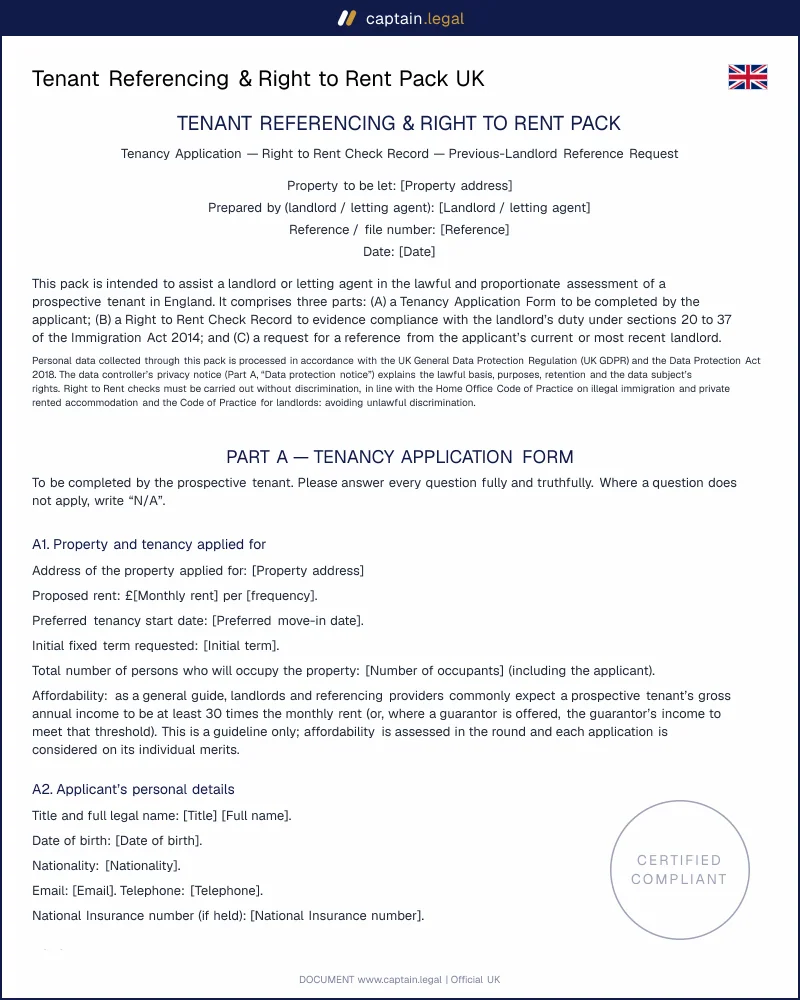
The Tenant Referencing & Right to Rent Pack gives a landlord or letting agent in England everything needed to vet a prospective tenant lawfully and build a defensible file before the keys change hands. It bundles three documents that work as one process: a structured tenant application form, a Right to Rent check record that locks in your statutory excuse under the Immigration Act 2014, and a previous-landlord reference request. Each is drafted to sit cleanly inside UK GDPR and the Data Protection Act 2018, so you collect only what you can justify and you can prove you did it. The pack downloads in Word and PDF, ready to edit, send and keep.

Referencing is where most landlord problems are quietly avoided or quietly created. A glowing reference that turns out to be the applicant's cousin, a credit check run without a lawful basis, a Right to Rent step skipped because completion was rushed: each one comes back later as arrears, a penalty, or a possession claim that wobbles at the first hearing. This pack exists to make the front end boring and the paper trail clean.

Compliant

2026 Legislation

50,000+ clients

trust us

Affordable

From $4.90 / doc

Secure payment

Instant download

Right to Rent Check Record UK | Immigration Act 2014

Secure payment · No subscription

Fill in the template

What is a tenant referencing and Right to Rent pack?

A tenant referencing and Right to Rent pack is a set of pre-tenancy vetting documents that a landlord or agent uses to assess whether an applicant is suitable and legally entitled to rent, while keeping the whole exercise compliant with data protection law. It is not a single form. It is a small workflow: gather the applicant's details and consents, verify their immigration status, and chase an independent reference from someone who has actually housed them before.

The three pieces do distinct jobs. The application form captures identity, employment, income, current address history and the contacts needed to verify all of it, alongside a clear privacy notice and the specific authorisations a landlord needs before running a credit search. The Right to Rent check record is the evidential document that proves you inspected the right material, on the right date, before the tenancy began. The previous-landlord reference request is the letter or form you send to a former landlord or agent, asking factual questions about rent payment, conduct and condition.

People often confuse referencing with the Right to Rent check, but they answer different questions. Referencing asks "can this person afford and look after my property?" Right to Rent asks "is this person legally allowed to rent in England at all?" One is commercial judgement. The other is a statutory duty with civil and criminal consequences. You need both, and passing one does not satisfy the other. A British passport holder with an immaculate credit file still requires a recorded Right to Rent check, and an applicant with a valid share code can still be a poor referencing risk.

2

When do you need this pack?

The obvious moment is a new let to a tenant you have never housed: you advertise, you shortlist, and before you commit you reference and check. The pack is built for exactly that gap between "I like this applicant" and "I have handed over keys", which is the only window in which a Right to Rent check earns you the statutory excuse. A check carried out after move-in does not protect you for the period before it.

It is also for the situations landlords forget. When you add an adult occupier to an existing tenancy, that person needs their own Right to Rent check and ideally their own application, because the duty attaches to every adult who occupies as a main home, not just the lead tenant. When a guarantor steps in, you reference them too, since a guarantee is only as good as the guarantor's own affordability. When you take on a tenant through a managing agent and later bring management in-house, you want the original referencing file, not a verbal assurance that "they were fine".

Two edge cases legitimately complicate things. The first is the applicant with time-limited immigration permission: their Right to Rent check is valid only until their leave expires or for a defined follow-up period, and you must diarise a recheck rather than assume the first check lasts forever. The second is the applicant who refuses a previous-landlord reference because the relationship ended badly. That refusal is itself information; a clean file records that you asked, what you were told, and what you decided, so the reasoning survives scrutiny if the tenancy later sours.

3

Key clauses included in the pack

  • The applicant declaration and privacy notice opens the application form and does the heavy data-protection lifting. It tells the applicant what data you collect, why, who you share it with, how long you keep it and the lawful basis you rely on, then captures the specific authorisation needed before any credit search. A credit check run without this in place is a breach of data protection law, so the clause is drafted to be explicit and unambiguous rather than buried in a pre-ticked box.
  • The employment and affordability section asks for income, employer contact, contract type and the documentary proof you will verify, structured so you assess affordability on objective figures rather than impressions. It avoids questions that stray into protected characteristics under the Equality Act 2010.
  • The Right to Rent check record logs the document or share code inspected, the date of inspection, who carried it out, and whether the permission is unlimited or time-limited, with a prompt to set a recheck date. Completed and retained correctly, this single page is what stands between you and a four-figure penalty.
  • The previous-landlord reference request poses factual, answerable questions: was rent paid on time, was the deposit returned in full, was the property left in reasonable condition, would the landlord let to this tenant again. It is deliberately factual because a reference is a statement with potential legal consequences for the person giving it, so opinion and speculation are kept out.
  • The consent and retention block records how long each document is held and confirms deletion when the data is no longer needed, satisfying the storage-limitation principle and giving you a defensible answer if an applicant later exercises a data-access or erasure right.
4

Regional considerations

England is the only nation where the Right to Rent duty bites, and the pack is built around that. The full scheme applies to lettings here, the civil-penalty exposure is real, and the GOV.UK online check is the route most landlords now default to. Since the Renters' Rights Act 2025 reforms took effect, English landlords also operate without Section 21, which makes a thorough referencing file more valuable, because you can no longer rely on a quick no-fault exit if the vetting was weak.

Wales has no Right to Rent scheme, so the immigration-check element of the pack is not a statutory requirement for Welsh properties, though referencing and data-protection compliance still apply in full. Welsh lettings are governed by the Renting Homes (Wales) Act 2016, which uses occupation contracts rather than ASTs, so the surrounding tenancy paperwork differs even though the vetting logic is the same. Do not run an English Right to Rent record as if it created a legal duty in Wales, because it does not, and the contractual framework around it is different.

Scotland likewise has no Right to Rent duty. Lettings use the private residential tenancy under the Private Housing (Tenancies) (Scotland) Act 2016, and referencing must respect the same UK GDPR and Data Protection Act 2018 rules that apply across Britain. The affordability and previous-landlord elements of the pack transfer cleanly; the immigration record does not carry the same statutory weight.

Northern Ireland sits outside the Right to Rent scheme too, with its own tenancy regime under the Private Tenancies Act (Northern Ireland) 2022. The practical upshot for all three devolved nations is the same: use the referencing and data-protection parts confidently, and treat the Right to Rent record as an England-specific document rather than a UK-wide one.

5

How to fill out this pack

You start by selecting the document you need first, usually the application form, and entering the property and landlord or agent details so the privacy notice names the correct data controller. From there you set out the data you intend to collect and tick the lawful basis you rely on, which the form prompts you to do rather than leaving blank. The applicant then completes their identity, address history, employment and income, and signs the declaration that authorises the credit search.

Next you complete the Right to Rent check record at the point you actually inspect the evidence, not from memory afterwards. You record whether you used a manual document check, the share-code service or an IDSP, note the date, and flag any time-limited permission so a recheck reminder is captured. Finally you send the previous-landlord reference request, keeping the questions factual, and you file every response. The pack is designed so the three documents cross-reference each other, which is what lets you point a deposit scheme, a court or the Home Office at one coherent file rather than scattered emails. If you also need the surrounding tenancy paperwork, the same workflow feeds straight into an assured shorthold tenancy agreement drafted for England and Wales.

6

Common mistakes to avoid

The most expensive error is treating the Right to Rent check as a formality and doing it late. The statutory excuse only protects checks completed before the tenancy begins, so a check run on move-in day for a tenancy that started a week earlier gives no defence for that week. Landlords also routinely check only the lead tenant and forget that the duty covers every adult occupier, which is precisely the gap the Home Office targets in enforcement. Closely related is the failure to diarise rechecks for time-limited permission; the first check does not run forever, and an expired follow-up is treated as no check at all. Keep originals or a properly retained online result, because accepting a photocopy and discarding the source is a documented reason penalties survive appeal.

On the data side, the recurring mistake is running a credit search without a clear lawful basis, often because someone assumed a signature on the tenancy covered it. It does not. A second trap is over-collection: asking for documents you will never use, which breaches the data-minimisation principle and gives an applicant a legitimate complaint to the ICO. The third is discrimination creeping into referencing decisions, now a sharper risk because the Renters' Rights Act 2025 made benefit and family status explicitly off-limits. When you reach the point of regaining possession, remember Section 21 is gone, so a thin referencing file can no longer be rescued by a no-fault notice. If you are preparing for that route, the Section 8 notice seeking possession template is the document that now does that work, and a clean reference file is what supports the grounds.

Key takeaways

RIGHT TO RENT

A recorded check creates your statutory excuse

A Right to Rent check is a legal duty in England, not a box-ticking exercise. The pack’s check record is designed to evidence that you inspected the prescribed documents (or digital status), on the right date, before the tenancy begins. Keep that evidence, and you have the statutory excuse against a civil penalty even if the tenant’s status later proves defective.

PENALTIES

Get it wrong and the consequences bite

Skipping the check or doing it badly can cost far more than a void period. Civil penalties were increased in February 2024 and can reach £10,000 per disqualified occupier for a first breach and £20,000 for repeat breaches. If you knowingly let to someone without the right to rent, the Immigration Act 2016 regime can also expose you to criminal liability.

UK GDPR

Reference lawfully, and only what you need

Referencing and Right to Rent answer different questions, so do not treat a credit file or a share code as a substitute for the other. The application form and reference request are drafted to sit within UK GDPR and the Data Protection Act 2018, with a clear privacy notice and specific authorisations before any credit search. Collect only justifiable data and keep a clean audit trail.

Frequently Asked Questions

The pack is a set of vetting and record-keeping documents rather than a contract, so "binding" works differently here. The application form and previous-landlord reference create a factual record and, where signed, an authorisation to process data; they hold up as evidence of what you collected and agreed. The Right to Rent check record is the document that carries genuine legal weight, because a correctly completed and retained check establishes the statutory excuse under the Immigration Act 2014. The pack is drafted to England and Wales practice and aligned with UK GDPR, but no template substitutes for completing the steps properly and on time.

In England, yes, on every adult aged 18 or over who will occupy the property as their only or main home, regardless of nationality. A British or Irish citizen still requires a recorded check; you cannot assume status from accent, appearance or a passport you glanced at but did not log. The duty applies to lead tenants, joint tenants and adult occupiers added during a tenancy. Checking only the named tenant is one of the most common and most penalised mistakes. Scotland, Wales and Northern Ireland have no Right to Rent scheme, so the duty is England-only, though referencing and data-protection rules still apply everywhere.

It depends on the occupier's immigration status. Where the person has an unlimited right to rent, a single correctly completed initial check generally lasts for the tenancy without a statutory follow-up. Where the person has time-limited permission, the check is valid only until their leave expires or for a defined follow-up window, and you must carry out a recheck before that point to keep your statutory excuse alive. The safe practice is to diarise the recheck date the moment you complete the first check, which is why the record in this pack prompts you to capture it.

No. Running a credit search on an applicant without a lawful basis breaches UK GDPR and the Data Protection Act 2018. The cleanest route is explicit, specific authorisation captured in the application form, supported by a plain privacy notice that explains what you collect and why. Some landlords rely on legitimate interests for the broader vetting file, but for a credit search itself a clear authorisation avoids argument. Either way the applicant must be informed before the search runs, and you cannot use a pre-ticked box. The wider tenancy documents you may need afterwards, such as a deposit receipt with the prescribed information for England and Wales, carry their own data and deadline rules.

Keep the questions factual and answerable: whether rent was paid on time, whether the tenancy ran its full term, whether the deposit was returned, whether the property was left in reasonable condition, and whether the landlord would let to the tenant again. Avoid inviting opinion or anything touching a protected characteristic under the Equality Act 2010. A reference is a statement with potential legal consequences for the person giving it, so a tight factual structure protects both sides. The reference request in this pack is built around exactly these questions, which also makes responses easier to compare across applicants.

You receive the pack in both Word and PDF. The Word version lets you edit names, property details and any property-specific clauses before sending, while the PDF gives you a clean, signable copy for the file. Most landlords edit in Word, then save and store the signed PDF as the retained record, which matters for the Right to Rent element because the Home Office expects a properly retained check rather than a discarded copy.

It can, for a landlord comfortable running the process themselves, and it gives you full control of the data and the file. The pack structures the application, the Right to Rent record and the previous-landlord reference so you are not improvising. What it does not do is run the credit search itself; for that you still use a credit reference provider, with the applicant's authorisation captured in the form. Many self-managing landlords use the pack for structure and a single agency search for the credit element, which keeps costs down without thinning the file.

4.8/5

29 verified reviews · 50 000+ downloads

Right to Rent Check Record UK | Immigration Act 2014
  • Immediate access to the document
  • PDF + Word download
  • Compliant with 2026 legislation
  • Reviewed by lawyers
Fill in the template
Secure payment · No subscription
Updated on June 7, 2026

You might also like

Assured Shorthold Tenancy Agreement
Memorandum of Sale Template UK