The right sits in the Carer's Leave Act 2023, which received Royal Assent on 24 May 2023 and inserted new sections 80J to 80M into the Employment Rights Act 1996. The detail came through the Carer's Leave Regulations 2024 (SI 2024/251), which came into force on 6 April 2024 and extend to England, Wales and Scotland. Together they create a day-one entitlement: there is no qualifying period of service, which sets carer's leave apart from most other statutory leave rights. This is a genuine statutory right, not a discretionary perk, and treating it as optional exposes the employer to a tribunal claim.
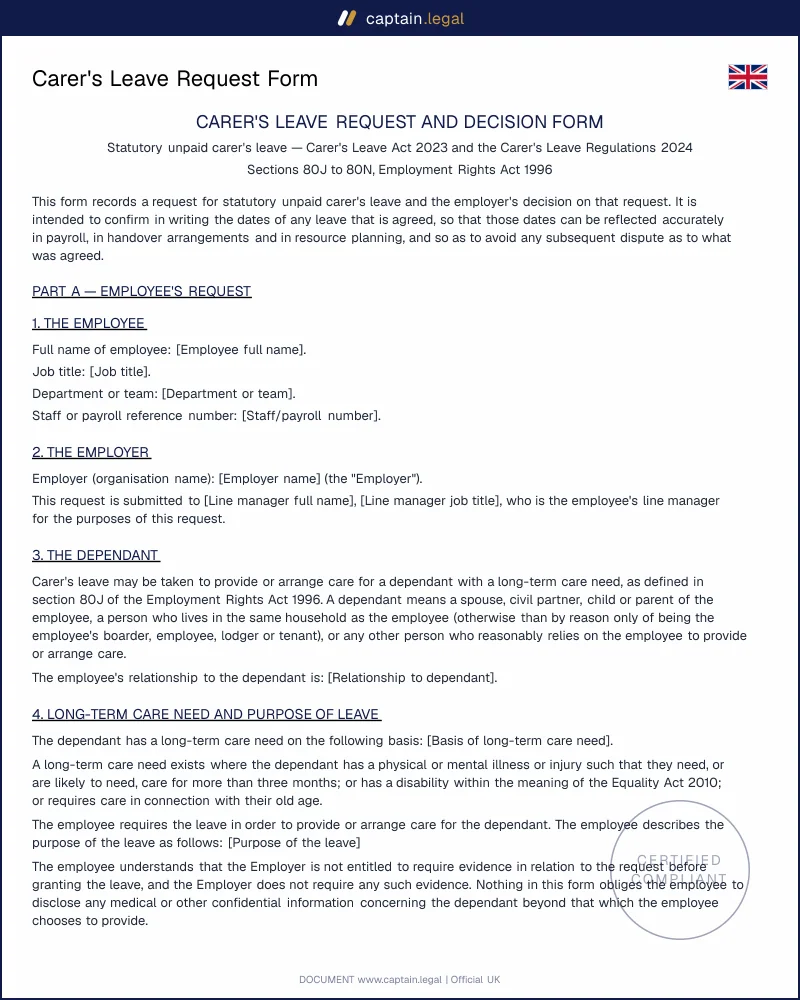
The entitlement is up to one week of unpaid leave in any rolling 12-month period. A "week" tracks the employee's normal working pattern, so a full-time employee on five days gets five days, while a part-timer gets their contracted days rounded up to the nearest half day. Leave can be taken in half-day or full-day blocks, which is why the form prompts for increments rather than assuming a continuous stretch. The dependant must be someone the employee reasonably expects to provide or arrange care for: a spouse, partner, child, parent, anyone living in the same household other than a lodger or tenant, or any person who relies on them for care. The long-term care need test is met where the person has an illness or injury expected to last at least three months, has a disability under the Equality Act 2010, or needs care connected with old age.
Notice is the part that trips up both sides. The employee must give notice of at least twice the number of days requested, or three days, whichever is greater, though the employer may waive this. The employer can postpone, but cannot outright refuse, and a postponement must allow the leave within a month of the original dates, with written reasons given within seven days. The official summary of the entitlement is set out in the GOV.UK guide to statutory carer's leave for employers and employees. The Act also protects against detriment and dismissal linked to taking or seeking the leave, which is exactly the protection a dated, properly recorded form helps you evidence.