Create my document
Login

Choose country

United KingdomUnited KingdomChoose country
Real Estate

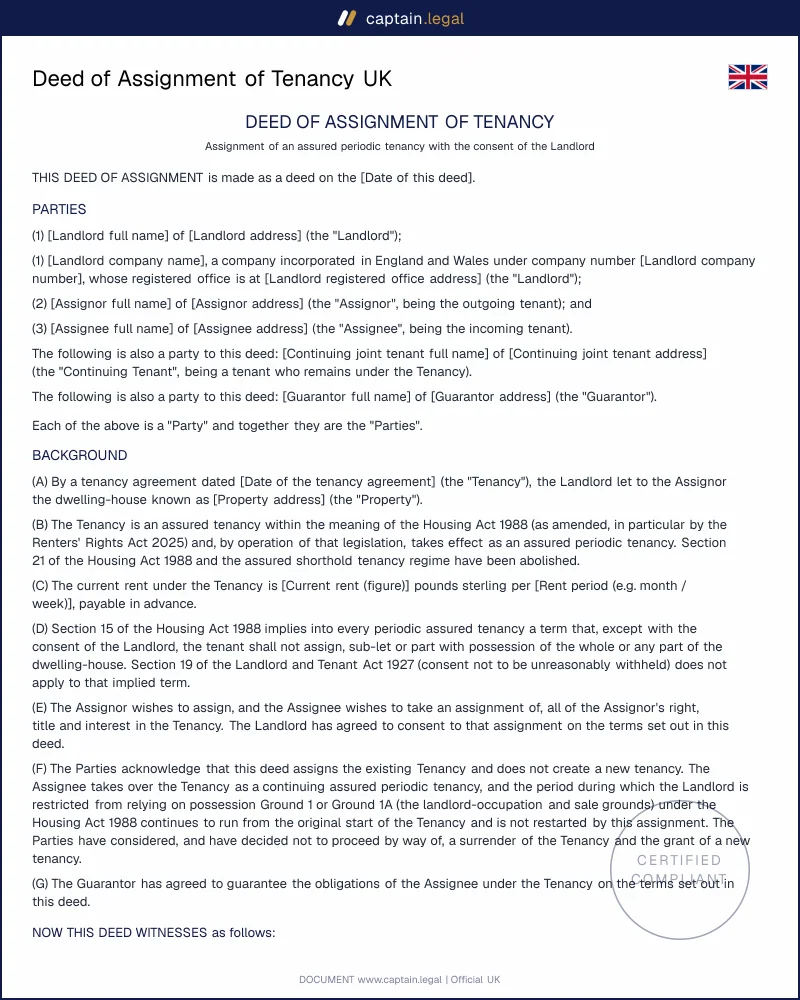
Deed of Assignment of Tenancy | Section 15 HA 1988

Assign an assured tenancy under s.15 Housing Act 1988 and s.52 LPA 1925. Records landlord consent and tenant release post Renters' Rights Act. Word, PDF.
4.6/519 reviews50 000+ downloadsInstant download
Share

A deed of assignment of tenancy transfers a tenant's interest in a rented home from one person to another, with the landlord's consent, while the tenancy itself continues unbroken. It is the document you reach for when an outgoing tenant wants to leave a shared let, a couple separates and one partner stays, or a joint tenant moves on and a replacement steps into their shoes. Since the Renters' Rights Act 2025 reshaped the private rented sector, almost every private let in England is now an assured periodic tenancy, and assignment remains one of the few clean ways to change who holds that tenancy without ending it and starting again. Our editable Word and PDF template records the transfer, the landlord's consent and the release of the outgoing tenant in a single instrument.

Compliant

2026 Legislation

50,000+ clients

trust us

Affordable

From $4.90 / doc

Secure payment

Instant download

Deed of Assignment of Tenancy | Section 15 HA 1988

Secure payment · No subscription

Fill in the template

What is a deed of assignment of tenancy?

A deed of assignment of tenancy is the formal transfer of an existing tenant's legal interest under a tenancy agreement to a new tenant, leaving the tenancy on foot rather than terminating it. The person leaving is the assignor; the person taking over is the assignee. Everything that was part of the original tenancy passes across: the rent level, the term, the repairing obligations, the deposit arrangements and any conditions the landlord imposed at the outset.

People confuse assignment with two neighbours, and the difference matters. Assignment is not subletting. A sublet creates a fresh, separate tenancy underneath the existing one, so the original tenant stays liable to the landlord and becomes a landlord themselves to the subtenant. Assignment hands the whole interest over and, where the outgoing tenant is properly released, ends their exposure. Assignment is also not surrender and regrant, where the old tenancy is extinguished and a brand-new one created, which can reset deposit protection deadlines and trigger fresh compliance duties. The assignment route keeps the original tenancy alive, which is usually what the parties actually want. Because a tenancy is an interest in land, a valid assignment of anything other than a very short tenancy must be made by deed, not by a simple signed agreement, which is exactly why this document takes the form it does and why our assured shorthold tenancy agreement template and this deed are designed to sit alongside each other.

2

When do you need this document?

The most common trigger is a change in a shared household. Three friends take a joint tenancy, one gets a job in another city, and the remaining two want a replacement to take over the departing tenant's share rather than start a fresh agreement that resets everyone's position. Assignment lets the incoming flatmate inherit the existing tenancy on the same terms, with the landlord's blessing recorded in writing.

Relationship breakdown is the next frequent scenario. When a couple holding a joint tenancy separates and one partner intends to stay, an assignment can transfer the leaving partner's interest to the one who remains, releasing the departing tenant from future rent liability. Without a properly drafted release, a tenant who has moved out can remain jointly and severally liable for rent they are not paying. That single point is the reason this deed earns its place.

Business and estate-planning situations make up much of the rest. A sole trader running a small operation from a let property may assign on a change of personnel, and personal arrangements between family members sometimes call for the same mechanism, which is where a clear paper trail like our private loan agreement template for family and friends shows its value when money has changed hands alongside the move. One edge case worth flagging: where the tenancy agreement contains an absolute bar on assignment, the landlord can refuse for any reason or none, and no deed will cure that. Another is the death of a tenant, which is succession, not assignment, and follows a separate statutory route entirely.

3

Key clauses included in our template

  • The identification of the parties names the landlord, the assignor and the assignee in full, together with the address of the property and the date and type of the original tenancy. Getting the tenancy description right matters more than it looks, because referring to an "assured shorthold tenancy" where the let is now an assured periodic tenancy can cast doubt on what is actually being transferred.
  • The operative transfer is the clause that does the legal work, assigning all the assignor's right, title and interest in the tenancy to the assignee from a stated date. It is drafted in conveyancing language precisely because section 52 Law of Property Act 1925 requires a deed to pass a legal interest in land.
  • The landlord's consent is recorded on the face of the deed, satisfying the requirement under section 15 Housing Act 1988 and removing any later argument that the assignment breached the tenancy. The landlord signs as a party so the consent cannot be challenged as informal or conditional.
  • The release of the outgoing tenant discharges the assignor from liabilities accruing after the assignment date, which is the protection a departing joint tenant most needs. The clause is careful to separate past liabilities, which may survive, from future ones, which the release extinguishes.
  • The assignee's covenants bind the new tenant to observe the tenancy terms going forward, including rent, repair and use, so the landlord steps into a relationship with the incoming tenant on the same footing as before.
  • The deposit and inventory acknowledgement confirms how the protected deposit is treated on assignment and references the agreed schedule of condition, a record our tenancy inventory and schedule of condition template is built to support at check-in and check-out.
4

Regional considerations

This deed is drafted for England, where the Renters' Rights Act 2025 reforms came into force on 1 May 2026 and where the Housing Act 1988 framework for assured tenancies applies. The assured periodic tenancy is now the standard private residential let, and any assignment should be described against that model rather than the pre-reform fixed-term AST. Landlords in England should also remember that the wider compliance regime travels with the tenancy on assignment: the How to Rent guide, gas safety records and the Energy Performance Certificate position do not reset, but the parties should confirm the incoming tenant is brought into the loop.

Wales operates a separate system entirely. The Renting Homes (Wales) Act 2016 replaced the assured shorthold tenancy with the "occupation contract" and the "contract-holder", and assignment of a Welsh occupation contract follows that Act's own rules and formalities rather than the Housing Act 1988. A deed written for England should not be used unamended for a Welsh property, and anyone letting across the border needs documents drawn to the right jurisdiction.

For lettings of a room in the landlord's own home, assignment is rarely the right tool, because a lodger under an excluded licence does not hold an assignable tenancy interest at all. That arrangement is governed by the licence itself, and our lodger agreement template for excluded occupiers explains why the route differs. Treating a licence as if it were an assignable tenancy is a common and costly mistake.

5

How to fill out this deed of assignment of tenancy

You start by identifying the property and the original tenancy, selecting whether it is an assured periodic tenancy or a surviving assured shorthold tenancy, so the deed describes the correct interest. From there you enter the names and addresses of the landlord, the outgoing tenant and the incoming tenant, and the date the assignment is to take effect. The template then prompts you to confirm the landlord's consent, which is recorded in the deed itself rather than in a separate letter, and to set out whether the outgoing tenant is being fully released from future liabilities.

You then deal with the practical handovers: the deposit, the inventory and any rent apportionment on the assignment date. The form guides you through the execution block, because a deed must be signed by each party in the presence of a witness who also signs, and delivered. Once completed you download the finished deed in Word and PDF, ready to print, sign and witness. If you are also putting fresh terms in place for the incoming tenant, the wider catalogue at our full UK document library covers the supporting paperwork.

6

Common mistakes to avoid

The first and most damaging error is treating an assignment as an informal swap. Tenants sometimes agree between themselves that one will "take over" the tenancy, the new occupier starts paying rent, and nobody executes a deed. The law does not recognise that as a valid assignment of a legal interest, and worse, if the landlord knowingly accepts rent from the newcomer, a court may infer that the old tenancy was surrendered and a new one granted, which resets deposit deadlines and compliance duties the landlord may not have met. The second mistake is omitting or fudging the landlord's consent. Because section 15 Housing Act 1988 makes consent the gateway, an assignment in breach of an absolute or qualified covenant can amount to a breach of the tenancy and expose the tenant to possession proceedings.

The third recurring error is forgetting the release. A departing joint tenant who signs over their interest but is never expressly released can stay liable for rent that accrues after they have gone, sometimes for years. The fourth is using pre-reform "fixed-term AST" wording in 2026, which no longer reflects how most tenancies are classified and can muddy what is being transferred. The fifth is botched execution: a deed that is signed but not witnessed, or not delivered, may fail the formalities under section 52 Law of Property Act 1925. Get the description, the consent, the release and the execution right, and the deed does its job.

Key takeaways

LEGAL FORM

An assignment must be done by deed

A tenancy is an interest in land, so an assignment needs the formalities of a deed under section 52(1) of the Law of Property Act 1925. That means proper execution, signature, witnessing and delivery. If you try to swap tenants by an informal agreement, it can be void at law, leaving the outgoing tenant still liable and the incoming occupier without a recognised legal interest.

CONSENT

Landlord consent is usually required

Section 15 of the Housing Act 1988 means you normally need the landlord’s consent to assign an assured tenancy, unless the tenancy agreement clearly says otherwise. In practice, a tenant cannot simply hand over the keys and the contract to a replacement. The landlord is entitled to know who will occupy the property and to assess the incoming tenant much like a new applicant.

PRACTICAL EFFECT

The tenancy continues; the tenant changes

Assignment transfers the whole tenant’s interest to the assignee while keeping the tenancy on foot. The rent, repairing obligations, deposit arrangements and any original conditions all carry across unchanged, unlike surrender and regrant which ends the old tenancy and creates a new one. After the Renters’ Rights Act 2025, with most lets now assured periodic tenancies from 1 May 2026, assignment remains a clean route to change names without restarting the tenancy.

Frequently Asked Questions

Yes, when it is completed accurately and executed correctly it is a legally binding deed. The key is form: because a tenancy is an interest in land, section 52 Law of Property Act 1925 requires the assignment to be made by deed, which means each party must sign in the presence of a witness who also signs, and the deed must be delivered. The template also records the landlord's consent on its face, satisfying section 15 Housing Act 1988, so the assignment is not open to challenge as a breach of the tenancy. Provided the parties are correctly named, the tenancy is accurately described and the execution block is followed, the deed transfers the interest at law and binds everyone who signs it.

In almost all cases, yes. The standard position under section 15 Housing Act 1988 is that consent is required, and most tenancy agreements either repeat this or impose an outright prohibition on assignment. Where the agreement contains a qualified covenant, the landlord cannot refuse unreasonably, but where it contains an absolute bar, the landlord can refuse for any reason. Attempting to assign without the consent you need is not just ineffective, it can be a breach of the tenancy that triggers possession action. Recording the consent inside the deed, as this template does, closes off later disputes about whether permission was actually given.

The deed is provided in editable Word and ready-to-print PDF formats. The Word version lets you adjust names, dates, the property description and the consent and release wording before signing, while the PDF is the clean copy you print for execution. A deed cannot usually be completed by electronic signature without careful additional steps, so most parties print the document, sign each copy by hand in front of a witness, and keep an original each. Having both formats means you can edit freely and still end up with a tidy document that a court or deposit scheme would accept as evidence of the transfer.

The assignment takes effect on the date stated in the deed, once all parties have signed, the signatures are witnessed and the deed is delivered. There is no statutory waiting period as there is with a possession notice, so an assignment can complete the same day if everyone is available to sign. The practical timeline is usually set by how quickly the landlord vets the incoming tenant and gives consent. Once that is in place, the deed itself is straightforward. Confirm the deposit treatment and the rent apportionment for the changeover date so there is no gap or overlap in who is responsible for what.

Because assignment continues the existing tenancy rather than ending it, the protected deposit and its prescribed information generally carry over rather than being repaid and re-taken. That said, the parties should confirm the position expressly: the outgoing tenant may want their contribution returned by the incoming tenant directly, while the protection scheme registration stays in place against the continuing tenancy. The deed includes a deposit acknowledgement clause for exactly this reason. Getting it wrong, by repaying and re-protecting, can accidentally look like a surrender and regrant, which is the outcome a clean assignment is designed to avoid.

Not on their own. A joint tenancy is a single interest held together, so a change to who holds it usually requires all the existing joint tenants and the landlord to be parties to the deed. The departing tenant assigns their interest, the remaining tenants and the incoming tenant agree to the new arrangement, and the landlord consents. Trying to deal with one tenant's "share" in isolation misunderstands how joint tenancies work and can leave the transfer ineffective. The template is structured to bring all the necessary parties into the document so the assignment holds together.

No, and the distinction is important. Subletting creates a new tenancy carved out underneath the existing one, so the original tenant remains liable to the landlord and becomes a landlord to the subtenant. Assignment transfers the original interest itself, so the incoming tenant deals directly with the landlord and, where properly released, the outgoing tenant steps away. They carry different consents, different documents and different consequences. If what you want is for someone to replace you entirely on the tenancy, assignment is the route; if you want to keep your tenancy and let someone occupy part of it, that is a sublet and a different agreement.

4.6/5

19 verified reviews · 50 000+ downloads

Deed of Assignment of Tenancy | Section 15 HA 1988
  • Immediate access to the document
  • PDF + Word download
  • Compliant with 2026 legislation
  • Reviewed by lawyers
Fill in the template
Secure payment · No subscription
Updated on June 23, 2026

You might also like

Tenant Referencing & Right to Rent Pack UK
Form 4A Section 13 Notice UK