A loan agreement between individuals is the written record that turns a private favour into an enforceable promise. It sets out who is lending, who is borrowing, how much is changing hands, on what terms the money will come back, and what happens if it does not. In the United Kingdom, this kind of agreement is the document of choice for family loans, loans between friends, partner-to-partner advances and informal director-style loans that sit outside regulated consumer credit. Used properly, it protects the lender's capital, gives the borrower a clear repayment plan, and keeps a difficult conversation from becoming a courtroom one. Our UK private loan agreement template is drafted to English law and ready for use across England, Wales, Scotland and Northern Ireland with minor adjustments.
Compliant
2026 Legislation
50,000+ clients
trust us
Affordable
From $4.90 / doc
Secure payment
Instant download
UK Private Loan Agreement Template — Family & Friends
Secure payment
What is a loan agreement between individuals?
A loan agreement between individuals is a bilateral contract under which one private person (the lender) advances a defined sum of money to another private person (the borrower), who undertakes to repay that sum, with or without interest, on agreed terms. In English law, the document is most commonly drafted as a simple contract signed by both parties, although it may also be executed as a deed under the Law of Property (Miscellaneous Provisions) Act 1989 where the lender wants a longer limitation window or where no consideration is exchanged beyond the loan itself.
The terminology matters. A loan agreement is the proper instrument when there is a structured repayment schedule, a defined term, and clear obligations on both sides. It should not be confused with a promissory note (sometimes called an IOU), which is a one-sided written promise by the borrower to pay, lighter on terms and often used for very small sums. Nor is it a gift letter, which records that no repayment is expected. A practitioner drafting these documents in private practice will almost always reach for the full agreement when the sum exceeds a few hundred pounds, when interest is charged, or when the repayment runs beyond a single instalment. The reason is straightforward: clarity removes the room for the kind of family argument that ends up in front of the County Court. For broader coverage of everyday agreements signed within households, see our UK personal legal document templates, which sit alongside this one in the same category.
Legal framework
In England and Wales, a loan between two private individuals is governed primarily by the general law of contract, supplemented by a thin layer of statute that practitioners need to keep in mind. The starting point is that a properly drafted, signed and dated written agreement creates binding obligations between the parties under the common law of contract, provided the four classical elements are present: offer, acceptance, consideration, and intention to create legal relations. The intention point is the one that catches families out. Where money passes between close relatives, the courts have repeatedly held that there is a presumption of advancement or a presumption against legal intent, most clearly articulated in cases such as Jones v Padavatton [1969] 1 WLR 328. A written agreement signed by both parties rebuts that presumption and converts the transaction into something the court will enforce.
The Consumer Credit Act 1974 sits in the background but, in most genuinely private arrangements, does not bite. The Act regulates lending in the course of a business, which means a one-off loan between two individuals who are not in the business of lending falls outside the licensing and disclosure regime administered by the Financial Conduct Authority. Where a private lender starts making loans regularly, or charges commercial rates of interest as part of a pattern, the analysis changes and FCA authorisation may become relevant. You can read the consolidated text of the Act on the official UK government legislation portal for the Consumer Credit Act 1974.
Two further statutes shape the document. The Limitation Act 1980 sets a six-year window from the date the cause of action accrues for actions on a simple contract (s.5), extended to twelve years where the agreement is executed as a deed (s.8). The Unfair Contract Terms Act 1977 and the implied duty of good faith in consumer-facing arrangements may apply where one party is in a markedly weaker position. Across Scotland, Scots law of obligations governs equivalent transactions with broadly similar substantive effect but a different procedural route through the sheriff court system.
When do you need this document?
The most common scenario is the family loan to support a property purchase, typically a parent advancing a deposit to a son or daughter buying a first home. Mortgage lenders will almost always ask whether the contribution is a gift or a loan, and they want documentary evidence either way. A signed agreement, accompanied by a separate gift letter where part of the sum is genuinely gifted, lets the solicitor and the lender satisfy their anti-money laundering obligations under the Money Laundering Regulations 2017 without delaying completion. Skipping this step regularly costs buyers two to three weeks at the worst possible moment in the transaction.
The second pattern is the loan between friends or partners to launch a business, made before incorporation or before a formal investor agreement is in place. Here the document does double duty: it protects the lender if the business fails, and it gives the borrower a paper trail when the company is later set up and the loan needs to be recharacterised as a director's loan or converted into equity. Our UK business legal documents library covers the corporate side of that conversation once the company exists.
Three further situations come up often. Loans between unmarried partners to fund renovations or a joint vehicle, where the relationship may not survive the repayment period, need a written record to avoid a later constructive trust dispute. Loans between siblings to cover an inheritance buy-out, where one party takes the family home and pays the others over time, deserve the protection of a deed. And employee loans advanced by an employer outside the payroll system, while strictly outside this template's scope, share the same drafting concerns and benefit from the same discipline. One edge case worth flagging: where the lender is non-resident or the borrower is paying interest, HMRC reporting and withholding tax obligations may apply under the Income Tax Act 2007.
Key clauses included in our template
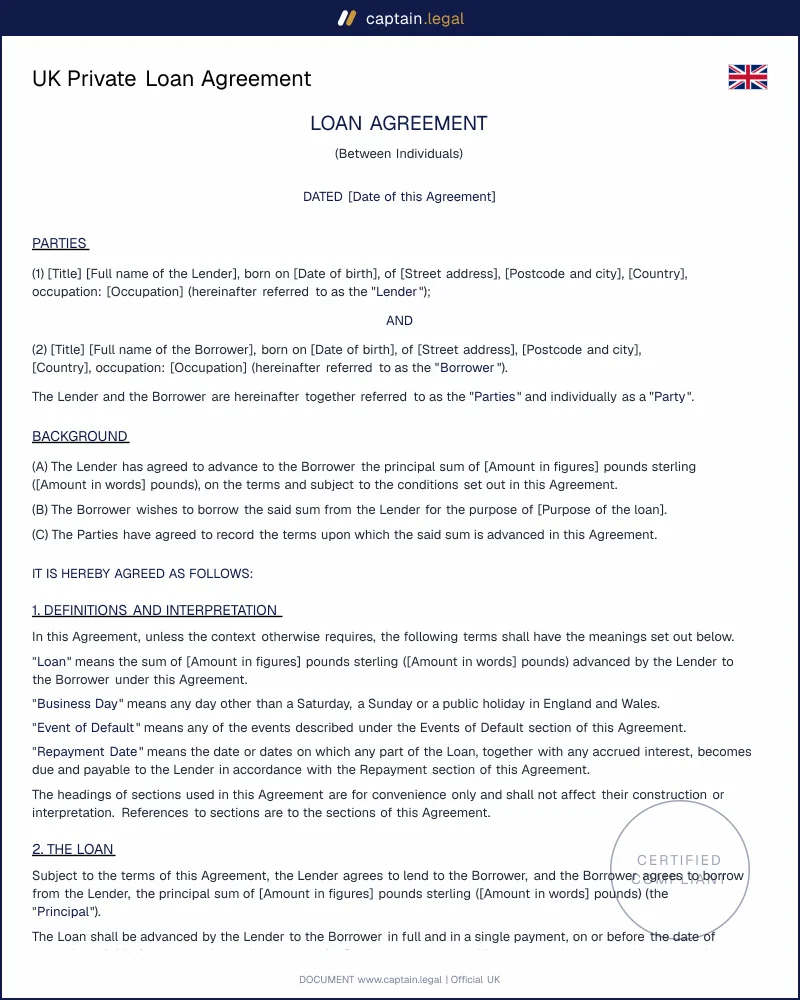
- The identification of the parties must record the full legal name, current address and date of birth of both lender and borrower. Initials, nicknames or "mum and dad" appear in real disputes more often than they should ; a court asked to enforce will want to see the same names that appear on identity documents and on the corresponding bank transfer.
- The principal sum and method of advance clause states the exact amount of the loan in pounds sterling, the date of advance, and the bank account into which it is paid. This single paragraph is what defends the lender against a later claim that the money was a gift rather than a loan.
- The interest clause is optional but should always be addressed expressly. If no interest is charged, the agreement should say so, since silence creates room for argument and adverse HMRC consequences for the lender. If interest is charged, the rate, compounding basis (simple or compound) and any default rate applicable on missed payments need to be set out. Rates above market levels can be challenged as penalty clauses.
- The repayment schedule specifies the instalment amount, the frequency (monthly is standard), the first payment date and the final payment date. A short repayment table appended to the agreement is good practice because it removes any later dispute about how much is owed at any given point.
- The early repayment and acceleration clauses give the borrower the right to repay early without penalty (or with a defined one) and give the lender the right to call the full balance due if the borrower misses a stated number of consecutive payments or breaches a material term.
- The events of default and remedies clause lists the specific triggers (non-payment, bankruptcy, death, breach of warranty) and the lender's response options, including the right to commence proceedings in the County Court under the Civil Procedure Rules to recover the outstanding balance plus statutory interest under s.69 of the County Courts Act 1984.
- The governing law and jurisdiction clause confirms whether the agreement is governed by the laws of England and Wales, Scotland, or Northern Ireland, and identifies the courts with exclusive jurisdiction over any dispute. For a private UK loan between residents of the same jurisdiction, this is straightforward but should never be left implicit.
Regional considerations
England and Wales account for the bulk of private loan agreements drafted in the UK and operate under the framework described above. Disputes are heard in the County Court for sums up to £100,000 and in the High Court above that threshold, with the small claims track handling matters below £10,000 and limiting recoverable legal costs. A practitioner drafting for clients in this jurisdiction will typically include an English law and exclusive jurisdiction of the English courts clause and execute the document as a simple contract unless a longer limitation window is needed.
Scotland applies the Scots law of obligations rather than English contract law, although the substantive effect on a private loan agreement is broadly similar. The key practical differences are procedural. Actions to recover under £5,000 go to the simple procedure in the sheriff court, sums between £5,000 and £100,000 proceed under ordinary cause, and prescription periods are set by the Prescription and Limitation (Scotland) Act 1973, which generally extinguishes obligations after five years from the date they became enforceable. Scottish parties should ensure the governing law clause names Scots law explicitly, since a default to English law will force them through an inconvenient jurisdictional argument before the substantive dispute can be heard.
Northern Ireland has its own court system, statute book and Limitation (Northern Ireland) Order 1989, but applies a contract law framework that mirrors England and Wales for most practical purposes relevant to a private loan. Local solicitors will adjust the jurisdiction clause to refer to the courts of Northern Ireland and to the Northern Ireland Civil Service enforcement procedures where a judgment needs to be executed. Cross-border loans within the UK (for example, a London-based lender advancing money to a Belfast-based borrower) need explicit thought about which jurisdiction's courts will hear any dispute and where any enforcement will take place.
How to fill out this loan agreement between individuals
You begin by selecting United Kingdom and choosing the specific jurisdiction within it: England and Wales, Scotland, or Northern Ireland. The template adjusts the governing law clause, the court names and the prescription or limitation references automatically, which removes the most common source of error in DIY drafting. From there, you enter the identification details of the lender and the borrower, taking care to use the names exactly as they appear on bank records and identification documents, since these are the names that will appear on any subsequent court process.
The next stage covers the financial terms. You set the principal amount in pounds sterling, choose whether interest applies, and, if it does, set the annual rate and the compounding basis. The form then asks you to define the repayment schedule, either as a single balloon payment on a defined date or as a series of equal instalments over a defined number of months. A live repayment table updates as you make changes, which lets you see at a glance how a higher rate or a longer term affects the total amount repayable.
The final stage handles signatures, witnessing and execution format. If you want to execute the document as a deed for the longer twelve-year limitation period, the form generates the appropriate testimonium and attestation clauses and prompts you to arrange independent witnesses. Once you confirm the choices, the agreement is produced in both Word and PDF, ready to sign and store. A copy is also kept in your account dashboard for future reference. Full library of available templates is searchable from our UK legal documents catalogue.
Common mistakes to avoid
The single most damaging error is the handshake loan with no written record, particularly within families. Parents who advance £30,000 to a child for a flat deposit and never paper the transaction discover years later, often during a divorce or a probate dispute, that there is no enforceable document and no clear evidence whether the money was a gift, a loan, or a part-payment for something else. The cost of drafting the agreement is trivial against the cost of the litigation that follows. The second mistake is the silent interest clause: parties who do not address interest at all expose themselves to an HMRC argument that the lender has made a deemed disposal for tax purposes, or to a borrower's later claim that the loan was interest-free when the lender has always assumed otherwise.
A third recurring error is inconsistent dating and signature pages, where the body of the document references a date that does not match the signatures, or where one party has signed but the other never returned a counterpart. English contract law requires both signatures to bring the agreement into force, and a single-sided execution is no agreement at all. The fourth mistake is failure to record the bank transfer evidence alongside the agreement: keeping the BACS reference, the cleared payment confirmation and the matching entry on the loan agreement creates an evidentiary chain that defeats almost any later challenge. The fifth and final mistake, particularly common in loans linked to property purchases, is failing to coordinate with the mortgage lender or the conveyancing solicitor, which can trigger anti-money-laundering escalations and delay completion by weeks. Coordination with employment-related advances is similarly important, and our UK employment law templates cover the parallel ground for staff loans.
Frequently Asked Questions
20 verified reviews · 50 000+ downloads
- Immediate access to the document
- PDF + Word download
- Compliant with 2026 legislation
- Reviewed by lawyers
You might also like