A statutory declaration is a formal written statement of fact that you sign in front of a solicitor, commissioner for oaths or notary public, who then countersigns it. It carries the same weight as a sworn affidavit but is used outside court proceedings: confirming your identity to a bank, explaining a name discrepancy to HMRC, supporting a passport application, or vouching for any factual matter that a third party will not accept on your unsupported word. The instrument is governed by the Statutory Declarations Act 1835 and remains, after nearly two centuries, the standard route by which an individual in England, Wales, Scotland and Northern Ireland gives a fact the imprimatur of a sworn oath without the expense of a court hearing.
This template is drafted for the general statutory declaration, meaning a free-form declaration whose subject matter is not pre-fixed by statute (unlike the s.38 Companies Act 2006 declaration of compliance, or the Landlord and Tenant Act 1954 contracting-out declaration, both of which require their own bespoke wording). Use it whenever a UK institution or authority asks you to swear or solemnly affirm a fact.
Compliant
2026 Legislation
50,000+ clients
trust us
Affordable
From $4.90 / doc
Secure payment
Instant download
Statutory Declaration Form UK — Sworn-Ready Template in Minutes
Secure payment
What is a statutory declaration?
A statutory declaration is a written statement that the declarant affirms to be true, made before an authorised officer under the Statutory Declarations Act 1835. It substitutes the religious oath that was previously required for non-judicial matters, and it is the civilian counterpart to the affidavit used in litigation. The declarant signs in the presence of the officer, who then signs and stamps the document; from that moment, the contents acquire evidential weight that the courts and public bodies treat almost identically to sworn testimony.
The instrument is often confused with two close cousins. A witness statement is the procedural device used in civil and tribunal proceedings under Civil Procedure Rules Part 32, and it ends with a statement of truth rather than a solemn declaration before an authorised person. An affidavit, by contrast, is sworn on oath before a court officer and is now reserved by CPR 32.15 to a narrow set of applications (contempt, freezing orders, certain insolvency matters). The statutory declaration sits between the two: more formal than a witness statement, less ceremonial than an affidavit, and admissible where neither is required but where a bare letter would not be accepted. Penalties for falsehood are severe: a person who wilfully makes a false statement in a statutory declaration commits an offence under section 5 of the Perjury Act 1911, punishable by up to two years' imprisonment, an unlimited fine, or both.
Legal framework
The foundational statute is the Statutory Declarations Act 1835, an Act of William IV that abolished a long list of unnecessary oaths and substituted a single statutory form of declaration. The text remains in force across the United Kingdom and can still be consulted in its revised official version on the UK legislation register, which incorporates all subsequent amendments by the editorial team at The National Archives. Section 18 prescribes the exact opening and closing wording that every declaration must adopt: "I, A.B., do solemnly and sincerely declare that … and I make this solemn declaration conscientiously believing the same to be true, and by virtue of the provisions of the Statutory Declarations Act 1835." Omitting or paraphrasing this jurat is the single most common reason for a declaration being rejected by a bank, the General Register Office, or HM Passport Office, and it cannot be cured retrospectively without re-executing the document.
The list of officers competent to administer a statutory declaration is set by a patchwork of statutes rather than a single provision. In England and Wales the Commissioners for Oaths Act 1889 and section 81 of the Solicitors Act 1974 authorise every practising solicitor holding a practising certificate to act as commissioner for oaths, with the limitation in section 1(3) of the Commissioners for Oaths Act 1889 that a solicitor may not take a declaration in a matter in which they or their firm are acting. A notary public, a justice of the peace and certain authorised court officers also qualify. In Scotland the equivalent role falls to notaries public and justices of the peace under the Requirements of Writing (Scotland) Act 1995. The fee is regulated: under the Commissioners for Oaths (Fees) Order 1993 it is £5 for the declaration itself plus £2 per exhibit, although in practice many high-street solicitors charge a higher administrative fee.
Form is everything. The declaration must be signed in the physical presence of the authorised officer (remote signing by video link is not accepted for general statutory declarations, despite limited COVID-era concessions that have since lapsed), each exhibit must be initialled and identified in the jurat, and any alteration must be initialled by both declarant and officer before swearing.
When do you need this document?
The most frequent trigger is a request from a bank, building society or insurer that asks the customer to confirm a fact the institution cannot verify from its own records. Classic examples include declaring that two different spellings of a surname (Catherine Smith on a marriage certificate, Katherine Smith on a mortgage application) refer to the same person, confirming the loss of a share certificate or premium bond before a replacement is issued, or vouching for the source of funds in a large deposit. The institution will usually supply its own pro-forma; this template is for the residual case where it does not, or where the customer prefers to control the drafting.
A second cluster of uses arises around identity and civil status. Applicants to HM Passport Office sometimes need to declare a long period of usage of an unregistered name, a deed-poll change that pre-dates the modern register, or the destruction of an earlier passport. The General Register Office accepts statutory declarations to correct errors on a birth, marriage or death certificate where the original informant is unavailable. In the employment context, an employer occasionally requests a declaration to confirm the right to work, the continuity of service across a TUPE transfer, or the absence of a criminal conviction where DBS results are awaited.
The third recurring scenario is the debt and family sphere. A statutory declaration can record an informal loan between relatives in a form that a court will treat as evidence of acknowledgement under section 29 of the Limitation Act 1980, and it is regularly used to support applications for grants of administration where a will cannot be found. One edge case worth flagging: a declaration cannot be used in lieu of a will, and it has no probate effect; an executor who tries to substitute one will see it rejected by the Probate Registry. For complementary debt-acknowledgement and IOU templates, the business catalogue offers purpose-built forms.
Key clauses included in our template
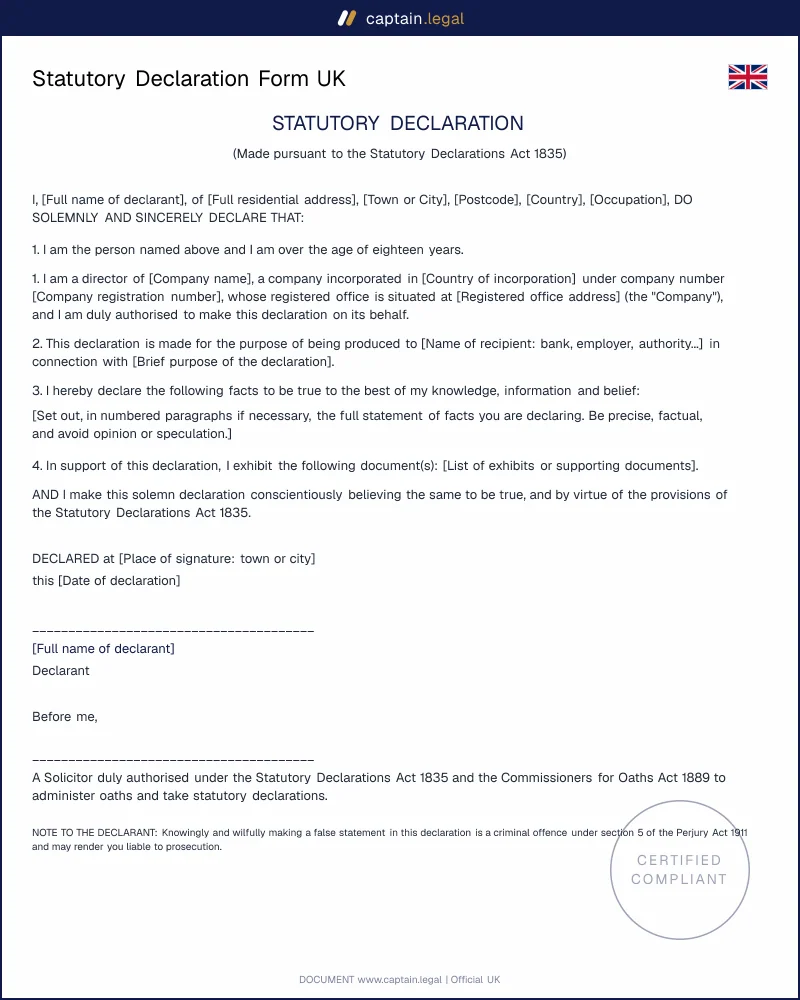
- The declarant block identifies you by full legal name, current residential address, occupation and (where relevant) date of birth, in the order required by section 18 of the 1835 Act. The block is drafted so that the declarant's identity is unambiguous on the face of the document, which matters because the officer's certificate later refers back to "the declarant named above" rather than repeating the details.
- The introductory recital opens with the statutory wording "I do solemnly and sincerely declare that…" and is followed by a numbered series of factual paragraphs. Each paragraph is restricted to one fact, drafted in the first person and in the past or present tense as appropriate, so that an authorised officer can read each numbered statement in isolation and the declarant can stand by each individually.
- The exhibit clause is used where supporting documents are referenced. Every exhibit is marked "This is the exhibit marked 'A' referred to in the statutory declaration of [name] sworn before me this [date]", initialled by the declarant and countersigned by the officer. Failure to mark exhibits in this precise form is, after the missing jurat, the second most common reason for rejection by banks and registries.
- The statutory jurat at the foot of the declaration reproduces verbatim the closing words mandated by the 1835 Act, including the reference to the Act by name. This wording is non-negotiable and cannot be shortened, even where the declarant feels it is archaic.
- The officer's certificate provides the space for the solicitor, notary or commissioner to record the date, the venue at which the declaration was sworn (full postal address, not merely the town), the officer's full name, capacity and signature, and the official stamp. The certificate is what converts an unsworn document into a statutory declaration.
- The schedule of exhibits is an optional appendix listing every document attached, in alphabetical order, with a one-line description of each. It is useful where five or more exhibits are appended, since it gives the reader a roadmap and helps the officer check completeness before swearing.
Regional considerations
England and Wales sees the bulk of statutory declarations in the United Kingdom and operates the most settled regime. Any solicitor holding a current practising certificate from the Solicitors Regulation Authority is a commissioner for oaths by virtue of section 81 of the Solicitors Act 1974, and Fellows of the Chartered Institute of Legal Executives have held equivalent powers since the Legal Services Act 2007. The statutory fee remains £5 plus £2 per exhibit under the Commissioners for Oaths (Fees) Order 1993, although many firms add a separate administrative charge. A solicitor who has acted, or whose firm has acted, for any party to the matter is barred from administering the declaration by section 1(3) of the Commissioners for Oaths Act 1889, so always check the conflict position before booking the appointment.
Scotland treats the instrument under a partially different framework. The Statutory Declarations Act 1835 extends to Scotland, but the procedural underpinnings sit within the Requirements of Writing (Scotland) Act 1995, and the authorised officers are notaries public, justices of the peace and certain court officials. A Scottish solicitor is not automatically a commissioner for oaths in the English sense; the relevant authority flows from their enrolment as a notary public with the Law Society of Scotland. The wording of the jurat remains identical, and a declaration sworn in Edinburgh is fully effective in London and Belfast.
Northern Ireland broadly mirrors the English regime, with solicitors enrolled with the Law Society of Northern Ireland acting as commissioners for oaths under the Commissioners for Oaths Act (Northern Ireland) 1979. A specific point of practice: declarations intended for use in the Republic of Ireland require an additional apostille under the Hague Convention, obtained from the Foreign, Commonwealth and Development Office in Milton Keynes. Allow at least ten working days for postal apostille and longer for premium counter service.
Use overseas: a statutory declaration sworn in the United Kingdom but intended for use abroad will almost always require legalisation. The destination country dictates whether a simple apostille suffices (Hague signatories) or full consular legalisation is required (non-Hague jurisdictions such as the United Arab Emirates). The choice of officer matters here too: many overseas authorities will only accept a declaration sworn before a notary public, not a commissioner for oaths, so check the destination's requirements before the appointment.
How to fill out this statutory declaration
You begin by selecting the jurisdiction in which the declaration will be sworn, since the wording of the officer's certificate and the schedule of competent officers adjust automatically to the law of England and Wales, Scotland, or Northern Ireland. The form then asks for your full legal name as it appears on your passport or birth certificate, your current residential address with postcode, and your occupation; these details populate both the declarant block and the recital. You are next prompted to state the purpose of the declaration in plain language, which becomes the opening paragraph and signals to the reader why the document exists.
The substantive section is presented as a numbered list, and the interface forces a single fact per paragraph to keep the structure faithful to the statutory form. Each paragraph can cross-reference an exhibit, and the form automatically generates the matching exhibit cover sheet for each attachment. Once the factual narrative is complete, the form previews the document with the Statutory Declarations Act 1835 jurat already inserted in the wording required by section 18, leaving only the date, venue and officer's signature blanks to be completed at the swearing. The final step prompts you to choose between Word and PDF output: Word is preferred where you anticipate last-minute factual amendments before the appointment, PDF where the text is settled and you only need a clean printable copy. The full UK catalogue of editable legal templates covers the surrounding documents you may need alongside the declaration.
Common mistakes to avoid
The first and most catastrophic error is treating the statutory declaration as something you can sign at home and post to the recipient. The 1835 Act requires physical attendance before an authorised officer, and a declaration that bears only the declarant's signature is not a statutory declaration at all: it is a private letter. Banks and registries spot this immediately and return the document, often without a refund of the fee already charged. The second error is omitting the closing jurat, or paraphrasing it as "I declare the above to be true"; the statute requires the precise wording reproduced in our template, and a digest version is fatally insufficient.
A third pitfall is mishandling exhibits. Each attached document must be marked with an exhibit number, identified in the body of the declaration, and initialled by both declarant and officer at the moment of swearing. Attaching a stack of unmarked photocopies after the appointment defeats the whole exercise and forces a fresh declaration. A fourth common slip is appointing a solicitor who has acted for any party connected to the underlying matter: under section 1(3) of the Commissioners for Oaths Act 1889 the declaration is void on its face, and the reviewing institution will catch the firm name on the letterhead. A final, subtler mistake is signing on a date that does not match the officer's certificate; courts and registries treat a date discrepancy as evidence that the swearing was not contemporaneous, which the Perjury Act 1911 takes seriously. For declarations connected to a property or tenancy matter, an additional layer of caution applies, since Land Registry forms have their own bespoke wording that overrides the general 1835 template.
Frequently Asked Questions
34 verified reviews · 50 000+ downloads
- Immediate access to the document
- PDF + Word download
- Compliant with 2026 legislation
- Reviewed by lawyers
You might also like