A Lasting Power of Attorney for Health and Welfare lets you appoint someone you trust to make decisions about your medical treatment, daily care and place of residence at the moment you can no longer make those decisions yourself. It is a statutory instrument under the Mental Capacity Act 2005, registered with the Office of the Public Guardian before it can ever be used, and it takes effect only once you have lost mental capacity. The donor is the adult granting the authority ; the attorney is the trusted person, or several people, who will speak in your name to clinicians, care home managers and social workers. Drafted properly, it spares your family the cost and delay of a Court of Protection deputyship application during one of the hardest moments of their lives.
Compliant
2026 Legislation
50,000+ clients
trust us
Affordable
From $4.90 / doc
Secure payment
Instant download
Health and Welfare LPA UK | Lasting Power of Attorney Form
Secure payment
What is a lasting power of attorney for health and welfare?
A Lasting Power of Attorney (LPA) is a formal legal instrument by which a competent adult, the donor, authorises one or more attorneys to act for them in the event of future incapacity. The Health and Welfare LPA is one of two statutory types created by sections 9 to 14 of the Mental Capacity Act 2005 ; the other, the Property and Financial Affairs LPA, deals with bank accounts, pensions and the family home. The two are entirely separate instruments. Many people execute both on the same day, but a Health and Welfare LPA does not give the attorney any access to your money, and a Property and Financial Affairs LPA does not let the attorney consent to surgery.
Older readers sometimes confuse the LPA with the Enduring Power of Attorney (EPA) regime it replaced. EPAs were abolished for new instruments from 1 October 2007 and only ever covered property and finances ; pre-2007 EPAs remain valid for that limited purpose, but they cannot be used for healthcare decisions and cannot be retrofitted to cover welfare matters. Anyone wanting to plan ahead for medical and care decisions today must use the modern Health and Welfare LPA. The instrument is also distinct from an advance decision to refuse treatment (a living will), which records specific refusals in advance rather than appointing a substitute decision-maker. Our UK personal legal documents catalogue groups these forward-planning instruments side by side, since most clients end up needing more than one.
Legal framework
The governing statute is the Mental Capacity Act 2005, which entered into force on 1 October 2007 and applies to England and Wales (Scotland operates under its own Adults with Incapacity (Scotland) Act 2000, and Northern Ireland under the Mental Capacity Act (Northern Ireland) 2016). Section 9 of the Act defines what an LPA is and how it must be created ; section 10 governs the appointment of attorneys ; section 11 sets out the restrictions specific to health and welfare attorneys, including the rules on life-sustaining treatment ; Schedule 1 lays down the prescribed form and execution requirements. The full text of these provisions is consolidated on the legislature's official portal: see the Mental Capacity Act 2005 statutory provisions on lasting powers of attorney for the controlling wording.
The instrument has no legal effect until it is registered with the Office of the Public Guardian (OPG), the executive agency of the Ministry of Justice that holds the public register of LPAs. Registration is not a rubber stamp : the OPG checks that the prescribed form has been correctly completed, that the donor was over 18 and had capacity at the moment of signing, that an independent certificate provider has confirmed the donor understood the document and was free from undue pressure, and that any named persons to be notified have had their statutory four-week objection window. The current statutory fee structure includes a remission and exemption scheme for donors on a low income or in receipt of certain benefits.
A Health and Welfare LPA only comes into operation once the donor has lost mental capacity in relation to the specific decision in question, as assessed under the two-stage test in section 2 of the Act. Capacity is decision-specific and time-specific : a donor may lack capacity to consent to a major operation today but retain capacity to choose what to eat for dinner. The attorney must act in the donor's best interests as defined by section 4, and is bound by the five statutory principles in section 1, including the presumption of capacity and the obligation to favour the least restrictive option. Decisions about life-sustaining treatment require an additional, explicit option to be ticked on the prescribed form ; without that election, the attorney cannot consent to or refuse such treatment, and clinicians remain governed by the ordinary best-interests procedure.
When do you need this document?
The most common trigger is a diagnosis of a progressive condition such as Alzheimer's, vascular dementia, Parkinson's disease with cognitive involvement, motor neurone disease or early-onset multiple sclerosis. The donor still has capacity at the point of diagnosis, but the clinical trajectory makes it predictable that capacity will be lost within a few years. Executing the LPA early, while the donor's understanding is unimpeachable, protects the instrument against any later challenge based on the donor's mental state at the moment of signing. Cases where instruments are signed in the final weeks before a hospital admission are the ones most often disputed by relatives.
A second scenario is preventive planning by healthy adults, particularly those over fifty, those living alone, expatriates with British nationality, and same-sex partners whose status as next-of-kin can still be questioned in clinical practice despite the Civil Partnership Act 2004 and the Marriage (Same Sex Couples) Act 2013. A Health and Welfare LPA removes that ambiguity at the bedside. Adults with no spouse or children also use it heavily, since the Mental Capacity Act gives no formal precedence to siblings or friends in the absence of an instrument. A third scenario is adults with learning disabilities or fluctuating mental health conditions who currently have capacity to make the appointment and wish to nominate a parent, sibling or trusted advocate.
One edge case worth flagging: donors who hold sensitive positions, such as company directors or trustees of registered charities. The Health and Welfare LPA itself does not affect those roles, but our UK business legal documents library and our charity governance templates collection cover the financial and governance instruments those donors should review in parallel, because incapacity provisions in articles of association and trust deeds rarely align with the LPA timeline.
Key clauses included in our template
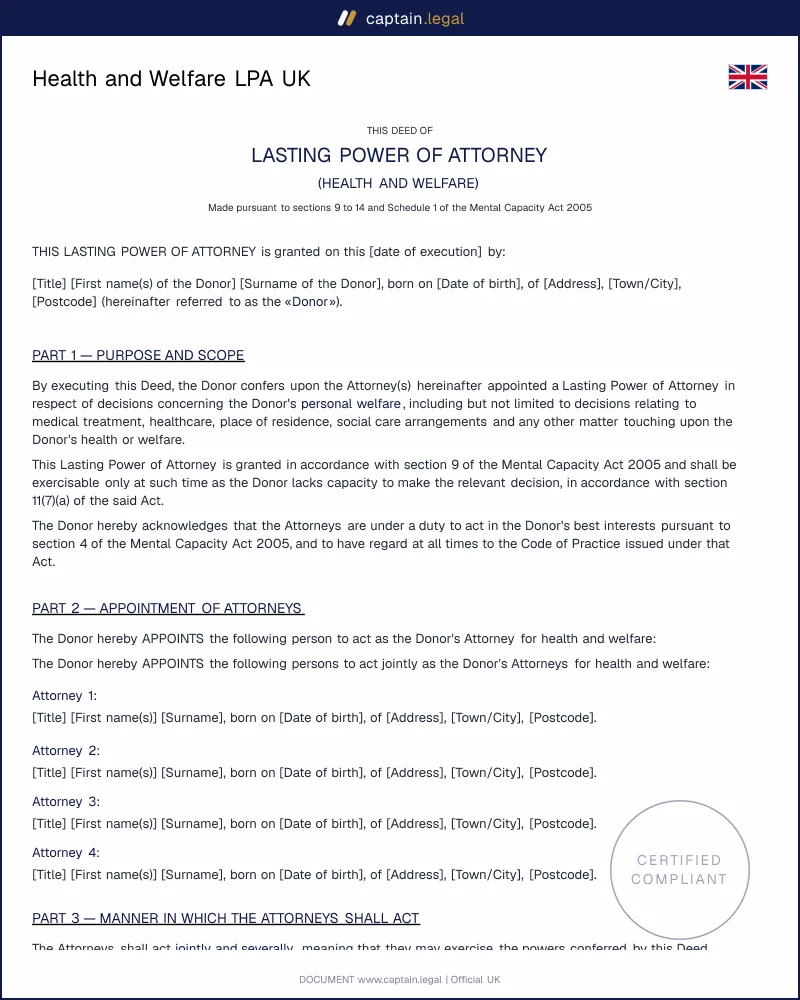
- The appointment of attorneys and the manner of acting is the first substantive clause. You can appoint a single attorney, or several to act jointly (every decision requires unanimous agreement), jointly and severally (any attorney can act alone), or jointly for some decisions and jointly and severally for others. Each option has consequences that the Mental Capacity Act takes seriously, and our template walks through them in plain English before you commit. Replacement attorneys can also be named to step in if a primary attorney dies, becomes bankrupt or loses capacity themselves.
- The scope of authority specifies the categories of welfare decision the attorneys may take. The default covers consent to medical treatment, choice of care setting (home, residential care, nursing home), arrangement of social care and day-to-day matters such as diet, dress and contact with named individuals. The instrument can narrow this scope by listing decisions the attorneys are not authorised to take, a feature useful for donors who want to retain personal autonomy over specific areas while ceding the rest.
- The life-sustaining treatment election is the single most consequential tick-box on the form. By selecting Option A, you authorise your attorneys to give or refuse consent to treatment that a clinician considers necessary to sustain life ; Option B withholds that authority and leaves life-sustaining decisions to the ordinary best-interests procedure. This box must be initialled correctly : an unticked or contradictorily ticked instrument has caused dozens of registration rejections at the OPG.
- The preferences and instructions section distinguishes between non-binding preferences (your wishes about, for example, religious observance, vegetarianism, contact with grandchildren) and legally binding instructions that the attorney must follow. Drafting an instruction that conflicts with the statutory best-interests test will be severed by the OPG on registration.
- The certificate provider statement and signature block carries the executed certificate from an independent person, either someone who has known the donor for at least two years, or a professional such as a GP, solicitor or registered social worker, confirming that the donor understood the instrument and signed without coercion. Without this statement, the LPA is void.
Regional considerations
England and Wales share a single statutory regime under the Mental Capacity Act 2005. The same prescribed forms (LP1H for Health and Welfare, LP1F for Property and Financial Affairs) are used in both jurisdictions, the same Office of the Public Guardian holds the register, and the same Court of Protection has supervisory jurisdiction. The only regional variation worth flagging is the practical one : in Wales, certain official correspondence and parts of the OPG portal are available bilingually under the Welsh Language (Wales) Measure 2011, and donors entitled to use Welsh in dealings with public authorities should not be deterred from doing so.
Scotland operates a wholly separate regime. The relevant instrument is a welfare power of attorney under Part 2 of the Adults with Incapacity (Scotland) Act 2000, registered with the Office of the Public Guardian (Scotland) in Falkirk, not the OPG for England and Wales. The drafting requirements differ, the prescribed forms differ, and an English Health and Welfare LPA is not automatically recognised north of the border. Scottish residents with property in England, or English residents who plan to retire to Scotland, often need parallel instruments.
Northern Ireland has, since the commencement of the Mental Capacity Act (Northern Ireland) 2016, its own incapacity statute, although certain provisions are being rolled out in phases. Pending full commencement, enduring powers of attorney under the Enduring Powers of Attorney (Northern Ireland) Order 1987 continue to play a role, and welfare decision-making remains heavily reliant on the Mental Health (Northern Ireland) Order 1986 and best-interests procedures. Cross-border families should plan for both regimes.
How to fill out this lasting power of attorney for health and welfare
You begin by identifying the donor and confirming that the donor is aged 18 or over and currently has capacity to execute the instrument. The form then asks for the attorneys, in order of preference, with full names, dates of birth and current addresses ; replacement attorneys are added in a separate panel. Our questionnaire prompts you at each step to consider whether the appointment should be joint, joint and several, or hybrid, and explains the practical consequences of each option before you commit. Once the attorney structure is set, the form addresses the scope of authority and any decisions you wish to exclude.
The life-sustaining treatment election is presented as a clearly framed binary choice rather than a buried tick-box, because that is the question most often misread on hand-completed paper forms. You then add any preferences and instructions, with examples drawn from registered LPAs to show what works and what the OPG has historically severed. The certificate provider section is generated dynamically depending on the type of certifier you choose. Finally, the instrument is paginated to match the OPG's prescribed layout, ready for wet-ink signing in the statutory order : donor first, then certificate provider, then each attorney. The completed pack includes the OPG registration form and a covering letter ; consult our UK legal document templates catalogue for any companion instruments you may want to sign on the same day.
Common mistakes to avoid
The single most frequent mistake is signing the pages in the wrong order. The Mental Capacity Act and the prescribed form require the donor to sign first, the certificate provider second, and only then each attorney. An instrument where an attorney has signed before the certificate provider will be rejected on registration, no matter how clearly the donor's intention is documented elsewhere. The second most frequent mistake is omitting the life-sustaining treatment election or initialling both options. Clinicians faced with a contradictory or unticked instrument default to the ordinary best-interests procedure, which is precisely the outcome the donor was usually trying to avoid.
A third recurring error is using the wrong certificate provider. A spouse, civil partner, child, attorney, or replacement attorney cannot certify the instrument, and neither can a business partner or paid care worker. The certifier must be a person who has known the donor for at least two years on a personal basis, or a relevant professional. Donors regularly ask a friendly GP who has only met them twice : the instrument is then refused. A fourth mistake is drafting binding instructions that are unlawful or impractical — for example, instructions that the attorney must refuse consent to any blood transfusion regardless of circumstances, when an advance decision to refuse treatment would be the proper vehicle. The OPG severs such clauses on registration, and the instrument is registered with the offending wording struck through, which is visually unsettling for the family that has to produce it at hospital reception. A final mistake is leaving the form on a shelf. An unregistered LPA has no legal effect ; the registration step is what gives the attorneys their authority.
Frequently Asked Questions
13 verified reviews · 50 000+ downloads
- Immediate access to the document
- PDF + Word download
- Compliant with 2026 legislation
- Reviewed by lawyers
You might also like