A debt acknowledgement letter is a written confirmation, signed by the debtor, that a specified sum of money is owed to a named creditor. In England and Wales it is commonly drafted as an IOU letter or promissory acknowledgement, and it serves two distinct purposes: recording the existence and quantum of the debt with sufficient precision to deter later denial, and producing a document capable of affecting the limitation clock under the Limitation Act 1980. The audience is broad. Private lenders who advanced money to a friend or relative, suppliers chasing an unpaid invoice, landlords pursuing arrears outside the tenancy agreement, and individuals settling sums after the breakdown of a personal arrangement all rely on the same instrument. A properly drafted acknowledgement is short, dated, and unambiguous.
Compliant
2026 Legislation
50,000+ clients
trust us
Affordable
From $4.90 / doc
Secure payment
Instant download
IOU Letter Template UK | Written Debt Acknowledgement (PDF)
Secure payment
What is a debt acknowledgement letter?
A debt acknowledgement letter, also known in everyday usage as an IOU letter or written acknowledgement of debt, is a unilateral statement by a debtor confirming that a defined sum is owed to a named creditor and, in most well-drafted versions, setting out how and when the debt will be repaid. It is not the same as a loan agreement. A loan agreement is bilateral, drafted at the moment funds change hands, and typically contains the lender's terms on interest, security and default. An acknowledgement is created later, often when the original arrangement was informal, oral, or poorly documented, and its function is evidential rather than constitutive. It does not create the debt ; it confirms a debt that already exists.
The distinction matters in practice. A solicitor preparing pre-action correspondence under the Practice Direction on Pre-Action Conduct will treat a signed acknowledgement very differently from an unsigned text message or a contested oral promise. The acknowledgement removes the most common defence raised in low-value debt claims, namely the denial that any sum was ever owed. It also fixes the quantum, which prevents the debtor from later arguing that part of the alleged debt was a gift, a loan to a third party, or a misremembered figure. For these reasons, the instrument is a staple of everyday personal legal paperwork in the UK, used wherever an informal arrangement needs to be put on a defensible footing without escalating to formal litigation.
Legal framework
The single most important provision is section 29(5) of the Limitation Act 1980, which deals with the fresh accrual of action on acknowledgment or part payment. For a simple contract debt the ordinary limitation period is six years from the date the cause of action accrued, usually the date payment fell due. Where the debtor acknowledges the claim in writing, the right of action is treated as having accrued on the date of the acknowledgement, not before. The clock is reset. The practical consequence is that a creditor sitting on a borderline statute-barred debt can, by obtaining a signed acknowledgement, recover a further six years of enforceability. Section 30(1) is the gatekeeping provision : to be effective for the purposes of section 29 of this Act, an acknowledgment must be in writing and signed by the person making it. An oral promise, a phone call, or an unsigned email from a third party does not qualify. The official text and editorial notes are set out in the Limitation Act 1980 section 29 on the National Archives legislation register.
Two further statutory layers should be checked before relying on a template. The Consumer Credit Act 1974, as amended in 2006 and now supervised by the Financial Conduct Authority, regulates consumer credit agreements and consumer hire agreements. A one-off informal loan between two private individuals, with no interest, no business of moneylending, and no carrying on of a regulated activity, sits outside the CCA's scope. By contrast, a debt arising from a regulated credit agreement, such as a personal loan or credit card balance, cannot be papered over by a private acknowledgement without engaging the protections in sections 61 to 65 and the Consumer Credit (Agreements) Regulations 2010. A debt acknowledgement is not a substitute for a properly executed regulated agreement and will not cure unenforceability under section 127. Civil enforcement, if matters proceed that far, runs through the Civil Procedure Rules, in particular the Pre-Action Protocol for Debt Claims applicable to claims brought by businesses against individuals. For business documents and supplier paperwork in the UK, the protocol's notice and information requirements should be observed before issuing a claim. Finally, where the underlying transaction is regulated, the Financial Services and Markets Act 2000 and the FCA's rules sit above the CCA and may apply.
When do you need this document?
The most frequent trigger is the informal loan to a friend, partner or relative that was never documented at the time of payment. Years pass, a relationship cools, and the lender wants something on paper before pursuing the matter. The acknowledgement formalises what was previously a handshake, sets out an agreed repayment plan, and creates a written record the lender can attach to a Letter Before Action. A close second is the unpaid invoice between two individuals or micro-businesses where the debtor accepts the sum but is unable to settle in full immediately. Rather than litigate, the parties record the balance and agree a schedule. The same logic applies to sums owed at the end of a cohabitation, a business partnership, or a joint household arrangement, where the parties want to separate cleanly with a documented obligation rather than a vague promise.
Two situations sit at the edge of standard use. The first is the statute-barred or near-barred debt. A creditor who suspects the six-year limitation period is close to expiry will sometimes seek an acknowledgement specifically to engage section 29(5). This must be done before limitation has run. Under section 29(7), a right of action once barred by this Act, shall not be revived by any subsequent acknowledgment or payment. An acknowledgement obtained a day late is worthless. The second edge case is the employment-related debt, such as a salary overpayment, a training cost recoverable on early departure, or an unreturned advance. These sit alongside obligations under the UK employment contracts and HR letters catalogue, and care is needed to ensure that any deduction or repayment terms comply with section 13 of the Employment Rights Act 1996 on unauthorised deductions from wages. A standalone acknowledgement is appropriate ; an attempt to set off through the payroll without consent is not.
Key clauses included in our template
The template is built around the requirements of section 30(1) and the practical needs of a creditor who may later have to enforce. Each clause is drafted with a specific evidential purpose in mind.
- The identification of the parties sets out the full legal name of the debtor and the creditor, current residential or registered address, and date of birth or company number where relevant. Vague references such as "my friend John" are replaced by sufficient particulars to satisfy a court that the signatory is the person liable. A signed acknowledgement that cannot be matched to a defendant is of limited value.
- The statement of the debt records the principal sum in figures and words, the date or dates on which the debt arose, and a brief description of the underlying transaction. The figure is stated without ambiguity. "Approximately £4,000" is unacceptable ; "the sum of £4,250 (four thousand two hundred and fifty pounds sterling)" is the standard form.
- The repayment schedule sets out the dates, amounts and method of each instalment, together with any final balloon payment. A schedule of monthly transfers of £250 on the 1st of each month, starting 1 March, until paid in full is preferable to a loose undertaking to repay "as soon as possible". Courts treat indeterminate timing with suspicion.
- The interest clause, if any, states the rate, whether simple or compound, and the date from which interest accrues. Many private acknowledgements between friends carry no interest and say so expressly. Where interest is charged, the parties should consider whether the underlying arrangement falls within the Consumer Credit Act 1974.
- The default and acceleration clause specifies what happens if an instalment is missed : a grace period, a notice of default, and the consequence that the entire outstanding balance becomes immediately payable. This converts the acknowledgement into a workable enforcement document.
- The signature block carries the debtor's signature, printed name, and date. A witness signature, while not required by section 30, is recommended where identity may later be disputed. The signature is what activates section 30(1) ; without it, the document is not an acknowledgement at law.
Regional considerations
The Limitation Act 1980 extends to England and Wales. Scotland operates under a different regime governed by the Prescription and Limitation (Scotland) Act 1973, where the equivalent prescriptive period for a simple contract debt is five years rather than six, and the rules on what constitutes a relevant acknowledgement differ in their detail. A creditor with a Scottish debtor should not assume that an English-style acknowledgement will produce the same limitation effect north of the border, and Scottish-qualified advice is recommended for sums of significance.
Northern Ireland has its own Limitation (Northern Ireland) Order 1989, broadly modelled on the 1980 Act but distinct. The six-year period for simple contract debts applies, and the acknowledgement provisions in articles 47 and 48 of the Order mirror sections 29 and 30 in substance. Practitioners draft Northern Irish acknowledgements with reference to the Order rather than the 1980 Act, and choice-of-law clauses should be drafted accordingly where the debtor is resident in Belfast or elsewhere in the province.
Within England and Wales, regional variation is procedural rather than substantive. The County Court Money Claims Centre in Salford handles paper claims, and the relevant local County Court hearing centre will be determined by the debtor's address under CPR Part 26. A creditor pursuing a debtor in Greater London will follow the same statutory framework as one based in Cornwall, but listing times and pre-action correspondence with local solicitors will vary. For non-profit creditors such as registered charities pursuing legacy gifts or member debts, additional governance considerations apply alongside the documents in the UK charity governance and constitutional documents library.
How to fill out this debt acknowledgement letter
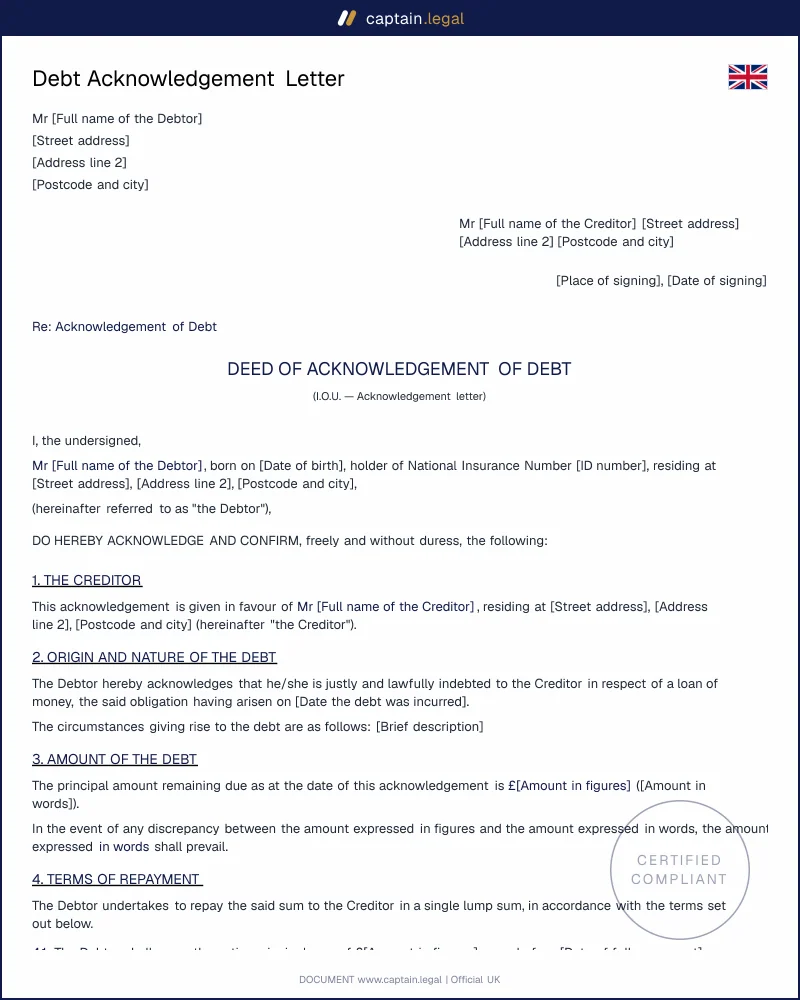
You begin by selecting whether the debtor is an individual or a company, because the identification block adjusts accordingly. From there, the form asks for the full names and addresses of both parties, the date or dates on which the underlying transaction took place, and a short description of the original arrangement, whether a cash loan, an unpaid invoice, or a sum owed at the end of a personal arrangement. The principal amount is entered in pounds sterling, in both figures and words, and the form generates the dual representation automatically to avoid the discrepancy that is one of the most common drafting errors in homemade IOUs.
The next section concerns repayment. You select a single lump sum or an instalment schedule, and where instalments are chosen, the form asks for the start date, the frequency, the per-instalment amount, and the final due date. Interest is optional and, if selected, the form prompts for a rate and whether it accrues from the date of the original advance or from the date of the acknowledgement. The default clause is set out in plain English with a configurable grace period. Once the inputs are complete, the document is produced in Word and PDF, ready for signature. The debtor signs and dates the acknowledgement, ideally in the presence of an adult witness who is not a member of either party's household.
Common mistakes to avoid
The most damaging error is failing to obtain the signature of the actual debtor. Section 30(1) requires the acknowledgement to be signed by the person making it. An email from the debtor's spouse, a typed name without a wet or electronic signature, or a third-party guarantor's signature on its own will not engage section 29. Courts have rejected attempted acknowledgements where the signatory could not be tied evidentially to the person liable, and the limitation clock continues to run as if nothing had happened. The second recurrent error is leaving the sum vague or undated. An acknowledgement that refers to "various amounts owed over the years" without specifying the principal and the date the debt fell due is of limited value, because the creditor still has to prove quantum at trial. The acknowledgement should do that work in advance.
A third mistake is misjudging the limitation deadline. Section 29(7) is unforgiving : once a debt is statute-barred, no later acknowledgement can revive it. Creditors who delay until the seventh year and then obtain a signed acknowledgement are too late, and the document is worthless for limitation purposes even if it remains useful as a moral lever. A fourth, frequently seen in landlord-tenant disputes that spill beyond the tenancy itself, is mixing the acknowledgement with the underlying rental documentation. Arrears claims governed by the tenancy agreement are pursued through the procedures in the UK tenancy agreements and property documents collection ; a separate debt for damage, unpaid utilities or post-tenancy sums benefits from its own freestanding acknowledgement. Mixing the two confuses limitation analysis and pre-action conduct. Finally, omitting a dispute-resolution or governing-law clause in cross-border cases creates avoidable jurisdictional argument.
Frequently Asked Questions
20 verified reviews · 50 000+ downloads
- Immediate access to the document
- PDF + Word download
- Compliant with 2026 legislation
- Reviewed by lawyers
You might also like