A Living Will, known in English law as an Advance Decision to Refuse Treatment (ADRT), lets a person of sound mind set out, in writing and in advance, which specific medical treatments they wish to refuse should they later lose the capacity to consent. It is not a request for euthanasia and it is not a wish-list; it is a legally binding refusal that sits at the heart of the Mental Capacity Act 2005. Properly drafted, signed and witnessed, an ADRT will be followed by NHS clinicians and private practitioners across England and Wales, even where doctors believe a different course would serve the patient's best interests. This template is designed for adults aged 18 or over who want their wishes on life-sustaining treatment, resuscitation, ventilation, artificial nutrition or other interventions to carry the full weight of statute.
Compliant
2026 Legislation
50,000+ clients
trust us
Affordable
From $4.90 / doc
Secure payment
Instant download
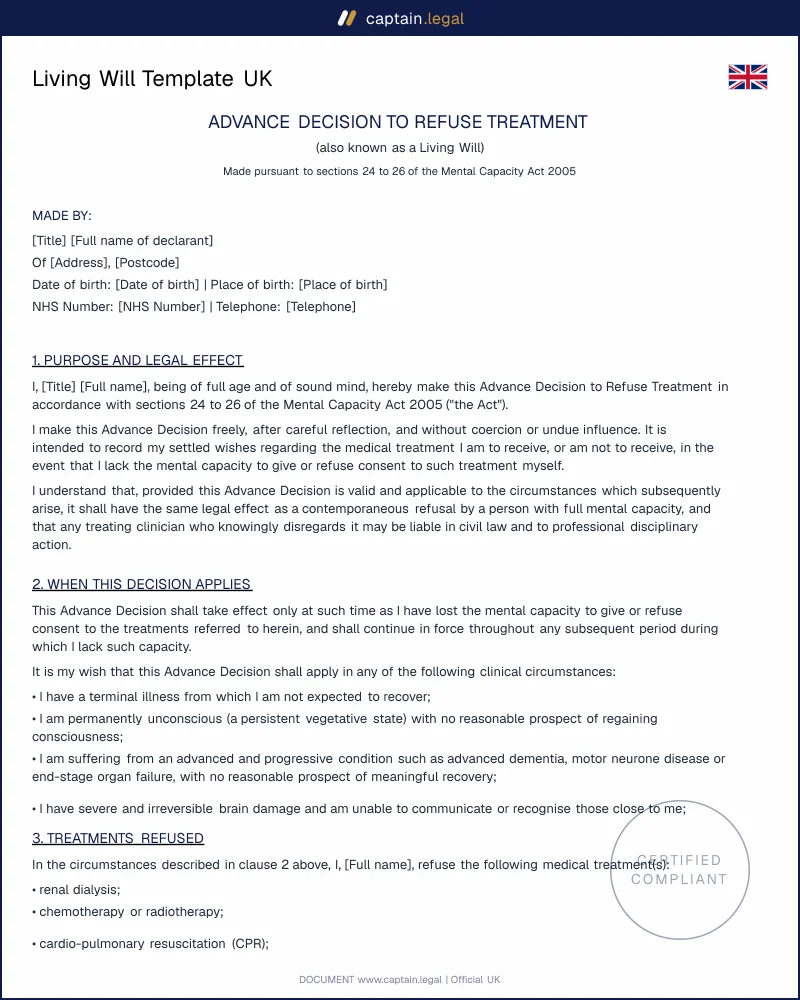
Advance Decision to Refuse Treatment (ADRT) — UK Template
Secure payment
What is a Living Will (Advance Decision to Refuse Treatment)?
A Living Will is the everyday name for what the Mental Capacity Act 2005 calls an Advance Decision to Refuse Treatment. The terminology matters: under sections 24 to 26 of the Act, only a properly constituted advance decision is binding on clinicians. A general "living will" expressing preferences, hopes or values is not binding on its own; it may inform a best-interests assessment under section 4, but it does not stop a doctor from treating you. The instrument has to refuse identifiable treatments in identifiable circumstances, and it has to be in writing where it touches on life-sustaining care. That is the line between an enforceable refusal and a sentimental statement.
The distinction with a Lasting Power of Attorney for Health and Welfare is the other point clients consistently misunderstand. An LPA appoints someone else to make decisions on your behalf once capacity is lost. An ADRT records your own decisions, made while you still have capacity, to apply once you lose it. The two instruments can coexist, but where they conflict the rules in section 25(2)(b) of the Mental Capacity Act 2005 govern: a later LPA giving the attorney authority to consent to or refuse the relevant treatment will override an earlier advance decision. Date your ADRT carefully and keep it consistent with any LPA you sign afterwards. A separate point of confusion is the advance statement of wishes, sometimes drafted alongside an ADRT; that document records preferences (food, music, religious observance) and is persuasive but never binding. The ADRT alone has the statutory force, and only the ADRT carries it.
Legal framework
The statutory foundation of every Advance Decision in England and Wales is the Mental Capacity Act 2005, with the operative provisions sitting at sections 24, 25 and 26. Section 24 defines what an advance decision is and who can make one: any person aged 18 or over with the mental capacity to make the decision at the time. Section 25 deals with validity and applicability, the two thresholds a clinician must check before following the document. Validity asks whether the decision still stands, whether it has been withdrawn, whether the patient has done anything clearly inconsistent with it, and whether a later LPA covers the same ground. Applicability asks whether the treatment actually proposed is the one refused, in the circumstances specified, and whether there are no reasonable grounds for believing that current circumstances were not anticipated by the patient. Section 26 confirms the binding effect: where an advance decision is valid and applicable, treatment given in contradiction of it is unlawful, and the doctor providing it has no defence under section 5 of the Act.
A separate layer of formality applies to refusals of life-sustaining treatment. To bind clinicians on that ground, the advance decision must be in writing, signed by the patient (or by someone in their presence and at their direction), witnessed, and contain an express statement that the refusal is to apply even if life is at risk. Omitting that life-at-risk verification is the single most common reason ADRTs are set aside by NHS trusts; the wording is not optional. The Mental Capacity Act Code of Practice, chapter 9, sets out the operational detail and is followed by NHS clinicians as a matter of professional duty under section 42 of the Act. Authoritative public guidance is published by the NHS guide to advance decisions to refuse treatment under the Mental Capacity Act 2005, and we recommend reading it alongside our template.
Three further statutes interact with an ADRT in practice. The Mental Health Act 1983, Part IV, allows compulsory treatment for mental disorder in detained patients to override an advance decision concerning that mental disorder, though physical conditions remain protected. The Suicide Act 1961 is untouched: a Living Will cannot authorise assisting a person to die, and the Mental Capacity Act expressly preserves the existing criminal law on murder, manslaughter and assisted suicide. Decisions concerning pregnant patients, finally, are not specifically excluded by the statute but raise complex questions which the courts continue to resolve case by case, weighing the welfare of any viable foetus against the patient's prior refusal.
When do you need this document?
The textbook trigger is a diagnosis of a progressive illness, typically motor neurone disease, advanced dementia, multiple sclerosis or Huntington's, where the patient knows their capacity will erode and wants to fix the limits of acceptable treatment now, while their decision-making is unquestioned. Solicitors specialising in private client work see most ADRTs drafted in this window, often alongside a Lasting Power of Attorney and an updated will, and the template here is designed to sit naturally within the broader catalogue of UK personal legal documents. A second frequent scenario is the prevention of cardiopulmonary resuscitation in a context where the patient has already considered, with their consultant, the likely outcomes of CPR on their existing comorbidities. A Do Not Attempt Cardiopulmonary Resuscitation form recorded in hospital notes is doctor-led; an ADRT is patient-led and travels with the patient between settings.
Faith-based refusals form a third category. Jehovah's Witnesses refusing blood transfusions and blood products have been the most litigated category of advance refusals in English law, and the High Court has confirmed repeatedly, beginning with HE v NHS Trust A [2003] EWHC 1017, that a properly drawn ADRT binds clinicians even where the treatment is life-saving. Some patients also wish to record refusals tied to specific scenarios: persistent vegetative state, advanced stages of dementia, or severe stroke with no realistic prospect of recovery. These situational refusals demand careful drafting, because section 25 will defeat the document if the clinical scenario in front of the doctor does not match the one the patient described. One edge case worth flagging: prisoners and detained patients can make valid ADRTs, but interactions with the Mental Health Act 1983 may limit their applicability. Pregnant patients can also make an ADRT, though clinicians will weigh the welfare of any viable foetus when applying section 25.
Key clauses included in our template
Our Advance Decision template is drafted to satisfy section 25 of the Mental Capacity Act 2005 in every clause, with the wording NHS Resolution and most trust legal teams expect to see.
- The identification clause records the patient's full name, address, date of birth and, where available, NHS number. A photograph and a copy of identification can be appended as a schedule; clinicians treating a patient at three in the morning need to be confident, on the face of the document, that the ADRT is theirs.
- The capacity declaration affirms that the patient is aged 18 or over and has the mental capacity at the date of signing to make the decisions set out. This protects the document against later challenges that the patient was already cognitively impaired when signing, a recurring ground of dispute in contested estates.
- The specified treatments clause lists each treatment refused, in language a clinician will recognise: cardiopulmonary resuscitation, mechanical ventilation, artificial nutrition and hydration, blood transfusion, antibiotic therapy in defined scenarios. Vague refusals of "heroic measures" will not bind anyone; the template uses standard clinical terminology drawn from the General Medical Council guidance.
- The circumstances clause sets out the clinical scenarios in which each refusal is to apply: terminal illness with no prospect of recovery, permanent unconsciousness, advanced and irreversible dementia. Section 25 requires applicability to current circumstances, so this clause is where most ADRTs succeed or fail in practice.
- The life-sustaining treatment verification is the express statement, in the wording suggested by the Code of Practice, that the refusals are to apply even if life is at risk. Without it, refusals of life-sustaining treatment have no binding effect under section 25(5).
- The signature and witness block records the patient's signature and that of an independent witness who is not a beneficiary under the patient's will or LPA attorney, with the date in full. The witness signs that they saw the patient sign and that the patient appeared to do so freely.
- The revocation, distribution and review clause records the patient's instructions on where copies are kept (GP record, family, solicitor), how revocation may be effected, and a recommended review interval of every two to three years.
Regional considerations
Captain.Legal's template is drafted for England and Wales, the territorial scope of the Mental Capacity Act 2005. The Act does not extend to Scotland or Northern Ireland, where separate regimes apply, and patients with cross-border lives need to plan accordingly. The same territorial logic governs other instruments in the Captain.Legal UK real estate templates library and the UK employment documents catalogue: always check the jurisdiction before relying on a template across the home nations.
Scotland operates under the Adults with Incapacity (Scotland) Act 2000. Advance decisions are recognised at common law rather than by statute, and the Adults with Incapacity (Scotland) Act 2000 Code of Practice sets the operational framework. The General Medical Council's guidance on end-of-life decisions, Treatment and care towards the end of life, applies UK-wide and bridges some of the procedural gap, but Scottish patients should consider the Welfare Power of Attorney under section 16 of the 2000 Act as the principal vehicle, supplemented by a clearly worded advance directive. Scottish clinicians will give significant weight to an England-and-Wales ADRT as evidence of prior wishes, though the statutory binding effect under sections 24 to 26 of the 2005 Act does not extend across the border.
Northern Ireland is governed by the Mental Capacity Act (Northern Ireland) 2016, which received Royal Assent in May 2016 and has been brought into force in stages. Its provisions on advance decisions broadly mirror the English regime but with distinct sections; the Department of Health (Northern Ireland) has issued accompanying guidance. Patients ordinarily resident in Northern Ireland who use our England and Wales template should take separate advice on territorial enforcement, particularly if they are likely to be treated across the border.
A practical wrinkle for patients with cross-border lives, including those splitting time between Wales and Scotland or between England and a second jurisdiction abroad, is that an ADRT valid in England and Wales is generally given evidential weight elsewhere as an expression of the patient's prior wishes, but it is not automatically binding under foreign or Scottish law. If you live partly in another jurisdiction, sign one document compliant with each regime and keep them consistent.
How to fill out this Living Will
You begin our questionnaire by confirming that you are aged 18 or over and ordinarily resident in England or Wales. The platform then asks for the personal identification details that will appear in the opening recital: your full name, current address, date of birth and, optionally, your NHS number. You then move to the substantive choices. For each category of treatment, you select either refuse in all circumstances, refuse only in the specified circumstances (with a free-text box to describe them in your own words), or consent to receive. The interface presents the options in the order most clinicians read them: cardiopulmonary resuscitation, mechanical ventilation, artificial nutrition and hydration, blood transfusion and blood products, antibiotic therapy in the context of terminal illness.
A separate screen handles the life-sustaining treatment verification, with explanatory text drawn from chapter 9 of the Mental Capacity Act Code of Practice. You tick to confirm that each life-sustaining refusal is to apply even at risk to your life; the platform will not let you skip this step. The final screens cover the appointment of any Lasting Power of Attorney you have already signed, the names and contact details of your GP and next of kin, and a review-date prompt that defaults to two years from signature. The template generates in Word and PDF, with a separate witness instruction sheet and an optional carry card. Once your ADRT is finalised, you can pair it with other instruments from the complete UK legal document catalogue so that your estate, your business affairs and your health wishes all sit in one place.
Common mistakes to avoid
The single most damaging mistake is omitting the life-at-risk statement on refusals of life-sustaining treatment. Section 25(5) of the Mental Capacity Act 2005 is uncompromising on this point: without the verification, clinicians are not merely entitled but obliged to treat. Our template builds the wording in by default, but patients who reuse a generic letter found online routinely lose this protection. The second recurring mistake is mis-describing the clinical circumstances. An ADRT that refuses ventilation "if I am unlikely to recover" gives the treating consultant a discretion the patient probably did not intend. Tightening the language to "where two consultants agree that there is no realistic prospect of regaining the capacity to recognise family and friends" gives the same instinct legal teeth.
The third pitfall is letting the ADRT go stale. A decision signed fifteen years ago and never reviewed will still be considered, but a judge or clinician applying section 25(2)(c) can take into account anything done by the patient since that is clearly inconsistent with the decision remaining their fixed view, such as accepting a treatment they had previously refused. Reviewing every two to three years, and re-signing after any major life event, keeps the document alive. The fourth is using the wrong witness: a witness who stands to inherit under the patient's will, or who is the attorney under the LPA, undermines the appearance of independence and invites a contest. A neutral adult, ideally the GP or a long-standing professional contact, is far stronger. Never witness with the family member you expect to benefit from your estate. The fifth, more procedural, is failing to lodge copies with the GP and any specialist consultant. An ADRT that nobody can find at the moment of crisis has the same effect as no ADRT at all.
Frequently Asked Questions
14 verified reviews · 50 000+ downloads
- Immediate access to the document
- PDF + Word download
- Compliant with 2026 legislation
- Reviewed by lawyers
You might also like