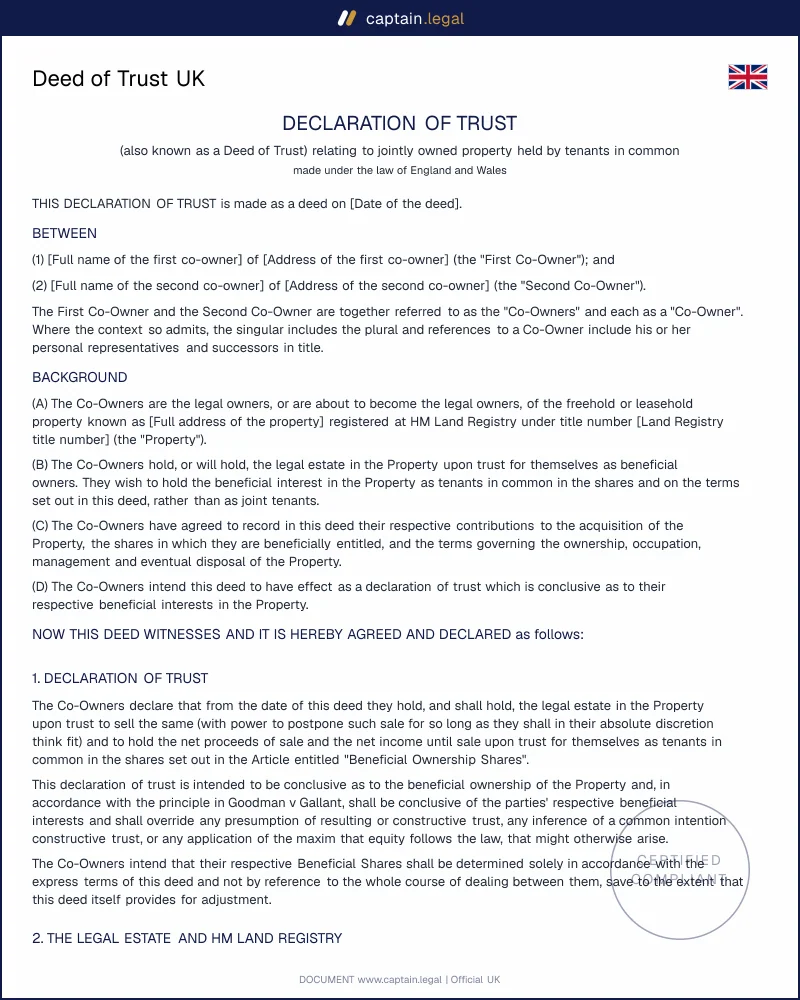
This deed is drafted for England and Wales, where the trust of land structure under TOLATA 1996 applies uniformly. The document is not suitable for Scotland, where land ownership runs on an entirely different system of pro indiviso shares and title conditions, nor for Northern Ireland, which has its own conveyancing regime. If your property sits north of the border or across the Irish Sea, this template is the wrong instrument.
Within England and Wales the substantive law is consistent, but a few practical variations are worth knowing. For leasehold flats, the beneficial shares declared in the deed sit behind the leasehold title, and you should check whether the lease or any mortgage requires the lender's consent before you formalise a tenancy in common; most residential mortgages permit it, but the deed should not contradict the mortgage terms. For properties with an existing mortgage, the deed governs the equity but does not release either party from the mortgage covenant, which remains joint and several regardless of the internal split. A 30% beneficial owner is still 100% liable to the lender if the other owner stops paying.
For mixed households where contributions genuinely change over year to year, some parties in England and Wales prefer a floating-share deed that recalculates on sale, while others fix the shares at completion for certainty. Neither is more correct, but the deed must say which model applies, because a floating-share clause left vague is a litigation magnet. If a child arrangements order or matrimonial proceedings are in play, take advice before relying on a generic deed, as the family court has powers that can override an ordinary declaration of trust.