Create my document
Login

Choose country

FranceBelgiqueEspañaUnited StatesUnited KingdomالمغربDeutschlandItalia
Leave Request

Sabbatical Agreement Template UK | Career Break Contract

Draft a UK sabbatical agreement that protects continuity of service and return rights. Lawyer-style template, ERA 1996 compliant. Word & PDF download.
4.8/528 reviews50 000+ downloadsInstant download
Share

A sabbatical agreement is the written contract that lets an employee step away from work for an extended period, usually unpaid, while keeping the employment relationship alive. It records the dates, the status of pay and benefits during the absence, whether continuity of service is preserved, and what the employee can expect on return. UK law gives no automatic right to a career break, which is exactly why a properly drafted career break agreement matters: everything that protects both sides has to be written down, because nothing is implied by statute. This template is built for employers and employees who have agreed the principle of an extended break and now need to formalise it cleanly, before the dates get "agreed in the corridor" and forgotten by payroll.

Compliant

2026 Legislation

50,000+ clients

trust us

Affordable

From $4.90 / doc

Secure payment

Instant download

Sabbatical Agreement Template UK | Career Break Contract

Secure payment · No subscription

Fill in the template

What is a sabbatical agreement?

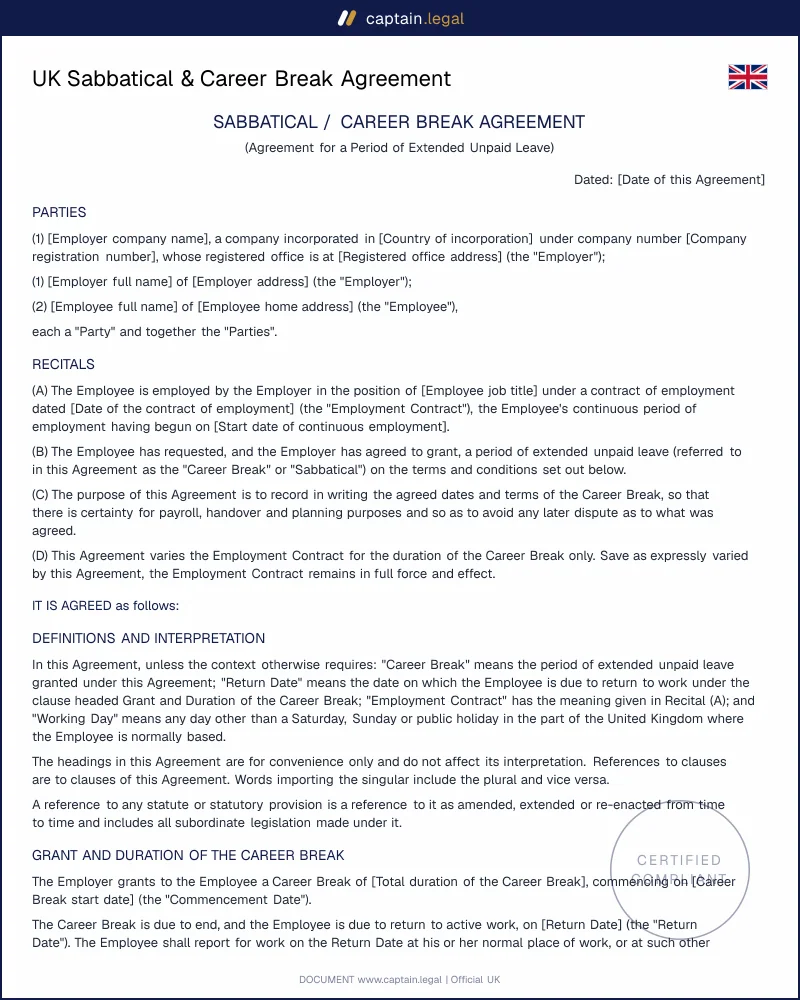
A sabbatical agreement is a formal variation of the existing contract of employment. It does not replace the contract; it suspends or modifies parts of it for a defined window, then restores them when the employee comes back. The document names the parties, fixes the start and end dates, states whether any salary or contractual benefits continue, and sets out the conditions attached to the break. Because a sabbatical sits outside statutory leave entirely, the agreement is the only thing standing between a smooth absence and a messy dispute about pay, pension, or the job waiting on return.

People often use sabbatical and career break interchangeably, but practitioners draw a real line between them. A sabbatical typically describes an unpaid release from attendance while the contract stays in force, so the employee remains employed throughout. A career break, in its strict sense, can involve the employee resigning on the understanding of re-employment later, which severs the contract and most rights with it. The wording you choose changes the legal effect, so a careful agreement spells out which model applies rather than leaving it to inference. This template defaults to the contract-preserving version, the safer choice for both the business and the individual, and lets you adjust the pay and benefits terms to fit the actual arrangement.

2

When do you need this agreement?

The most common trigger is an employee with several years of service asking for a long, planned absence: extended travel, study, a personal project, or recovery from sustained pressure at work. Many employers reserve sabbaticals as a retention tool for staff with three to five years of continuous service, and the agreement is what turns an informal "yes" into something both sides can rely on. A second scenario is the wellbeing break, where a business would rather grant proactive rest than lose a valued employee to burnout, and wants the terms recorded so the absence does not blur into open-ended sick leave.

Caring responsibilities make up a large share of requests too, where someone needs months away to look after a child, partner, or dependant but fully intends to come back. Here the right-to-return wording is the heart of the document, because the employee is taking a real financial risk and needs clarity on what they are returning to. The single most contested point in practice is whether the returning employee gets the exact same role or merely an equivalent one, and the agreement should resolve that before the leave starts, not after.

Two edge cases are worth flagging. If a request is really about a family-related entitlement, such as parental or unpaid leave covered by statutory rights, you should route it through the correct statutory mechanism rather than a sabbatical, because the legal protections differ sharply. And where an employer has informally granted breaks to several people over the years, that pattern can harden into an implied contractual right by custom and practice, so a one-off written agreement that states the break is discretionary protects the business from creating a precedent it never intended.

3

Key clauses included in our template

  • The dates and duration clause fixes a precise start and end, and confirms whether the end date is firm or subject to an agreed extension. This is the clause that defeats the "agreed in the corridor" dispute, because payroll, handover, and cover planning all flow from a single confirmed window rather than a vague understanding.
  • The continuity of service clause states expressly that the period counts toward continuous employment under section 212(3)(c) of the Employment Rights Act 1996. Without this, an employee returning after a long break can find their length-of-service rights challenged, so the agreement removes the ambiguity that the statute itself leaves open.
  • The pay and benefits clause sets out whether salary stops entirely, continues in part, and what happens to pension contributions, private medical cover, and other contractual benefits during the absence. It also addresses whether annual leave accrues, since statutory holiday usually does not accrue on unpaid leave under the Working Time Regulations 1998.
  • The right-to-return clause is drafted carefully because no statutory return right exists for sabbaticals. It specifies whether the employee returns to the same role or an equivalent position, and confirms that a genuine redundancy arising during the absence will follow a fair process in which the employee is consulted like any colleague.
  • The conditions and conduct clause covers eligibility, any restriction on working for a competitor during the break, confidentiality, and the consequences of not returning on the agreed date. It keeps the arrangement proportionate without reaching into the employee's private life more than the business genuinely needs.
4

Regional considerations

Employment law in England and Wales and in Scotland rests on the same statutory backbone for sabbaticals, since the Employment Rights Act 1996 and the Working Time Regulations 1998 apply across Great Britain. The continuity provisions and the absence of any statutory sabbatical right are identical, so a single well-drafted agreement works in both. The practical difference sits in enforcement and procedure: Scotland has its own court system, and a contractual dispute over an unpaid break could be raised in the Scottish courts rather than the courts of England and Wales, which is one reason a clear governing-law clause is worth including.

Northern Ireland runs on parallel but separate legislation. The continuity and leave rules mirror the Great Britain position closely, but they derive from Northern Ireland employment legislation rather than the Employment Rights Act 1996, and tribunals there operate under their own procedural rules. An agreement drafted for an employee based in Belfast should reference the local framework rather than assume the GB statute applies directly. Across all three jurisdictions the data you collect when handling a sabbatical request, including any sensitive personal information, must be processed in line with the Data Protection Act 2018 and UK GDPR, so the agreement should avoid asking for intrusive detail that the business does not actually need. If you are also formalising the underlying terms of employment, our full-time employment contract template for permanent staff pairs naturally with a sabbatical variation, and the day-one statement of written particulars template covers the baseline information every UK employee is entitled to receive.

5

How to fill out this sabbatical agreement

You begin by entering the names of the employer and employee and the date the existing employment started, since that start date is what the continuity clause protects. From there you set the agreed dates of the break and choose whether the arrangement is fully unpaid, partly paid, or paid, which adjusts the wording on salary and benefits automatically. The form then prompts you to confirm what happens to pension contributions and any contractual perks, so nothing is left to assumption when the employee is away and the next payroll run lands.

The middle of the process focuses on the return. You select whether the employee returns to the same role or an equivalent one, and the template inserts language confirming that continuity is preserved and that any redundancy during the absence will follow a fair, consultative process. You can then add conditions such as eligibility confirmation, a no-competition undertaking during the break, and the notice each side must give to bring the sabbatical to an early end. The result is a document tailored to your actual arrangement, ready to sign, and consistent with how UK employment documents are structured across the platform. A clean signed copy goes to the employee, and you keep one on file for planning and payroll.

6

Common mistakes to avoid

The mistake practitioners see most often is silence on continuity of service. Employers assume an agreed break automatically preserves it, and usually it does under section 212(3)(c), but leaving it unstated invites an argument later about whether length-of-service rights survived. Just as damaging is a vague return clause, or none at all: because there is no statutory right to return from a sabbatical, an employee who comes back to find their role gone has little protection unless the agreement created the right expressly. Treating a family-related request as a sabbatical is another trap, since it strips the employee of stronger statutory protections that would otherwise apply to parental or adoption leave.

A quieter error is letting sabbaticals become custom and practice. Grant enough of them informally and a tribunal may find you have created an implied contractual right for everyone, so each agreement should record that the break is discretionary and not a precedent. Employers also forget the pay detail that turns into the whole dispute: whether holiday accrues, whether pension pauses, and what happens if the employee simply does not return on the agreed date. Pin those points down in writing before the leave starts, because once the employee has gone, every gap in the document becomes a negotiation you no longer control. Finally, do not over-collect personal information when assessing a request; keep it proportionate and compliant with data protection law.

Key takeaways

Purpose

This is extended unpaid leave, in writing

The template is a sabbatical or career break agreement for a defined period of extended unpaid leave. It is dated and signed as a standalone agreement alongside the existing employment contract, so there is a clear record of what has been agreed. Treat it as a formal variation: fill in the dates, role details and any referenced employment contract date.

Parties

Identify the right employer and employee

The agreement must name the parties correctly, because the template switches depending on whether the employer is a company or an individual. For a company, you will need the company name, country of incorporation, company number and registered office address; for an individual, their full name and address. The employee’s full name and home address also need to match HR records.

Employment status

It ties back to the employment contract

The recitals link the employee’s role and the sabbatical to an existing contract of employment, including the job title and the contract date. That connection matters for continuity of service and return rights, which the template is designed to protect in an ERA 1996-compliant way. If the underlying contract details are wrong or missing, the protection you expect may be harder to rely on.

Frequently Asked Questions

Yes. Once both the employer and employee sign it, the sabbatical agreement operates as a binding variation of the existing contract of employment and is enforceable like any other contractual term. It does not need to be witnessed or notarised to take effect, though a signed and dated copy held by each party is the practical proof you will want if anything is later disputed. What makes it effective is precise drafting rather than any formality: clear dates, an express continuity clause referencing section 212(3)(c) of the Employment Rights Act 1996, and an explicit right-to-return statement. Because no statute governs sabbaticals, the written terms are the agreement, so the more clearly they are recorded, the more reliable the document becomes.

Not if the agreement is drafted correctly. Under section 212(3)(c) of the Employment Rights Act 1996, a week of absence "by arrangement or custom" counts toward continuous employment, and an agreed sabbatical falls within that wording. This is why the template includes an express continuity of service clause: it confirms in writing that the break does not reset your service clock. Continuity matters because it underpins the two-year qualifying period for unfair dismissal claims, statutory redundancy pay, and notice entitlement. The risk arises only when an arrangement is structured as a resignation with a promise of re-employment, which can sever continuity. The government's guidance on continuous employment explains which kinds of break do and do not interrupt service.

Yes. There is no statutory right to a sabbatical or career break in the UK, so granting one is entirely at the employer's discretion unless a contract or policy says otherwise. Employers commonly attach eligibility conditions such as a minimum of three to five years' continuous service, satisfactory performance, and operational capacity to cover the role during the absence. A request can be declined on genuine business grounds, and a refusal does not need the formal counter-notice process that applies to ordinary annual leave. That said, an employer who has routinely granted breaks should be consistent, because inconsistent decisions can raise fairness concerns and, over time, create an implied entitlement.

The agreement is delivered in editable Word format alongside a clean PDF. The Word file lets you adjust the dates, pay terms, benefit treatment, and return conditions to match your specific arrangement, then reuse the structure for future requests across the business. The PDF gives you a tidy, signature-ready version for the employee to review and sign. Because a sabbatical is so dependent on its precise terms, having an editable master is genuinely useful: you can tailor the continuity wording, the no-competition undertaking, and the return clause without rebuilding the document each time, while keeping the underlying legal framework intact.

Notice is set by agreement rather than statute, since no legislation governs sabbatical timing, but practitioners recommend building clear notice periods into the document on both sides. A common approach gives the employee a defined lead time to confirm the start, and requires advance notice before the agreed return so the business can plan the handover back. The template also lets you specify what happens if either party wants to end the break early, which avoids a stand-off if circumstances change. Fixing these timings in writing is what prevents the "agreed in the corridor" problem, where dates drift and payroll, cover, and planning all fall out of step.

Usually pension contributions pause during an unpaid break unless you and your employer agree otherwise, and statutory annual leave under the Working Time Regulations 1998 generally does not accrue while you are not being paid. Contractual holiday or enhanced benefits can be treated differently, which is exactly why the agreement asks you to state the position explicitly rather than leaving it to assumption. The template prompts you to confirm whether salary stops fully, whether any benefits continue, and how pension and holiday are handled for the duration. Recording this clearly protects both sides, because the treatment of pay and benefits is the single point most likely to surface as a dispute once the employee is back at work.

Being on a sabbatical does not shield you from a genuine redundancy, but it also does not exclude you from a fair process. If a redundancy situation arises while you are away, your employer must consult you and include you in selection on the same basis as colleagues who are at work, and your preserved continuity of service counts toward any statutory redundancy pay you are owed. The agreement reinforces this by confirming the right to return is to the same or an equivalent role, subject to a fair process. Absence is never a lawful reason to single someone out for redundancy, and a returning employee who was excluded from consultation may have grounds for an unfair dismissal claim.

4.8/5

28 verified reviews · 50 000+ downloads

Sabbatical Agreement Template UK | Career Break Contract
  • Immediate access to the document
  • PDF + Word download
  • Compliant with 2026 legislation
  • Reviewed by lawyers
Fill in the template
Secure payment · No subscription
Updated on May 30, 2026

You might also like

Self-Certification Sickness Form
Unpaid Leave Request Form UK