Create my document
Login

Choose country

United KingdomUnited KingdomChoose country
Non-Profit

Gift Aid Declaration Form UK | Income Tax Act 2007

Gift Aid declaration drafted to sections 413-430 Income Tax Act 2007, with taxpayer statement and joint-donor option. HMRC-ready Word and PDF.
4.8/526 reviews50 000+ downloadsInstant download
Share

A Gift Aid declaration is the short written statement that turns an ordinary donation into a reclaimable one, letting a UK charity recover 25p of basic rate tax for every £1 given without costing the donor a penny more. Our template is drafted to HMRC's declaration requirements and covers both a single past or present gift and an enduring declaration that applies to all future donations until cancelled. It captures the donor's full name, home address, the taxpayer confirmation and the precise statutory wording inspectors look for during a claim review, so your reclaim survives an audit rather than collapsing under it.

Charities, churches and community amateur sports clubs (CASCs) registered with HMRC use this form to put their fundraising on a compliant footing. It is the single piece of paper that stands between a donation and a disallowed claim, and the one HMRC asks to see first.

Compliant

2026 Legislation

50,000+ clients

trust us

Affordable

From $4.90 / doc

Secure payment

Instant download

Gift Aid Declaration Form UK | Income Tax Act 2007

Secure payment · No subscription

Fill in the template

What is a Gift Aid declaration form?

A Gift Aid declaration is the donor's authority for a charity to reclaim the basic rate Income Tax already paid on the money behind a gift. It is not a receipt and it is not a tax return. It is a statement, made by an individual who pays UK Income Tax or Capital Gains Tax, confirming that their donations should be treated under the Gift Aid scheme so the charity can recover tax from HMRC. Without a valid declaration on file, a donation from an individual simply does not qualify, no matter how generous it was or how clearly it was a gift.

People often confuse the declaration with the Gift Aid Small Donations Scheme (GASDS), and the distinction matters. GASDS lets a charity claim a top-up on small cash and contactless gifts of £30 or less without collecting any declaration at all, which is why bucket collections work. A Gift Aid declaration, by contrast, is donor-specific and identifies a named person, their address and the gift or gifts covered. The two routes cannot apply to the same donation: a gift backed by a declaration is excluded from GASDS, because it is already accounted for under Gift Aid proper. Our UK charity governance document templates sit alongside this form for organisations building out their wider compliance file.

2

When do you need this form?

The everyday trigger is the arrival of a new regular donor. Someone signs up to give monthly, and the charity wants every one of those gifts to carry the extra 25 per cent from HMRC. A single enduring declaration captures the lot, present and future, until the donor cancels it. The second common scenario is the one-off major gift: a supporter hands over a substantial sum after a campaign appeal, and a declaration limited to that gift secures the reclaim. You also reach for the form when running a sponsored event, where each sponsor who pays UK tax can declare individually so the charity claims on the sponsorship raised.

Retrospective claims are where the form earns its keep. A declaration can cover donations made up to four years before it is signed, so a charity onboarding a long-standing supporter can recover tax on years of past giving in one stroke, provided the donor paid sufficient tax across each of those years. That four-year window closes from the end of each tax year, so the clock is always running. Two edge cases legitimately complicate matters. Donations collected on behalf of others, where one person banks money raised from friends, cannot be Gift Aided by the collector: HMRC needs a separate declaration from each true donor. And membership subscriptions or sponsorship can qualify only when they are genuine gifts rather than payment for goods, services or admission, a line that the donor benefit rules in the Income Tax Act 2007 police closely.

3

Key clauses included in our template

  • The donor identification block captures full forename and surname, not initials, plus the donor's home address including postcode. HMRC strongly prefers full forenames and the home address is mandatory, because both are matched against records when a claim is checked. A declaration carrying only "J. Smith" or a work address is a routine reason for disallowance.
  • The scope selector lets the donor choose between a single named gift, all donations going forward, and the retrospective four-year backdating option, or any combination of these. This is the clause that converts a one-off form into an enduring declaration, and getting it wrong is the difference between claiming on one gift and claiming on a decade of giving.
  • The taxpayer responsibility statement sets out, in HMRC's required terms, that the donor must have paid enough Income Tax or Capital Gains Tax to cover what every charity reclaims, and that any shortfall is the donor's to settle. The charity may print this on the form or evidence it separately, but our template builds it in so the obligation is never left unexplained.
  • The charity details and reclaim confirmation name your organisation and, where held, your charity number, and state that the identified gifts are to be treated as Gift Aid donations. A joint declaration option allows spouses or partners living together to declare on one form, provided the full details of both are given.
  • The cancellation and change-of-circumstances notice tells the donor to inform the charity if they stop paying sufficient tax, or if their name or address changes, so your records stay clean between the biennial reviews HMRC expects.
4

Regional considerations

Gift Aid is a UK-wide scheme administered by HMRC, but devolved Income Tax rates create wrinkles worth flagging to donors. For donors resident in England and Northern Ireland, the position is straightforward: the charity reclaims at the UK basic rate, and higher and additional rate taxpayers claim the difference between their rate and basic rate through Self Assessment. Nothing about the declaration form changes by location, and the same wording serves donors across all four nations.

For Scotland, the Scottish Parliament sets its own Income Tax bands under powers in the Scotland Act 2012, yet the charity's reclaim is unaffected: charities still recover Gift Aid at the rest-of-UK basic rate on donations from Scottish taxpayers. The complication is purely at the donor's end. A Scottish taxpayer on the intermediate, higher, advanced or top rate can reclaim the difference between the rate they actually pay and the basic rate the charity has claimed, which means more of your Scottish supporters than you might expect have personal relief to claim back. The declaration itself needs no Scottish variant.

For Wales, Welsh rates of Income Tax apply, but the outcome mirrors Scotland in the way that matters to charities: Gift Aid continues to be reclaimed at the UK basic rate, and Welsh donors paying above it can claim the difference. Across every nation the practical message to put to donors is the same: the form works identically wherever they live, and any higher-rate relief is theirs to pursue personally. Charities employing staff alongside fundraising will find our UK employment contract and HR templates a useful companion set.

5

How to fill out this Gift Aid declaration form

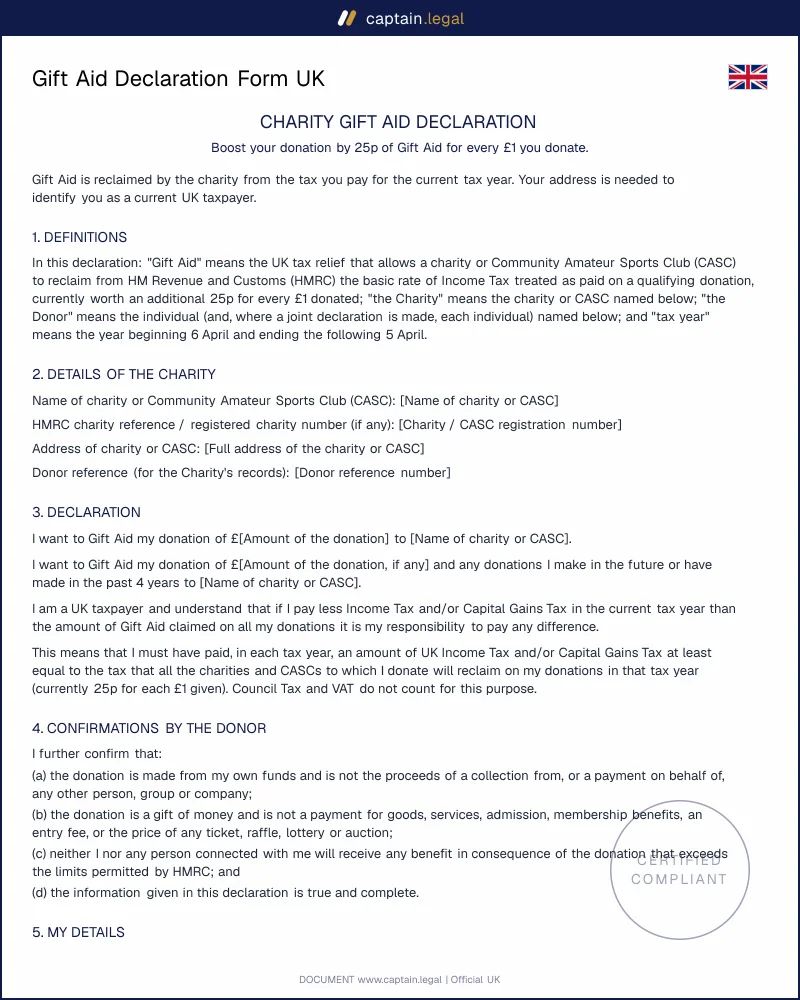
You begin by entering your charity's details, its registered name and, if it has one, its charity number, so every declaration that comes back is unmistakably tied to your organisation. From there the form turns to the donor, who supplies their full forename, surname and home address with postcode, the three fields HMRC matches when it checks a claim. Next comes the decisive choice of scope: the donor ticks whether the declaration covers a single specified gift, all donations from today onward, or donations made in the past four years as well, and our form makes that selection explicit rather than leaving it buried in small print. The taxpayer responsibility statement is presented for the donor to acknowledge before they date the declaration. A signature box is included even though HMRC does not strictly require one, because a signed form is the cleanest evidence in an inspection. You then save the completed declaration to your records, where it must stay for as long as you claim on it, and feed the donor's name, the donation date and the amount into HMRC's Charities Online service when you submit. For sponsored campaigns, the same logic runs across a multi-donor sponsorship sheet. Organisations formalising trustee decisions will find the matching trustees' written resolution template for UK charities sits naturally beside this form.

6

Common mistakes to avoid

The most expensive error is treating the declaration as optional housekeeping. HMRC operates a check-later regime, paying claims first and auditing afterwards, so a missing or defective declaration surfaces months down the line when the reclaim is clawed back with interest. Charities lose claims for the dullest reasons: a donor's address omitted or out of date, a work address used instead of a home one, initials in place of a full forename, or a declaration that names no specific gift and gives no enduring scope. Each of these is fatal to the line it sits on, and inspectors find them quickly because matching donor records is exactly what an audit does. Records must be kept for six years from the end of the accounting period they relate to, and enduring declarations must be kept for as long as they are claimed against, however old.

A second cluster of mistakes concerns eligibility the charity never tested. Claiming on money one person collected from a group, on payments that were really purchases of goods or event tickets, or on company donations (which follow entirely separate rules and carry no reclaim for the charity) all produce invalid claims. The taxpayer statement gets skipped surprisingly often, leaving HMRC unable to see that the donor's tax obligation was explained, which is itself a compliance failure. HMRC recommends rechecking active donors' details at least every two years, and charities that never do drift into claiming on supporters who have moved, died or stopped paying tax. A well-drafted form, like the others in our UK personal and statutory declaration templates, removes most of these failure points before they reach an inspector.

Key takeaways

Gift Aid value

Turns donations into a 25% reclaim

A valid Gift Aid declaration lets a UK charity reclaim 25p of basic rate tax for every £1 donated, without the donor paying anything extra. Without the declaration on file, the same donation simply does not qualify for Gift Aid, even if it was clearly a gift. Treat this as the piece of evidence HMRC will ask for first during any claim check.

Declaration rules

Include the exact details HMRC expects

HMRC does not issue an official form, but the content is not optional. The declaration must record the donor’s full name and home address, identify the charity, and specify the gift(s) covered, whether for a single past or present donation or an enduring statement for future gifts until cancelled. It must also include the taxpayer responsibility wording that inspectors look for when reviewing claims.

Donor liability

Donor must cover the tax reclaimed

Gift Aid only works where the donor has paid enough UK Income Tax or Capital Gains Tax in the relevant tax year to cover what charities will reclaim on their donations. If they have not paid sufficient tax, the shortfall is owed to HMRC by the donor, not the charity. That is why the taxpayer confirmation is more than admin: it reduces disputes when HMRC queries a claim.

Frequently Asked Questions

Yes. A declaration drafted to HMRC's requirements is fully valid for reclaiming tax under sections 413 to 430 of the Income Tax Act 2007. HMRC publishes no official form and expressly allows charities to use their own, provided the wording captures the donor's full name and home address, names the charity, identifies the gifts and carries the taxpayer responsibility statement. Our template includes every required element. A signature is not legally essential, since a declaration can be made orally or electronically, but a signed written form remains the strongest evidence if HMRC audits the claim, which is why the form provides for one.

The template is available in both Microsoft Word and PDF. The Word version is the one to use when you are adapting wording, adding your charity number, branding the header or building a multi-donor sponsorship sheet, because every field stays editable. Once the content is settled, the PDF gives you a clean, fixed version to email to donors or print for events, and a returned PDF is easy to file as your audit record. Most charities keep an editable Word master and circulate a locked PDF, so the version donors complete cannot be altered after signing. Both formats satisfy HMRC's record-keeping expectations equally.

A declaration can cover donations made in the previous four years, so a new supporter can unlock tax on years of past giving in a single form, as long as they paid enough Income Tax or Capital Gains Tax in each of those years. Separately, the charity must submit its reclaim to HMRC within four years of the end of the accounting period (or tax year) in which the donation was received. Miss that window and the tax is lost. Declarations themselves must be retained for six years from the end of the relevant accounting period, and enduring declarations indefinitely while still claimed on.

No signature is strictly required by HMRC. A valid declaration can be given in writing, orally, by email, online or even by text message, and an unsigned written form is still effective if it contains all the required information. That said, an unsigned oral declaration must be confirmed in writing by the charity within a set period to stand up, and a signed form sidesteps that complication entirely. For audit safety, collecting a signed and dated declaration is the sensible default, which is why our template includes a signature and date block.

Yes. HMRC permits two people who are spouses or who live together as partners to make a joint Gift Aid declaration on the same form, provided the full name and home address of each is given. This is useful for couples who donate from a shared household, and our template includes a joint-declaration option so both sets of details are captured correctly. Each person must individually have paid enough UK tax to cover their share of the reclaim. Donations genuinely made by other people in a group, however, always need a separate declaration from each true donor.

Once you submit through HMRC's Charities Online service, claims are typically paid directly into the charity's bank account within four to six weeks. There is no obligation to claim monthly; most small charities batch their claims quarterly or annually to suit volunteer capacity. The reclaim is worth 25p for every £1 donated, calculated as the gift divided by 80 then multiplied by 20, so a £100 donation yields a £25 reclaim. Keeping declarations complete and donor details current is what keeps that payment cycle smooth and audit-proof.

For donations under £30 collected as cash or contactless, the Gift Aid Small Donations Scheme lets you claim the same 25 per cent top-up without any declaration, which is why it suits collection tins and bucket collections. But GASDS and Gift Aid proper cannot apply to the same gift, and GASDS eligibility depends on your charity having made successful Gift Aid claims, so the declaration route remains essential for named donors. Charities also building their constitution and registration file will find the matching UK charity constitution and CIO templates help complete the wider governance picture.

4.8/5

26 verified reviews · 50 000+ downloads

Gift Aid Declaration Form UK | Income Tax Act 2007
  • Immediate access to the document
  • PDF + Word download
  • Compliant with 2026 legislation
  • Reviewed by lawyers
Fill in the template
Secure payment · No subscription
Updated on June 23, 2026

You might also like

CIO Constitution UK
Charity Trustee Resignation Letter UK