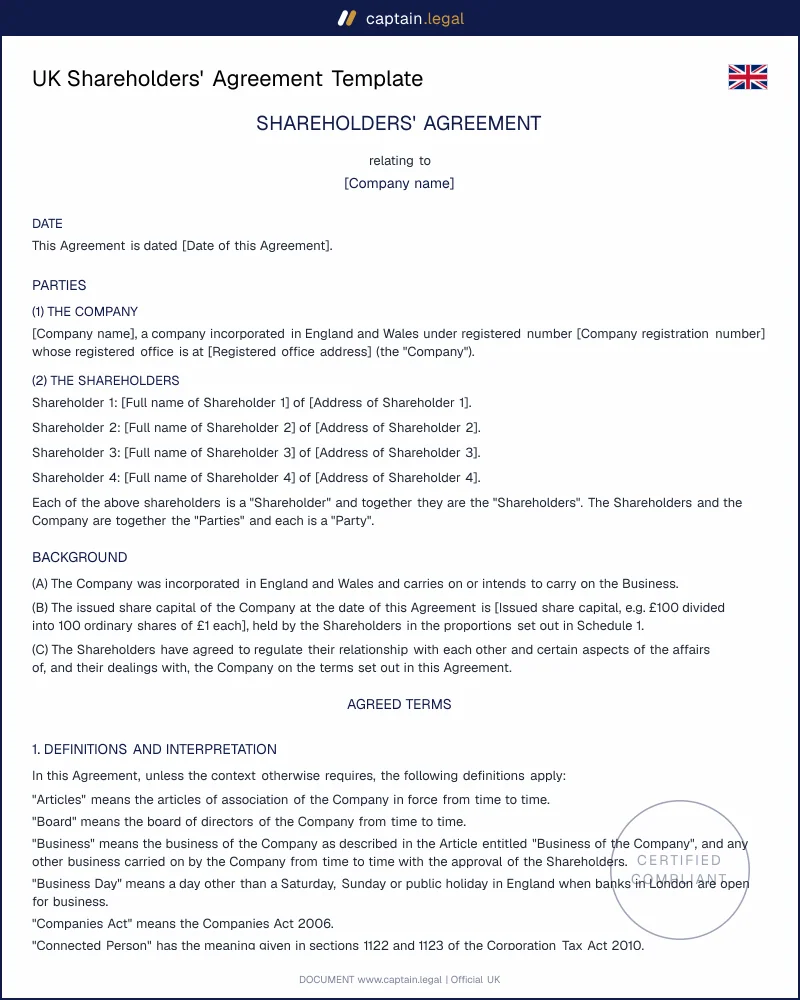
The Companies Act 2006 applies uniformly across the United Kingdom, so the core mechanics of a shareholders' agreement work the same whether the company is registered in England, Wales, Scotland or Northern Ireland. The single register at Companies House covers Great Britain and Northern Ireland alike, and pre-emption, drag-along and reserved matters operate identically wherever the company sits. The differences are not in company law but in the surrounding legal system the agreement plugs into.
England and Wales share one legal jurisdiction, and most UK shareholders' agreements are expressed to be governed by the law of England and Wales with the English courts given exclusive jurisdiction. This is the default this template is drafted for, and it is what investors and solicitors expect to see in a standard private company deal.
Scotland has a separate legal system, and an agreement involving a Scottish-registered company or Scottish-resident parties should usually choose Scots law and the jurisdiction of the Scottish courts. Concepts such as interdict (the Scottish equivalent of an injunction) and differences in the law of contract and remedies mean a clause drafted purely for England may need adjustment. The Companies Act 2006 itself is unaffected, but the governing-law and dispute-resolution clauses should reflect the Scottish forum.
Northern Ireland likewise has its own court system and its own body of contract and property law, though it sits close to England and Wales in substance. Russell v Northern Bank was itself a Northern Irish appeal, a reminder that the leading authority on enforceability binds across the UK. An agreement for a Northern Irish company should specify Northern Irish governing law and the jurisdiction of its courts. Whichever nation applies, the constitutional foundations should be reflected in your memorandum of association for your UK company at incorporation.