Create my document
Login

Choose country

FranceBelgiqueEspañaUnited StatesUnited KingdomالمغربDeutschlandItalia
Leave Request

UK Flexible Working Request Form | Day-One Right, Word & PDF

Submit a compliant flexible working request and record the decision in writing. Built around section 80F ERA 1996 and the ACAS Code. Editable, ready in minutes.
4.8/511 reviews50 000+ downloadsInstant download
Share

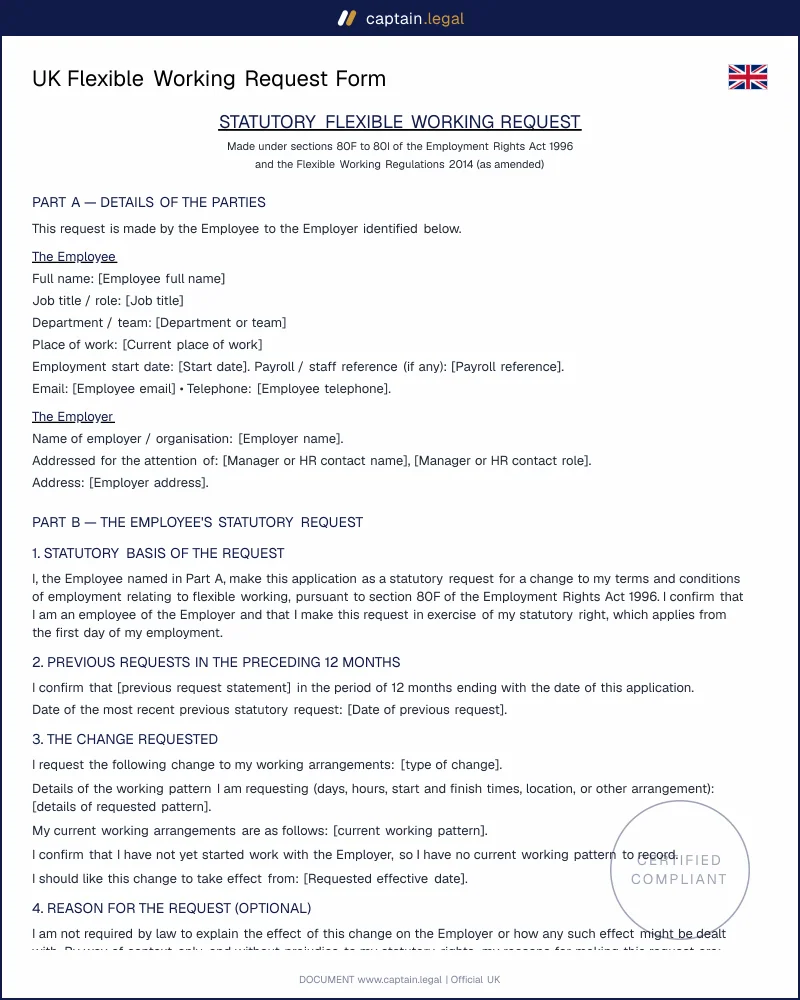
A statutory Flexible Working Request Form lets an employee formally ask their employer to change when, where, or how they work, and gives the employer a structured way to record the decision. It exists because a request made over coffee on a Friday rarely survives contact with payroll, the rota, or a later dispute about "what was actually agreed". This UK form is built around section 80F of the Employment Rights Act 1996 and the current ACAS Code of Practice on requests for flexible working, so a request to compress hours, shift start times, or move to hybrid working is captured with the information the law expects and a written employer response that closes the loop.

It is the document you reach for when you want the dates, the pattern, and the answer all in one place, signed and dated, rather than half-remembered from a corridor conversation.

Compliant

2026 Legislation

50,000+ clients

trust us

Affordable

From $4.90 / doc

Secure payment

Instant download

UK Flexible Working Request Form | Day-One Right, Word & PDF

Secure payment · No subscription

Fill in the template

What is a flexible working request form?

A flexible working request is a formal application by an employee to vary their contractual working arrangements, covering hours, timing, or place of work. The form does two jobs in one document. First, it gives the employee a compliant way to set out the change they want and the date they would like it to start, which is exactly what section 80F ERA 1996 requires for a request to count as statutory. Second, it gives the employer a structured response section to agree the request, agree it in part, or refuse it on one of the eight permitted business grounds, with the reasoning recorded in writing.

People often confuse a statutory request with an informal chat about working patterns. The distinction matters. An informal arrangement can be withdrawn at any time and carries none of the procedural protections; a statutory request triggers a strict process, a two-month decision deadline, and a route to an employment tribunal if the employer mishandles it. The form keeps you on the statutory side of that line. It also separates the request from the outcome: making a request from day one of employment is now a legal right, but it does not guarantee the change will be granted. Keeping the two clearly distinct in the paperwork is what stops a "yes in principle" from being read later as a binding variation of contract. For wider absence and leave paperwork, our UK leave request templates for annual, parental and sick leave cover the documents that sit alongside this one.

2

When do you need this document?

The clearest trigger is an employee who wants a permanent change to their pattern, a parent moving to school-friendly hours, someone shifting to a four-day compressed week, or a recent hire asking to work from home three days a week from their first month. Because the right now applies from day one, you may receive a request before the new starter has even completed induction, and treating it as "too soon to be serious" is a mistake employers regularly regret. A second common scenario is the return from maternity, adoption, or shared parental leave, where a change in hours is often the difference between the employee staying and resigning; handling that request well is both a retention move and a discrimination-risk management move.

You also need the form when an informal arrangement has quietly become the norm and one side now wants it documented. Many hybrid patterns began as pandemic improvisations and were never written down, which leaves both parties exposed when a manager changes or a dispute arises. Putting the arrangement through the statutory process converts a fragile understanding into a recorded decision. Watch the timing here: once a statutory request lands, the two-month clock starts, and an employer who lets it lapse without a decision can find the request treated as a procedural failure. One edge case worth flagging is the employee juggling a disability-related adjustment alongside a flexible working request. The two routes are legally distinct, and a refusal that ignores the Equality Act 2010 dimension can convert a routine refusal into a discrimination claim. If your business also manages staff exits and contractual variation, our UK redundancy notice letter template with statutory pay and notice handles the harder end of that spectrum.

3

Key clauses included in our template

  • The employee request section prompts for the specific change to working pattern, the proposed start date, and a clear statement that the application is being made under the statutory regime. This is the part that determines whether the request counts as statutory at all, so the wording mirrors the language of section 80F ERA 1996 rather than leaving the employee to improvise.
  • The previous request declaration asks whether the employee has made an earlier statutory request in the past twelve months and on what date. Because the law now permits only two requests in any rolling year, this field protects the employer from inadvertently processing a third request and protects the employee from a request being rejected on a technicality.
  • The employer response block is drafted to record one of three outcomes cleanly: full agreement, partial agreement, or refusal. Where the answer is refusal, the form forces selection of one or more of the eight permitted business grounds and a short reasoned explanation, which is exactly what a tribunal will look for if the decision is later challenged.
  • The agreed terms and effective date field captures the confirmed pattern and the date it takes effect, so the approved arrangement reads as a deliberate variation of contract rather than an informal favour. This is the single field that prevents the "we never agreed those dates" dispute at payroll and planning level.
  • The consultation and extension record notes any meeting held before a decision and any written agreement to extend the two-month deadline, evidencing the fair process the ACAS Code expects. Our UK dismissal letter template built to the ACAS Code follows the same documented-process logic for the other side of the employment relationship.
4

How to fill out this flexible working request form

You start in the employee section, naming the current working pattern and the precise change you are asking for, whether that is a reduction in days, a shift in start and finish times, or a move to home or hybrid working. From there the form asks for the date you want the new arrangement to begin, and it prompts you to confirm in writing that this is a statutory request and whether you have made one in the past twelve months. The employer then moves to the response section, where the form guides them through agreeing, agreeing in part, or refusing, and if refusing, selecting from the eight permitted business grounds with a short written reason attached.

Once a decision is reached, the agreed terms and the effective date are recorded together, and both parties date and sign. Because the document is editable, an employer can adapt the consultation notes and any agreed extension to match how the conversation actually ran, then save a clean copy for the personnel file. The result is a single record that satisfies the statutory information requirements and gives payroll and line managers an unambiguous start date to plan around. If you are also issuing or updating core contractual paperwork, our UK statement of written particulars template for day-one compliance pairs naturally with an approved flexible working change.

5

Common mistakes to avoid

The most frequent error is treating the request informally and never writing the decision down. A manager agrees a pattern verbally, the employee starts working it, and three months later a new manager queries the arrangement with nothing on file to support it. The fix is mechanical: record the outcome, the agreed pattern, and the effective date in one place, signed. The second recurring mistake is missing the two-month decision window. Employers used to the old three-month deadline let the clock run, and a request that is neither agreed nor properly refused within the statutory period exposes the business to a procedural complaint and, in the worst cases, a tribunal award.

A third trap is refusing on a ground that is not one of the eight permitted business reasons, or refusing without any consultation at all. "It does not suit us" is not a statutory ground, and a refusal that skips the consultation stage will struggle if challenged. Employers also stumble by ignoring the Equality Act 2010 overlay where the requesting employee has caring responsibilities or a disability, since a request that looks ordinary may carry discrimination risk that a flat refusal triggers. Finally, some employers demand intrusive supporting detail the law no longer requires, asking the employee to justify the business impact of their own request when the 2023 reforms removed that obligation. Keep the process proportionate, documented, and inside the deadline. For the full suite of compliant staffing documents, our UK employment law templates reviewed by employment professionals cover the contracts and letters that surround this form.

Key takeaways

DAY-ONE RIGHT

You can request flexible working immediately

Since 6 April 2024, the statutory right applies from your first day of employment, so you do not need 26 weeks’ service to ask. You can also make two statutory requests in any rolling 12-month period. The form helps you frame the request as statutory, so it triggers the legal process rather than being treated as a casual arrangement.

STATUTORY FORM

Put the change and start date in writing

For a request to count under section 80F Employment Rights Act 1996, it must be in writing, say it is a flexible working request, describe the change you want, and state when you want it to take effect. It should also record whether you have made a previous request and when. This avoids later arguments about what was agreed in a corridor chat.

EMPLOYER DUTIES

A decision is due within two months

A statutory request forces a structured employer response: agree, agree in part, or refuse. The employer must reach a decision within two months unless you both agree an extension in writing, and they must consult you before refusing. Any refusal must rely on one or more of the eight permitted business grounds, with reasons recorded, which matters if the handling is later challenged.

Frequently Asked Questions

The template itself is a form, not a contract, but once completed and signed it produces a binding record of what was agreed. A flexible working request made through it qualifies as a statutory request under section 80F of the Employment Rights Act 1996 provided it is in writing, states the change sought, and gives a start date. When the employer agrees the request and both parties sign the response section, the agreed pattern becomes a permanent variation of the employment contract, enforceable like any other contractual term. The legal weight comes from the statutory framework and the signatures, not from the stationery, which is why recording the agreed terms and effective date precisely is so important.

The document is available in editable Microsoft Word and clean PDF formats. The Word version lets an employer or employee adjust the wording, add consultation notes, or tailor the response section to how the conversation actually unfolded, which is the version most HR teams keep on file. The PDF is the tidy, print-ready copy for signing and for the personnel record. Because employment documents often need light customisation per employee, having both formats means you can edit once in Word and export a finalised PDF for each completed request without rebuilding the form each time.

Since 6 April 2024 the employer must reach a decision within two months of receiving the request, down from the previous three months, unless both parties agree in writing to extend that period. The employer must also consult the employee before refusing. If the deadline passes with no decision and no agreed extension, the employer is in breach of the statutory process, which can support a complaint to an employment tribunal. The practical advice is to diarise the two-month date the moment a request arrives and to document any agreed extension before, not after, the original deadline expires.

Yes, but only on one or more of eight statutory business grounds, such as the burden of additional costs, detrimental effect on the ability to meet customer demand, detrimental impact on quality or performance, inability to reorganise work among existing staff, or insufficient work during the proposed periods. A refusal on any other basis is not a valid statutory refusal. The employer must also consult before refusing and give the reason in writing. Reforms on the horizon will require employers to show that a refusal is reasonable, not simply that a ground exists, so a well-documented, consulted decision is increasingly the safest position.

No. The qualifying service requirement was abolished on 6 April 2024, and the right to make a statutory flexible working request now applies from the first day of employment. You can make up to two statutory requests in any rolling twelve-month period, and you can only have one live request at a time, so a second must wait until the first is concluded or withdrawn. The day-one right means employers may receive requests from new starters very early, and the same statutory process and two-month deadline apply regardless of how long the employee has been in post.

In most cases, yes. A statutory flexible working request that is agreed results in a permanent change to the contractual terms on hours, timing, or place of work, unless the parties expressly agree a trial period or a temporary arrangement instead. This is precisely why the agreed-terms field on the form matters so much: it records whether the change is permanent or time-limited and fixes the effective date. If you want a trial before committing, that should be written into the response section explicitly, because a change implemented without that caveat is treated as a settled variation rather than an experiment.

If an employer fails to deal with a request properly, refuses on a non-permitted ground, or lets the two-month deadline lapse without a decision or agreed extension, the employee can complain to an employment tribunal. Compensation for a mishandled request is capped at eight weeks' pay, subject to the statutory weekly limit. The Employment Rights Act 1996 separately protects employees from being subjected to a detriment or dismissed for making a request. Keeping a written record of the request, the response, and any consultation is the strongest evidence in such a claim, which is the core reason this form is structured the way it is.

4.8/5

11 verified reviews · 50 000+ downloads

UK Flexible Working Request Form | Day-One Right, Word & PDF
  • Immediate access to the document
  • PDF + Word download
  • Compliant with 2026 legislation
  • Reviewed by lawyers
Fill in the template
Secure payment · No subscription
Updated on May 30, 2026

You might also like

Unpaid Parental Leave Request Form
Adoption Leave Request Form UK