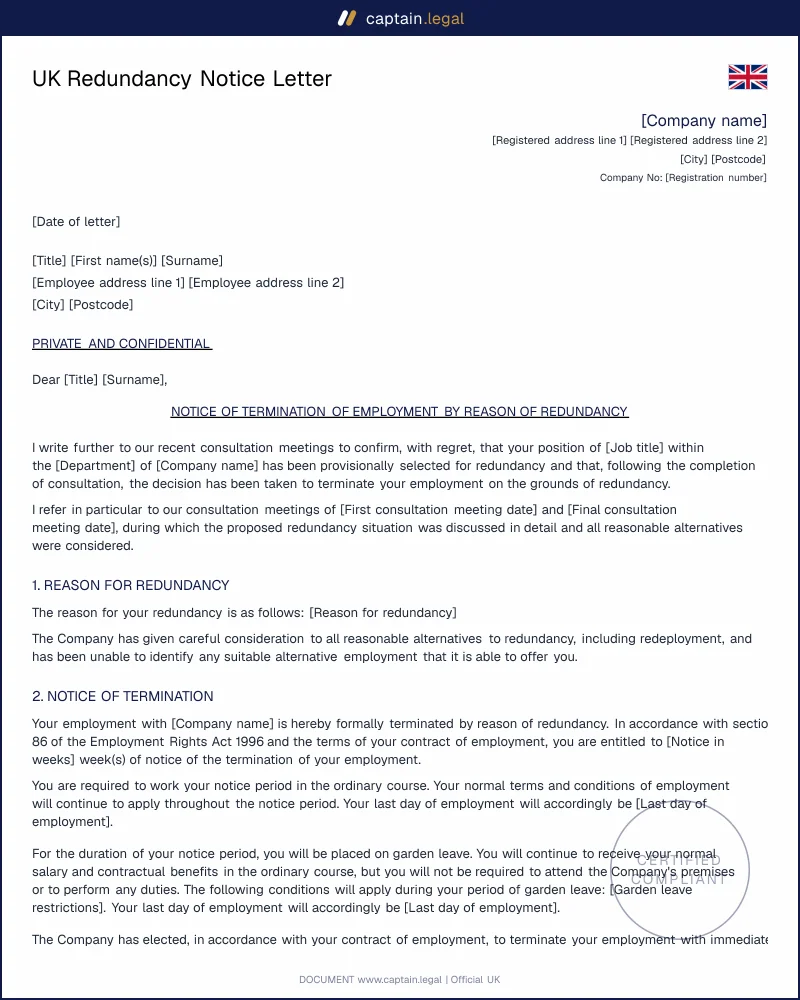
A redundancy notice letter is the formal written notification an employer sends to an employee whose role has become redundant, setting out the reason for the dismissal, the agreed termination date, the calculation of the statutory redundancy payment owed and the employee's right to reasonable time off to look for new work. Issued at the close of a fair consultation cycle, the letter is the document an employment tribunal will read first when deciding whether the dismissal was genuinely on grounds of redundancy and whether the procedure met the standards set by the Employment Rights Act 1996. Captain.Legal generates a UK-compliant redundancy notice letter tailored to your jurisdiction, your headcount and the individual employee's length of service.
Compliant
2026 Legislation
50,000+ clients
trust us
Affordable
From $4.90 / doc
Secure payment
Instant download
UK Redundancy Notice Letter | Statutory Pay & Notice
Secure payment
What is a redundancy notice letter?
A redundancy notice letter is the written communication confirming that an employee's employment will end on grounds of redundancy as defined by section 139 of the Employment Rights Act 1996. The letter typically follows a documented selection process and a series of individual consultation meetings, and is issued only once the employer has reached the genuine decision to terminate the contract. In legal terms, it is simultaneously a notice of termination under section 86 ERA 1996 and the trigger for entitlement to a statutory redundancy payment under section 135 ERA 1996, provided the employee has accrued at least two years of continuous service. Most employers issue the letter on company letterhead, deliver it by hand at a face-to-face meeting and follow up with a copy sent by recorded post.
The letter must not be confused with neighbouring documents that sit elsewhere in the workflow. A consultation invitation letter opens the process and explains the proposed redundancy situation; an at-risk letter places an employee in the pool of those potentially affected without yet confirming termination. Only the redundancy notice letter dismisses the employee. The letter is also distinct from a settlement agreement, which extinguishes the employee's tribunal claims in exchange for an enhanced payment and must satisfy the formalities of section 203 ERA 1996. The notice letter, by contrast, is unilateral: it imposes the termination on the agreed date and triggers the statutory entitlements, without itself settling any future claim. Our UK employment law document library keeps the at-risk, consultation and notice templates aligned so the file stays internally consistent.
Legal framework
The statute that defines redundancy and prescribes the bulk of the procedure is the Employment Rights Act 1996. Section 139 sets the three-limb test that determines whether a dismissal genuinely qualifies as redundancy: cessation of the business as a whole, closure of the specific workplace where the employee is engaged, or a diminution in the requirement for employees to carry out work of a particular kind. Section 135 establishes the right to a redundancy payment for any employee dismissed under that section who has at least two years of continuous service, and section 162 lays down the calculation formula. The formula reads age and length of service together: half a week's pay for each completed year of service under the age of 22, one week's pay for each year between 22 and 40, and one and a half weeks' pay for each year from 41 onwards, capped at 20 years of reckonable service and subject to the statutory weekly pay limit set annually by Order of the Secretary of State. Section 86 ERA 1996 fixes the statutory minimum notice period, which rises from one week after a month of service to a ceiling of twelve weeks after twelve years.
Collective redundancies sit under a parallel statute. The Trade Union and Labour Relations (Consolidation) Act 1992 requires employers proposing 20 or more dismissals at one establishment within a 90-day window to consult with appropriate representatives for a minimum of 30 days, extending to 45 days where 100 or more dismissals are proposed. The same Act compels notification to the Secretary of State on form HR1, with criminal penalties for default. Layered on top, the Employment Rights Act 2025 tightens fire-and-rehire practices and aligns the consultation triggers more closely with the position summarised in the GOV.UK guidance on redundancy rights and the statutory redundancy payments scheme, the official reference document on the calculation tables and the cap on a week's pay.
When do you need this document?
The most common trigger is a single-employee redundancy following the closure of a role within a small or medium-sized business: a finance assistant whose duties have been absorbed by automation, a regional sales manager whose territory has been merged with the rest of the country, or a warehouse operative whose shift pattern has been discontinued. In each of these scenarios, individual consultation is mandatory under the Polkey v AE Dayton Services line of authority, and the notice letter is issued only once the consultation cycle has closed.
The second scenario is the multi-employee redundancy that falls below the 20-employee threshold for collective consultation. A firm planning to make five roles redundant in a single department still owes each affected employee a fair individual process, but is not subject to the 30-day pause imposed by the TULRCA 1992. The notice letter is the same in form, with the consultation timeline compressed.
The third use case is the larger restructuring that does trigger collective consultation. Here, the notice letter is preceded by a longer cycle of representative consultation, an HR1 filing with the Insolvency Service and the documented selection of employees from a defined pool. Watch the timing carefully: serving notice before the statutory 30 or 45-day consultation period has elapsed is the textbook route to a protective award of up to 90 days' pay per affected employee. One edge case worth flagging is the TUPE transfer scenario, where the transferee makes redundancies post-transfer for economic, technical or organisational reasons, a situation drafted alongside the rest of our UK business and corporate templates.
Key clauses included in our template
Our redundancy notice letter is structured around the disclosures a tribunal expects to see in a defensible procedure, then layered with the practical wording that protects the employer from common downstream claims.
- The identification of the parties and the role made redundant opens the letter with the employee's full name, position and start date, alongside the legal identity of the employer. The clause anchors the section 139 ERA 1996 test by naming the specific role that has ceased to be required, which forecloses any later argument that the dismissal was in reality for capability or conduct.
- The statement of the genuine redundancy situation sets out which of the three statutory limbs applies and summarises the underlying business reason. Vague phrasing such as "operational reasons" is replaced by a specific narrative tying the dismissal to the cause, supported where appropriate by reference to the consultation papers shared during the process.
- The calculation of the statutory redundancy payment itemises continuous service from the date established under section 211 ERA 1996, applies the age-based multipliers of section 162 and references the statutory cap on a week's pay. The clause shows the workings on the face of the letter, which removes one of the most common sources of post-termination disputes.
- The statement of notice and last working day sets the termination date, identifies whether the employee will work the notice or receive payment in lieu of notice under the contract, and confirms how accrued but untaken holiday will be paid out under the Working Time Regulations 1998.
- The right to reasonable time off to look for work invokes section 52 ERA 1996 expressly, sets the practical mechanism for requesting that time off and confirms the cap of two-fifths of a week's pay applied across the notice period.
- The right of appeal offers the employee a route to challenge the decision in line with the ACAS Code of Practice on Disciplinary and Grievance Procedures, identifies the appropriate appeal officer and sets a deadline for written grounds.
Regional considerations
England and Wales form the default jurisdiction for the template. Employment tribunals sit in regional centres, the ACAS Code of Practice on Disciplinary and Grievance Procedures applies in full and the pool-selection principles laid down in Williams v Compair Maxam [1982] continue to govern fair criteria. Market practice is to align the termination date with the payroll month and to provide a written calculation of redundancy pay using the tables maintained by the Department for Business and Trade. Be careful with the pool definition: a pool drawn too narrowly to give a genuine choice is the most frequent ground for a successful unfair dismissal claim, and a tribunal will look behind the labels at the underlying selection logic.
Scotland applies the same substantive law of the Employment Rights Act 1996, but procedure runs through the Scottish Employment Tribunals system. The notice letter should specify Scots law as the governing law of contract where the employment relationship is centred north of the border, and reference any clause derived from Scottish authorities such as the Bluebell Apparel v Dickinson line on restrictive covenants where these survive the termination. Public-holiday entitlements differ because Scotland observes Saint Andrew's Day and certain regional bank holidays, which the holiday-accrual paragraph of the letter adjusts once you select Scotland in the configurator. The Sheriff Court rather than the County Court is the relevant forum for any wrongful-dismissal contract claim above the tribunal cap.
Northern Ireland operates under the Employment Rights (Northern Ireland) Order 1996, a parallel statute that mirrors the Great Britain regime but is not identical. The tribunal system is run by Industrial Tribunals and the Labour Relations Agency Code of Practice replaces the ACAS code, although the substantive principles converge. Statutory redundancy pay is calculated on the same age-and-service formula, with a separate weekly cap reviewed annually by the Northern Ireland Assembly. Bank holidays differ markedly because of the additional days observed locally, and the template flags every paragraph where the wording switches to the Northern Irish equivalent. Employers operating across all three jurisdictions usually maintain three parallel versions of the letter rather than a single hybrid document, because the tribunal procedures, governing-law clauses and statutory references diverge in ways that cannot be papered over with generic language.
How to fill out this redundancy notice letter
The configurator on Captain.Legal walks you through the letter in the order an experienced HR director would draft it. You start by selecting the jurisdiction, since that choice cascades through the references to ERA 1996, the Employment Rights (Northern Ireland) Order 1996 and the relevant tribunal system. From there, the form captures the legal identity of the employer, the registered address and the company number that will appear in the letterhead.
The employee block follows, with the full legal name, the role title, the start date that anchors continuous service for the section 162 calculation and the date of birth required for the age-based multipliers. The configurator then offers a structured field for the redundancy situation, with three preset templates aligned to the three limbs of section 139. The redundancy pay calculation engine populates automatically from the dates and the contractual weekly pay you enter, applies the statutory cap and prints the workings on the face of the letter.
You then choose whether the employee will work the notice period or receive payment in lieu, confirm the wording on the section 52 ERA 1996 time-off right and nominate the appeal officer. The letter is generated in Word and PDF and stored in your dashboard alongside the rest of your UK personal documents library for re-use across the rest of the process.
Common mistakes to avoid
The single most expensive mistake is serving the notice letter before the consultation process has genuinely concluded. A letter dated within the statutory 30 or 45-day collective consultation window is the textbook trigger for a protective award of up to 90 days' pay per affected employee, even where the underlying redundancy reason is genuine. A second classic error is calculating the redundancy pay against actual weekly earnings rather than the contractual weekly figure: the statutory formula in section 162 ERA 1996 operates on a notional week's pay subject to the statutory cap, not on the employee's headline salary. The third recurring problem is the omission of the section 52 right to time off to look for work, which the employee can enforce through a separate tribunal claim regardless of the validity of the underlying dismissal.
A fourth mistake is the selection-pool error: defining the pool too narrowly to give the appearance of choice, then dismissing the only employee in it. The Williams v Compair Maxam criteria require a genuine, defensible pool with objective selection criteria, and charities running redundancy programmes face additional Charity Commission scrutiny on this point, which is why our UK charity and governance templates include the scoring matrices that document the selection trail. The fifth and most easily avoided error is the failure to offer a right of appeal, an ACAS Code requirement whose absence routinely adds an uplift of up to 25 per cent to any successful tribunal award.
Frequently Asked Questions
24 verified reviews · 50 000+ downloads
- Immediate access to the document
- PDF + Word download
- Compliant with 2026 legislation
- Reviewed by lawyers
You might also like