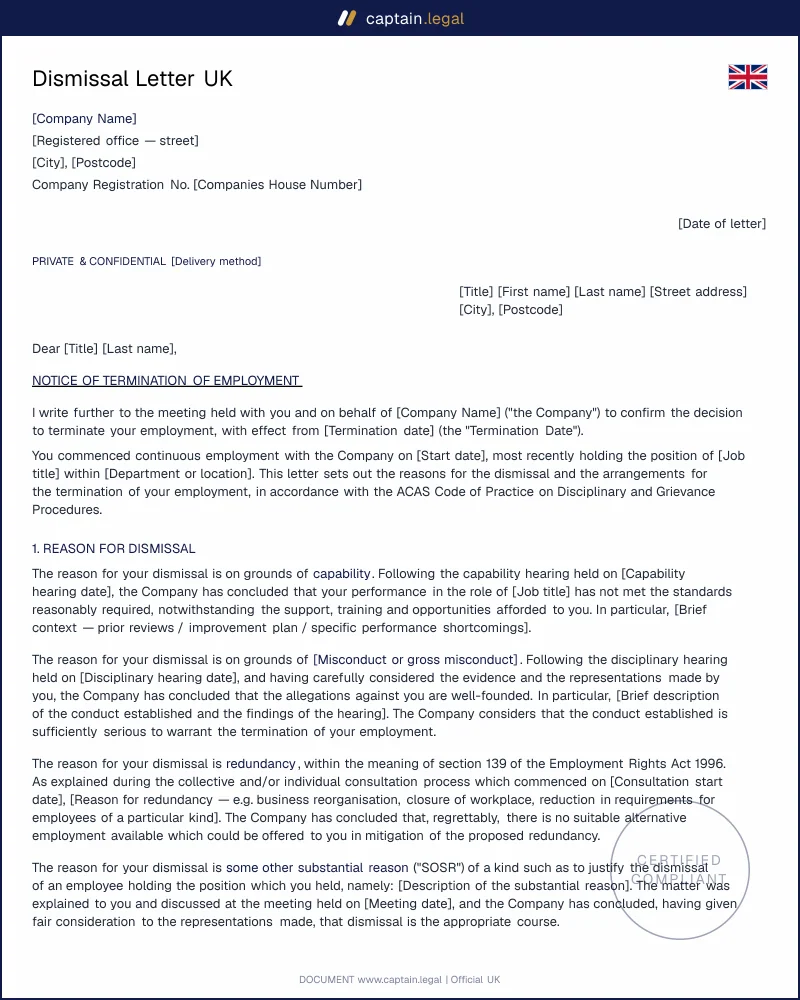
A dismissal letter is the written record of a UK employer's decision to end an employment relationship, setting out the reason for dismissal, the effective date and the applicable notice period. It is not a procedural nicety. Under the Employment Rights Act 1996 and the Acas Code of Practice on Disciplinary and Grievance Procedures, this paperwork is one of the first things an employment tribunal scrutinises when deciding whether a dismissal was fair. The template covers the five potentially fair grounds an employer can rely on, capability, conduct, redundancy, statutory illegality and some other substantial reason, with the correct procedural framing built in. It is drafted for directors, HR managers and line managers in UK businesses who need to issue a defensible notice of termination without rewriting boilerplate from an outdated precedent.
Compliant
2026 Legislation
50,000+ clients
trust us
Affordable
From $4.90 / doc
Secure payment
Instant download
Dismissal Letter UK | ACAS Code Compliant
Secure payment
What is a dismissal letter?
A dismissal letter is the formal written instrument by which an employer terminates a contract of employment, identifying the legal reason for the decision, the effective date and the notice arrangements. In English and Welsh employment law it serves two distinct functions. First, it operates as the contractual notice required under section 86 of the Employment Rights Act 1996 or under the employee's written terms, whichever period is longer. Second, it is the principal item of evidence in any subsequent tribunal claim, because tribunals read what the employer said at the time, not what the employer would later prefer it had said.
It is often confused with a termination agreement or a settlement agreement under section 203 ERA 1996. The two are not interchangeable. A dismissal letter is a unilateral act by the employer; a settlement agreement is a bilateral document signed after independent legal advice, compromising statutory claims in exchange for an agreed sum. The Acas Code sits on top of both. Where dismissal is for conduct or capability, the Code expects the employer to investigate, hold a disciplinary hearing, give the employee a fair chance to respond, and offer a right of appeal. Skipping any of these steps does not invalidate the letter, but it can increase any tribunal award by up to 25 per cent.
Legal framework
The backbone statute is the Employment Rights Act 1996. Section 94 confers the right not to be unfairly dismissed on employees with at least two years' continuous service. Section 98 then sets out the five potentially fair reasons: capability or qualifications, conduct, redundancy, statutory illegality, and some other substantial reason of a kind such as to justify dismissal. A dismissal letter must align with one of these grounds and cannot mix categories in a single act. Recording a redundancy as a capability issue, or the other way around, is the single most common reason employers lose at tribunal.
Procedure is governed by the Acas Code of Practice on Disciplinary and Grievance Procedures, issued under section 199 of the Trade Union and Labour Relations (Consolidation) Act 1992. The Code applies to conduct and capability dismissals; it does not apply to redundancy or to the non-renewal of fixed-term contracts on their expiry, although fairness still requires consultation in both cases. The full text of the Code is published by the Acas statutory code on disciplinary and grievance procedures, and forms the baseline a tribunal will measure your process against. An unreasonable failure to follow the Code allows a tribunal to increase any award by up to 25 per cent; an unreasonable failure by the employee can reduce it by the same proportion.
Notice rights sit in layers. The contract sets one period and section 86 ERA 1996 sets a statutory floor: one week after one month's service, then one week per completed year up to a maximum of twelve. The longer of the two applies. Discrimination law, principally the Equality Act 2010, runs in parallel: a dismissal that is fair on its facts can still be unlawful if a protected characteristic was a meaningful reason for the decision. Our UK employment law templates library is structured around that overlap, so the dismissal letter speaks to both regimes without forcing the user to know either by heart.
When do you need this document?
The most common trigger is gross misconduct, where dishonesty, violence, or serious breach of policy makes summary dismissal a proportionate response. Even here, "summary" does not mean "without process". A tribunal will expect a documented investigation, a disciplinary hearing and a written outcome before any letter goes out. Issuing a dismissal letter the same day the misconduct is reported is a tribunal's red flag, because it suggests the decision was made before the employee was heard.
The next category is capability dismissals, where an employee cannot perform to the required standard after support and a formal improvement plan. These cases turn on the paper trail: appraisals, formal warnings, clear targets. A capability letter that lands without any prior written warning is rarely defensible, however genuine the underlying performance issue.
Redundancy drives a different process but the same end document. Where a role is genuinely no longer required, the letter records the end of consultation and the agreed leaving date, and crystallises the statutory redundancy payment under sections 162 and 163 ERA 1996. Statutory illegality typically arises when an employee loses the right to work in the UK or a professional qualification is revoked; the letter has to refer to the specific legal bar, not to a generic phrase, because vague wording invites a discrimination claim. Finally, some other substantial reason covers irretrievable breakdown of trust, third-party pressure, or refusal to accept reasonable contract changes during a restructure. SOSR is legally narrow, and the letter has to be precise about facts and timing. Charity trustees acting as employers face an additional governance overlay, and our UK charity governance templates cover the trustee-side documentation that runs alongside the dismissal.
Key clauses included in our template
- The identification of the parties must name the employee in full with job title and PAYE reference, and the precise trading entity that is the employer. Group structures matter here: the wrong company name on the letter can void the notice and force the employer to restart the process.
- The statement of dismissal and effective date sets out clearly that the relationship is ending, on what date, and whether the employee will work the notice period, be placed on garden leave, or receive payment in lieu of notice (PILON). Vague phrasing like "your employment will come to an end shortly" has been treated by tribunals as ambiguous and unenforceable.
- The stated reason for dismissal is drafted to one of the five categories under section 98 ERA 1996, anchored to the specific facts found at the disciplinary hearing. A reason recorded as "underperformance" without supporting evidence is almost always unwound on appeal, because the employer has not engaged with the statutory test of fairness.
- The notice and final pay schedule reconciles contractual notice with the statutory minimum under section 86 ERA 1996, sets out accrued but untaken holiday pay calculated to the effective date, and itemises any vested bonus or commission. Where PILON is used, the post-employment notice pay tax treatment is flagged so payroll can withhold correctly.
- The right of appeal is set out in line with paragraph 26 of the Acas Code of Practice, including the time limit for lodging an appeal and the manager who will hear it. Omitting this clause is the single fastest way to add 10 to 25 per cent to a tribunal award.
- The return of property and post-termination obligations clause covers laptops, phones, access cards, confidential information, and any restrictive covenants. Where the role included tied or service accommodation, the letter cross-references the housing arrangement, which sits alongside our UK tenancy and property templates.
Devolved nuances across the UK
Employment law is largely reserved to Westminster, so the Employment Rights Act 1996, the Equality Act 2010 and the Acas Code of Practice apply across England, Wales, Scotland and Northern Ireland. The procedural overlay, however, is not identical in every nation, and a dismissal letter drafted as if the UK were a single jurisdiction can fail on appeal.
Scotland uses the same statutory framework, but claims are heard by the Employment Tribunals (Scotland) with their own practice directions on disclosure and on the form of dismissal documentation lodged as a production. Northern Ireland is a distinct jurisdiction altogether. The equivalent of the Acas Code is the Labour Relations Agency Code of Practice on Disciplinary and Grievance Procedures, and claims go to the Industrial Tribunals and the Fair Employment Tribunal. The Employment Rights (Northern Ireland) Order 1996 mirrors much of the British ERA but with its own section numbering, and any reference to the Acas Code in a NI dismissal letter should be substituted for the LRA Code. Employers running payroll from a single GB head office often miss this, and a Northern Ireland tribunal will treat the wrong citation as evidence of a flawed process. In Wales, the Welsh language provisions can apply where the employer routinely operates in Welsh, with bilingual dismissal documentation expected for Welsh-speaking employees.
How to fill out this dismissal letter
You start by selecting the reason for dismissal from the five categories under section 98 ERA 1996. The form adjusts immediately, surfacing the right procedural questions for conduct, capability, redundancy, illegality or SOSR, and dropping clauses that do not apply. Choosing conduct, for example, brings up fields for the date of the investigation meeting, the date of the disciplinary hearing and a summary of the facts found, because those are the items a tribunal will want to see.
You then complete the identification block, the effective date, the notice arrangements (worked notice, garden leave, or PILON) and the final pay calculation. The system applies the statutory notice floor under section 86 ERA 1996 against any contractual period and warns you if the contractual minimum sits below the statutory one. Holiday pay is calculated to the effective date based on the figures you provide.
The appeal clause is drafted automatically to the Acas Code, or to the LRA Code if you select a Northern Ireland workplace, with the time limit and the named appeal manager pulled into the body of the letter. You finalise the references to the contract of employment, sign electronically or print for wet signature, and download the document in editable Word and final PDF formats. Our UK personal document templates handle the related individual paperwork if the employee needs a counterpart acknowledgement.
Common mistakes to avoid
The most frequent error is conflating dismissal with the disciplinary outcome. The letter records the decision, but the decision must have been taken at the disciplinary hearing, with the employee present and given a chance to respond. A letter dated the same day as the alleged misconduct, with no recorded hearing in between, reads as predetermined and is regularly overturned. Tribunals look for at least a few working days between investigation, hearing and outcome letter.
Employers also routinely understate the notice period, defaulting to one week or one month without checking the statutory floor. Section 86 ERA 1996 gives one week per completed year of service up to twelve. An employee with nine years' service is entitled to nine weeks' notice or pay in lieu, regardless of what the contract says. Underpaying creates a wrongful dismissal claim that is straightforward to win and difficult to defend.
A third recurring error is omitting the right of appeal, particularly for misconduct dismissals at smaller employers; tribunals treat its absence as a presumption of unfairness. The same applies to vague reasons: "for various reasons we have decided to end your employment" is not a reason recognised by section 98. Finally, in redundancy scenarios, employers often issue a dismissal letter before consultation has properly concluded, which can collapse the entire process and trigger a protective award. Our UK business documents catalogue provides the related corporate restructuring templates where redundancy sits inside a broader reorganisation.
Frequently Asked Questions
31 verified reviews · 50 000+ downloads
- Immediate access to the document
- PDF + Word download
- Compliant with 2026 legislation
- Reviewed by lawyers
You might also like