A statement of written particulars is the written record of the essential terms of employment that every UK employer must hand to a new joiner on or before their first day of work. It is the first document HMRC, ACAS and the employment tribunal will look at if a dispute arises about pay, hours, notice or holiday. Since the Good Work Plan reforms of 6 April 2020, the right applies to both employees and workers, and the old two-month grace period has been abolished. This page covers what the document must contain, what section 1 of the Employment Rights Act 1996 actually requires, and how a compliant section 1 statement is built in practice.
Compliant
2026 Legislation
50,000+ clients
trust us
Affordable
From $4.90 / doc
Secure payment
Instant download
Section 1 Statement Template UK | Day-One Compliance
Secure payment
What is a statement of written particulars?
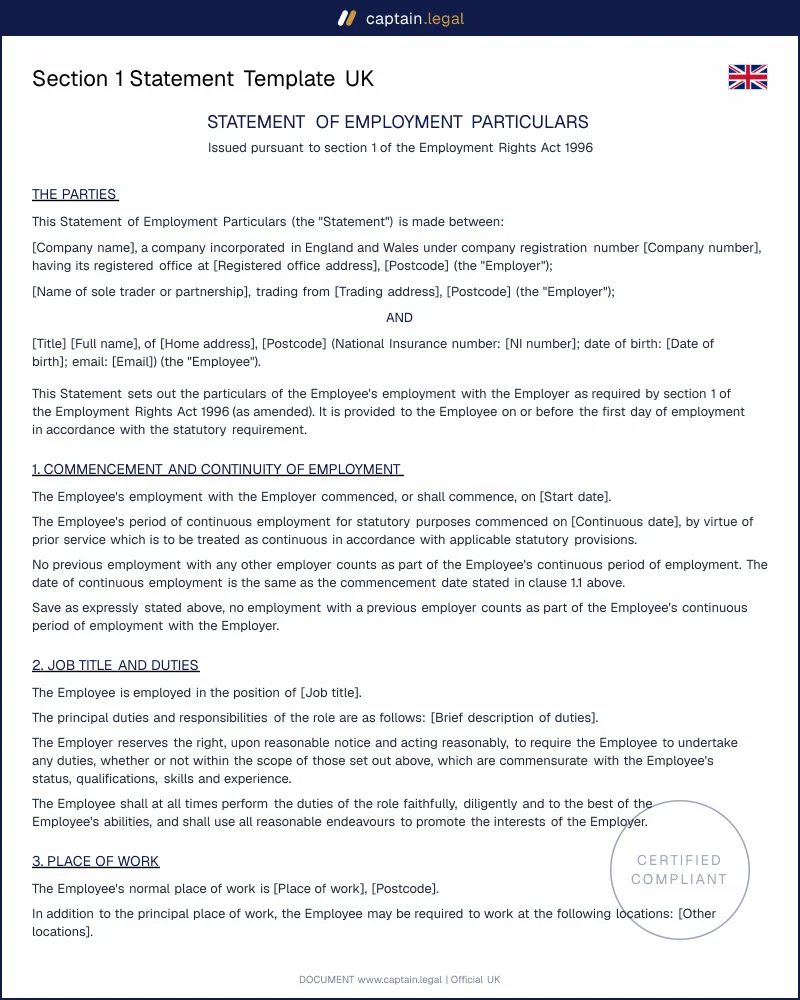
A statement of written particulars is the document, mandated by section 1 of the Employment Rights Act 1996, that sets out the principal terms on which a worker is engaged by a UK employer. It is sometimes called a section 1 statement, a written statement of employment particulars, or, loosely, an employment contract. Strictly speaking it is not the same thing as the contract of employment. The contract can exist orally or be inferred from conduct, while the statement is a stand-alone written record that the law requires you to hand over, regardless of whether a longer signed contract exists.
The practical effect is that the statement carries near-contractual weight in front of a tribunal. Judges treat the particulars as strong evidence of the agreed terms, and they treat their absence as a red flag. If you only have one HR document in place, this is the one. Most UK employers combine the statement with a fuller contract of employment, which is good practice : you satisfy section 1 and you also deal with confidentiality, intellectual property assignment and post-termination restrictions in the same document. Within the broader library of UK employment law templates available on Captain.Legal, the statement of particulars sits at the foundation of every other letter, warning and dismissal document. If the underlying terms are not fixed in writing, the rest of the paperwork rests on sand.
Legal framework
The statutory backbone is section 1 of the Employment Rights Act 1996, supplemented by sections 2 to 7B and amended by The Employment Rights (Employment Particulars and Paid Annual Leave) (Amendment) Regulations 2018 (SI 2018/1378), which came into force on 6 April 2020 as part of the Good Work Plan. Two changes from those regulations matter in practice. First, the obligation to provide the statement now arises on or before the first day of employment, not within two months as before. Second, the right was extended to workers, not just employees, which captures most casual staff, zero-hours operatives, and many directly engaged agency contributors.
The mandatory contents are set out in section 1(3) and 1(4). The statement must contain the names of the parties, the dates of employment and continuous service, the rate of pay and intervals at which it is paid, the hours of work and any variable patterns, the holiday entitlement, the job title or a brief description of the role, the place of work, the length of the engagement if not permanent, and the notice periods on each side. Since April 2020 it must also cover the probationary period, any training entitlement, paid leave beyond holiday, other benefits, and a note on disciplinary and grievance procedures. Pension arrangements, collective agreements and sick pay must be addressed, though some details may be referred to a separate accessible document under section 2.
The enforcement mechanism is subtler than employers often realise. There is no free-standing claim for failing to provide a statement, but section 38 of the Employment Act 2002 allows a tribunal to award two to four weeks' pay on top of any successful claim where the employer was in breach at the date of proceedings. The cap on a week's pay applies, yet the principle is clear : a missing or defective statement turns a winnable case into a more expensive one. The authoritative starting point for the wording itself is the consolidated text of section 1 of the Employment Rights Act 1996 on legislation.gov.uk, which carries the current annotations and commencement notes.
When do you need this document?
The most obvious trigger is a new hire : whether the recruit is a part-time receptionist on twelve hours a week or a senior manager on a six-figure package, the statement is due on or before day one. There is no minimum service threshold, no probation exception, and no opt-out for short engagements. The right is a day-one right, and the clock starts on the date physically worked, not on the day the contract was signed or the offer accepted.
The second common situation is a material change to existing terms. Section 4 of the Employment Rights Act 1996 requires the employer to give a written statement of any change in any of the matters specified in sections 1 to 3, at the earliest opportunity and in any event within one month. Promotions, pay rises that change the rate of pay, shifts in working hours, a new place of work : all of these need a written update.
A third scenario, often overlooked, is the conversion of a worker into an employee, or the formalisation of a contractor relationship that has drifted into something closer to employment. Founders making their first hires while still finalising the company set-up paperwork for UK businesses frequently fall into this trap : they engage a "freelancer" who in practice works set hours under direction, and they never issue a statement. Treat this as a flashing red light. Two edge cases close the list : TUPE transfers, where the incoming employer inherits the obligations and must reissue particulars for any post-transfer variation; and employees seconded abroad for more than a month, who need additional information about currency of pay and return arrangements under section 1(4)(k).
Key clauses included in our template
The template is structured around the section 1 checklist, with the additional drafting a UK employer actually needs today. Every clause has been drawn from current practice in employment law firms and refined against the Good Work Plan amendments.
- The identification of the parties and the start dates is precise to the letter. The statement gives the legal name of the employer (with company registration number where applicable), the worker's full legal name, the date the engagement began, and the date continuous employment started taking into account any transferred service under TUPE or associated-employer rules. A miscalculated continuity date can quietly inflate or destroy unfair dismissal eligibility two years later.
- The remuneration block sets out the rate of pay, the intervals at which it is paid, and the method of calculation where pay is variable. The clause references National Minimum Wage Act 1998 compliance for hourly staff and includes the formula for any commission, bonus or overtime, so that wage deductions cannot be challenged later under section 13 ERA 1996.
- The working time clause covers normal hours, variable patterns, overtime and night work, integrating the Working Time Regulations 1998 limits and the 48-hour weekly opt-out where relevant. Holiday entitlement is expressed in weeks plus a clear method for calculating accrual on a pro rata basis for part-year and irregular-hours workers.
- The probationary period clause specifies the length, any extension mechanism, the shortened notice that applies during probation, and the performance review steps. This addition has been required in writing since April 2020 and is one of the most frequently missed items in legacy templates.
- The termination and notice clause sets out the statutory minima under section 86 ERA 1996 and any enhanced contractual notice, together with garden leave, pay in lieu of notice, and the right to make deductions on final salary in defined circumstances.
- The benefits, disciplinary and grievance note lists or refers to the relevant procedures and entitlements in line with section 3 ERA 1996, with the option to incorporate the ACAS Code of Practice on Disciplinary and Grievance Procedures by reference.
Variations by status and sector
Since 6 April 2020 the same statutory framework applies to workers and employees alike, but the practical drafting differs in important ways depending on the type of engagement.
Permanent employees receive the standard form of the statement, integrated with the full contract of employment. This is the version covering ordinary full-time and part-time staff on indefinite contracts, where notice periods follow section 86 ERA 1996 (one week per year of service, capped at twelve), and where probation, pension auto-enrolment and the full ACAS Code apply. The statement should always be paired with the substantive contract document where post-termination restrictions or confidentiality protections are needed.
Fixed-term employees require additional drafting around the non-renewal terms, the expiry date or specified event, and the equality-of-treatment principles imposed by the Fixed-term Employees (Prevention of Less Favourable Treatment) Regulations 2002. After four years of continuous fixed-term service the engagement converts to permanent unless objectively justified, and the statement must be drafted with that conversion risk in view from day one.
Zero-hours and casual workers receive a statement structured around the requirement to describe the terms relating to hours, including any obligation to accept or decline work. The drafting intersects with section 27A ERA 1996 on exclusivity clauses, which are void in zero-hours contracts, and with the predictable working patterns regime introduced by the Workers (Predictable Terms and Conditions) Act 2023. Get this wrong and the entire engagement model can be challenged.
Sector-specific considerations apply to hospitality and property-management businesses, where workers move between multiple sites. The "place of work" clause needs to specify the principal site or the range of sites, not a single address. Employers running rental portfolios benefit from coordinating their HR paperwork with the UK property and tenancy template suite on Captain.Legal, so that house-keepers, caretakers and on-site managers are documented coherently across both the property and the employment file.
How to fill out this statement of written particulars
The Captain.Legal generator opens with a short orientation question : are you issuing a brand-new statement, recording a change to existing particulars under section 4 ERA 1996, or producing a full contract of employment that incorporates the statement. The answer routes you to the correct template variant. From there you enter the employer details, including the trading name, registered address, and company number where applicable.
The next block deals with the worker : full legal name, address, start date, and any earlier continuous-service date carried over from a previous engagement. The tool prompts you to confirm right-to-work status and to flag any TUPE inheritance, because both affect the wording of the continuous-service clause. You then move through the substantive terms in the order they appear in section 1(3) and 1(4) : pay, hours, holiday, place of work, job title, probation, notice. The form does not let you skip the mandatory items, by design. Where a particular does not apply, the generator inserts the required "no particulars" wording under section 2(1).
The final stage is signature and delivery. You can sign electronically within the platform, download as Word for further customisation, or download as PDF for printed delivery. A clean signed copy goes to the worker on or before the first day; you keep the original on file. Many employees treat the signed statement as a foundational piece of their own paperwork, alongside the personal legal forms catalogue for individuals in the UK, when later applying for a mortgage, a visa or a credit reference.
Common mistakes to avoid
The first mistake is issuing the statement too late. Before April 2020 you had two months; you no longer do. A statement handed over in the second week, however thorough, is non-compliant on its face, and the breach crystallises immediately. The second is treating workers as outside the regime. Casual staff, zero-hours operatives and many directly engaged agency workers all sit within section 1 and receive the same day-one right as employees. Charities in particular often assume their stipend-funded staff are outside the rules, when in reality many meet the worker definition under section 230(3)(b) ERA 1996. Trustees of organisations registered through the Captain.Legal catalogue of UK charity governance documents should review every paid engagement against the worker test before defaulting to a volunteer agreement.
The third mistake is using a generic contract template drafted before 2020 and never updated. The giveaways are the absence of a probationary period clause, the lack of a training entitlement, no reference to a disciplinary procedure, and a stale "within two months" service clause carried forward from older precedent. The fourth is failing to issue a written change when terms move. A pay rise without written confirmation breaches section 4 ERA 1996, even though no employee will complain about the rise itself. The fifth and final mistake is conflating the statement with the offer letter. An offer letter is conditional and precedes the engagement; the statement comes on or before day one and is unconditional. Treating one as the other is the classic small-business misstep, and it surfaces only when the worker resigns and asks for written terms in tribunal pre-action correspondence.
Frequently Asked Questions
47 verified reviews · 50 000+ downloads
- Immediate access to the document
- PDF + Word download
- Compliant with 2026 legislation
- Reviewed by lawyers
You might also like