A commercial lease agreement is the written contract under which a landlord grants a business tenant the right to occupy premises for trade, professional or industrial use in England and Wales. It governs everything from rent reviews and repairing obligations to break clauses and the question that decides every commercial letting in this jurisdiction: whether the tenancy is granted inside or outside the security of tenure regime of Part II of the Landlord and Tenant Act 1954. Whether you are letting a high-street shop in Manchester, an office floor in the City of London, a light-industrial unit in the Midlands or a warehouse on the M25 corridor, the same statutory framework applies, and the drafting choices made on day one shape the parties' rights for the entire term and well beyond expiry.
Compliant
2026 Legislation
50,000+ clients
trust us
Affordable
From $4.90 / doc
Secure payment
Instant download
Commercial Lease Agreement UK | 1954 Act Compliant Template
Secure payment
What is a commercial lease agreement?
In English law, a commercial lease (also called a business tenancy or business lease) is a tenancy granted over premises occupied wholly or partly for the purposes of a business carried on by the tenant. The statutory definition in section 23(1) of the Landlord and Tenant Act 1954 is deliberately wide : "business" covers a trade, profession or employment, and any activity carried on by a body of persons, whether incorporated or not. A solicitor's office, a fish-and-chip shop, a yoga studio run by a sole trader, a logistics warehouse and a members' club all fall within the same regime.
The document is functionally distinct from an assured shorthold tenancy under the Housing Act 1988 and from a residential lease : it is not subject to the deposit protection rules, the section 21 / section 8 notice procedure, or the Tenant Fees Act 2019. It is also distinct from a licence to occupy, which gives only a personal permission and no estate in the land. The line between lease and licence was settled by the House of Lords in Street v Mountford [1985] : where exclusive possession is granted for a term at a rent, the agreement is a tenancy regardless of how the parties have labelled it. Mislabelling a lease as a licence does not avoid the 1954 Act ; courts will look at the substance, and the consequences for the landlord can be severe. For broader context on commercial property documentation, our UK real estate templates library covers the related instruments most landlords need alongside a lease.
Legal framework
The statutory backbone of every English commercial lease is Part II of the Landlord and Tenant Act 1954 (sections 22 to 46), the post-war code that gives qualifying business tenants what practitioners call security of tenure. The principle is straightforward in theory and treacherous in practice : where the Act applies, the tenancy does not automatically end on the contractual expiry date. Instead, it continues under section 24 until terminated by one of the statutory mechanisms, and the tenant has a statutory right to apply to the County Court for a new tenancy on terms set by the court if the parties cannot agree. This right is the single most valuable asset most business tenants hold, and the single most contentious issue most landlords face on lease expiry. The full text of Part II is publicly available on the UK government legislation portal for the Landlord and Tenant Act 1954 and remains essential reading before signing anything.
The 1954 Act was substantially modernised by the Regulatory Reform (Business Tenancies) (England and Wales) Order 2003 (SI 2003/3096), which came into force on 1 June 2004. The 2003 reforms abolished the old court-approved contracting-out procedure and replaced it with the current warning notice and tenant declaration regime prescribed by the Landlord and Tenant Act 1954, Part 2 (Notices) Regulations 2004 (SI 2004/1005). To exclude security of tenure validly, the landlord must serve a warning notice in the prescribed form before the lease is entered into, and the tenant must respond with either a simple declaration (where the lease is signed at least 14 days later) or a statutory declaration sworn before an independent solicitor (where the parties wish to proceed sooner). A defective contracting-out routinely leaves a landlord locked into a renewal it never intended to grant.
Termination is governed by a tight notice regime : the landlord serves a section 25 notice stating either proposed terms for a new tenancy or one of the seven grounds of opposition in section 30(1) ; the tenant may pre-empt by serving a section 26 request for a new tenancy ; and either party may apply to court within strict windows. The Law Commission opened a wide-ranging review of Part II in late 2024, with consultation responses now under analysis, so reform of the contracting-out model is foreseeable. Until any reform is enacted, the 1954 Act in its current form continues to govern every business letting in England and Wales.
When do you need this document?
The most common trigger is the first letting of business premises, where a landlord grants a fixed term of three, five or ten years to a tenant taking possession of a shop, office or unit. Even on a short term, a written commercial lease is essential : an oral agreement creates a tenancy at will or a periodic tenancy by operation of law, and neither gives the landlord the protections expected in a proper letting. A second frequent scenario is the renewal of an expiring lease, whether negotiated consensually under the 1954 Act or imposed by the court. The terms of the new lease are usually heavily based on the previous one, but rent reviews, repairing covenants and break rights are routinely renegotiated. Our suite of business legal documents for UK companies often runs alongside a lease when a tenant company is being incorporated or restructured at the same time as taking new premises.
A third use case is the assignment or underletting of an existing lease. Most modern commercial leases require the landlord's consent under section 19(1A) of the Landlord and Tenant Act 1927, and an authorised guarantee agreement is typically demanded under the Landlord and Tenant (Covenants) Act 1995. The underlease itself is a freestanding commercial lease and should be drafted as such, not as a casual side-letter. A fourth scenario, and one many landlords underestimate, is the post-term holdover : where a tenant remains in occupation after the contractual expiry of a lease that was not contracted out, section 24 of the 1954 Act keeps the tenancy alive on the existing terms until properly terminated. A landlord who accepts rent during this period without serving a section 25 notice may find renewal is no longer realistically resistible.
Edge cases worth flagging : pop-up lettings under six months are excluded from Part II by section 43(3), so a true short-term occupation can sit outside the regime altogether. And mixed-use premises, where a flat above a shop is let on the same lease, require careful drafting to avoid the residential element pulling the contract into the Housing Act 1988.
Key clauses included in our template
- The parties and demised premises clause identifies the landlord, tenant and any guarantor with full registered office addresses and company numbers, and defines the demise by reference to a plan and a measured area in line with the RICS Property Measurement standard. A vague demise is the source of most boundary disputes during the term ; the clause closes that door.
- The term and break provisions set the contractual length and any break rights, with the conditions for valid exercise drafted to the standards laid down in Mannai Investment Co Ltd v Eagle Star Life Assurance [1997]. Break clauses are notoriously easy to lose ; vacant possession, all sums paid and material compliance conditions are each tested rigorously.
- The rent and rent review clause specifies the initial rent, the payment dates (typically the usual quarter days), VAT treatment if the landlord has opted to tax under VATA 1994 Schedule 10, and the review pattern. Most modern reviews are upwards-only open market or RPI-linked with a collar and cap.
- The repairing covenant is the single most consequential financial clause for a tenant. A full repairing and insuring lease puts the entire fabric on the tenant ; a schedule of condition limits the obligation to the state recorded at commencement. The drafting choice can mean a six-figure dilapidations bill at expiry.
- The insurance covenant typically requires the landlord to insure and the tenant to reimburse the premium, with detailed provisions for reinstatement after damage and rent suspension during reinstatement.
- The alienation clause governs assignment, underletting, charging and parting with possession, qualified by the statutory reasonableness requirement and usually backed by an authorised guarantee agreement on assignment.
- The security of tenure clause is the make-or-break provision : it confirms whether the tenancy is granted inside or outside Part II of the 1954 Act and, where outside, recites the statutory contracting-out procedure with the dates of the warning notice and tenant declaration.
Regional considerations
England and Wales share a single statutory framework under the 1954 Act, but practical considerations vary noticeably by region and by sector, and good drafting reflects that.
London and the South East account for the bulk of office and prime retail lettings, and tenants here routinely negotiate harder for cap and collar rent reviews, shorter terms with tenant-only break options at the third or fifth year, and schedules of condition limiting repairing liability. The Model Commercial Lease, developed by a working group of City practitioners, is the de facto market standard in central London for office lettings above 5,000 sq ft and is used as a starting point in most negotiations.
Industrial and logistics lettings, particularly in the Midlands, the M62 corridor and the warehouse hubs around the M1, follow a different pattern. Landlords expect full repairing and insuring terms, longer initial commitments of ten to fifteen years, and yard areas defined precisely by reference to a plan because operational HGV access drives the lettable value. Service charge schedules are usually simpler than in multi-let offices but more contentious where estate-wide infrastructure is involved.
Wales applies the same 1954 Act regime, but commercial property in Wales also engages the Welsh Language (Wales) Measure 2011 for certain public-sector landlords and the Land Transaction Tax under the Land Transaction Tax and Anti-avoidance of Devolved Taxes (Wales) Act 2017, replacing SDLT for premises in Wales. A landlord granting a commercial lease over Welsh premises must engage the Welsh Revenue Authority rather than HMRC for the tax filing.
High-street retail across the country has been reshaped since the pandemic. Turnover rents have re-emerged in the discretionary retail and food-and-beverage sectors, and Code for Leasing Business Premises 2020 compliance is increasingly expected by institutional landlords. The Code is voluntary but is now embedded in many heads of terms, particularly where the tenant is a national operator. For tenants whose business model relies on a workforce based at the premises, our UK employment law document templates should be reviewed in parallel with the lease, since many obligations under the lease (signage, opening hours, health-and-safety) interact with employment policies.
How to fill out this commercial lease agreement
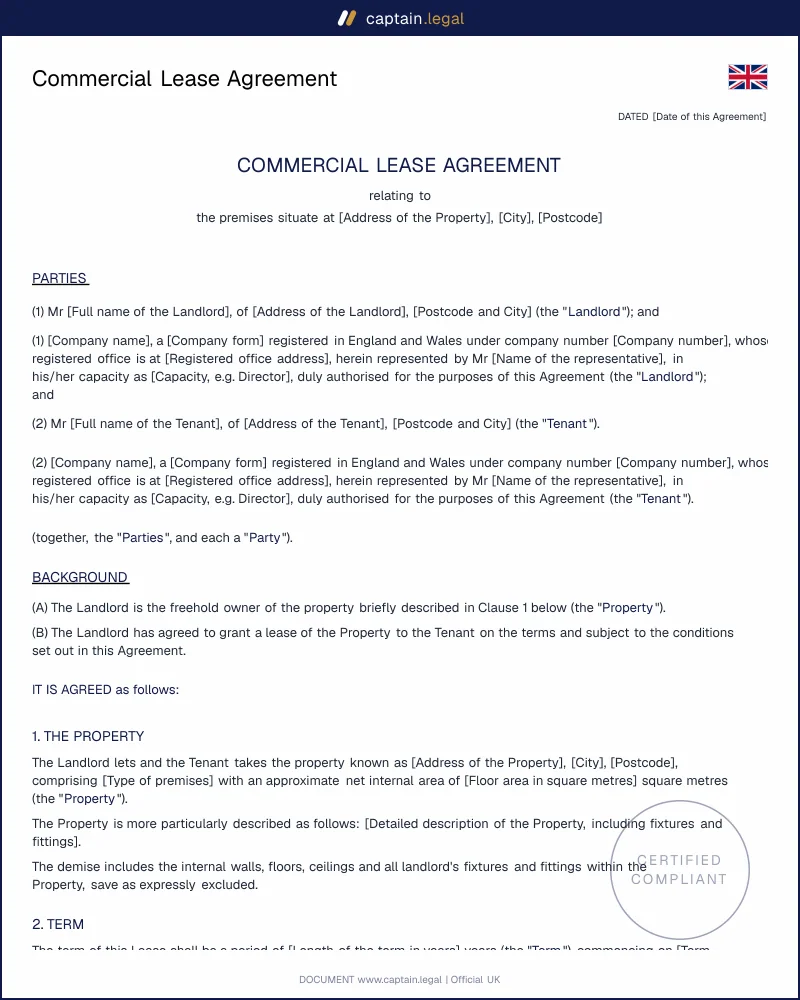
You begin by selecting whether the tenancy will be granted inside or outside the security of tenure provisions of Part II of the Landlord and Tenant Act 1954, because that single answer changes the structure of the document and the procedural steps required before signature. From there, the form asks for the parties : full names and registered addresses for company landlords and tenants, registered numbers from Companies House, and details of any guarantor whose covenant the landlord requires. The demised premises are described next, with a field for the address, the floor or unit, and an upload slot for a plan ; the template will warn you if the description is too vague to support a clean demise.
You then enter the commercial heads : term length, rent, payment frequency, VAT election status, rent review pattern, break dates and break conditions, repairing standard (FRI or limited by schedule of condition), insurance arrangement, and permitted use drafted to the Use Classes Order. The contracting-out section is generated only if you selected an excluded tenancy at the start, and it produces the prescribed warning notice and the matching tenant declaration or statutory declaration in the form mandated by SI 2004/1005, ready to be served and signed in the correct sequence. The completed lease, the warning notice and the declaration are then available together for download in Word and PDF, formatted for execution as a deed under section 1 of the Law of Property (Miscellaneous Provisions) Act 1989. If you handle multiple lettings, the full UK legal documents catalogue lets you reuse party details across leases, deeds of variation and licences to assign without re-keying.
Common mistakes to avoid
The most common drafting failure is botched contracting-out. Landlords frequently serve the warning notice late, sign the lease less than 14 days after a simple declaration, or accept a simple declaration where a statutory declaration sworn before an independent solicitor was required. Each of these defects leaves the tenancy fully protected by Part II despite the parties' clear intention to exclude it, and the landlord discovers the problem only when seeking possession years later. A second recurring error is sloppy break clause drafting : conditional breaks that require the tenant to deliver vacant possession, pay all sums due and remedy all breaches are routinely lost on technicalities, and every senior surveyor in the country has seen a multi-million-pound break invalidated because the tenant left fixtures in place that the lease deemed landlord's property.
A third category of mistake concerns repairing obligations. Tenants sign full repairing covenants over premises that were already dilapidated at the start of the term, without a schedule of condition limiting their liability, and face a Schedule of Dilapidations claim at expiry that wipes out the commercial benefit of the entire occupation. Fourth, alienation provisions are often drafted without reference to the Landlord and Tenant (Covenants) Act 1995 requirement for an authorised guarantee agreement, leaving the landlord with no recourse against an outgoing tenant when the assignee defaults. Finally, VAT treatment is regularly ignored at heads-of-terms stage. Where the landlord has opted to tax, the rent and service charge become standard-rated, and a tenant whose own supplies are exempt cannot recover the input VAT, materially changing the economics of the deal.
Frequently Asked Questions
20 verified reviews · 50 000+ downloads
- Immediate access to the document
- PDF + Word download
- Compliant with 2026 legislation
- Reviewed by lawyers
You might also like