UK maternity leave sits on two statutory pillars. The right to Statutory Maternity Leave comes from the Employment Rights Act 1996 and the Maternity and Parental Leave etc. Regulations 1999; the right to Statutory Maternity Pay comes from the Social Security Contributions and Benefits Act 1992 and the Statutory Maternity Pay (General) Regulations 1986. Every employee, regardless of length of service or hours, is entitled to 52 weeks of leave split into 26 weeks of Ordinary Maternity Leave and 26 weeks of Additional Maternity Leave. Pay is a separate test with its own qualifying conditions, which is why an employee can be fully entitled to leave yet receive Maternity Allowance from the DWP rather than SMP from her employer.
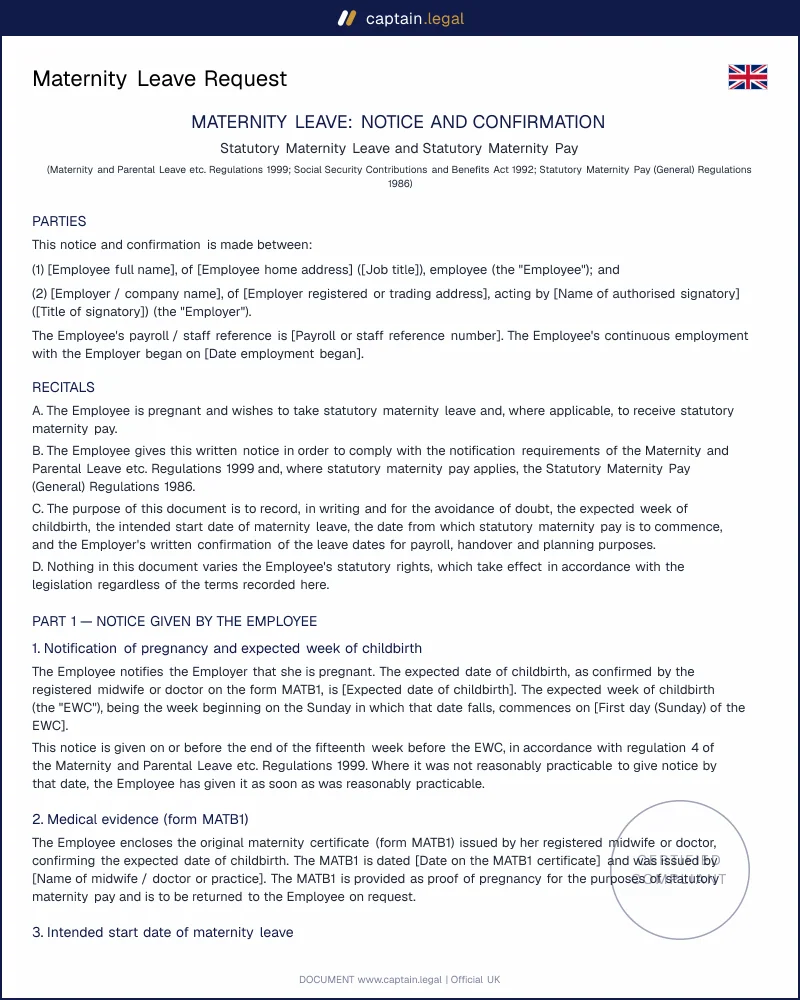
The notice rule is the part that catches employers out. Under regulation 4 of the 1999 Regulations, the employee must tell her employer, no later than the end of the qualifying week, that she is pregnant, the expected week of childbirth, and the date she intends her leave to start. The qualifying week is the 15th week before the expected week of childbirth. The earliest leave can begin is the 11th week before the EWC. The MATB1 certificate, issued by a midwife or GP from around 20 weeks of pregnancy, is the standard proof of the due date and the document payroll uses to confirm SMP eligibility. For SMP specifically, the employee must give 28 days' notice of the intended pay start date and supply that certificate; HMRC guidance is clear that an employer who cannot produce the MATB1, the notice and the calculation workings risks losing the right to reclaim the SMP it has paid. The authoritative reference here is the GOV.UK employer guide to Statutory Maternity Pay eligibility and proof of pregnancy, which sets out the proof and timing rules in full. Miss the confirmation deadline and the consequences land on the employer, not the employee: the law requires the employer to write back within 28 days confirming the date leave will end, and silence weakens the employer's position on the return date later.