Create my document
Login

Choose country

FranceBelgiqueEspañaUnited StatesUnited KingdomMarocDeutschlandItaliaSchweiz
Employment

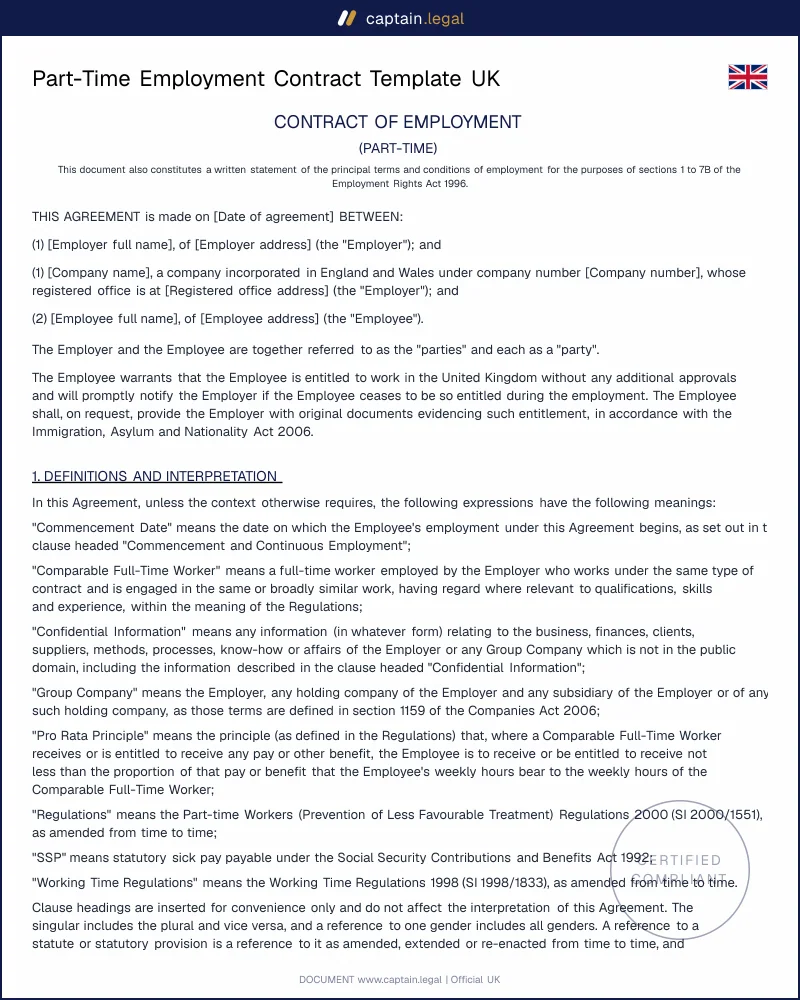
UK Part-Time Employment Contract | PTWR 2000 Compliant

Lawyer-grade part-time contract built on the Part-time Workers Regulations 2000, ERA 1996 s.1 and WTR 1998. Day-one compliant, pro-rata throughout. Word & PDF.
4.7/518 reviews50 000+ downloadsInstant download
Share

A part-time employment contract is the written agreement you give a member of staff who works fewer hours than your full-time benchmark, typically anything below a standard 35 to 40-hour week. It sets out hours, pay, holiday and notice, and it locks in the one thing that trips up most small employers: part-time staff are entitled to the same treatment as full-timers, calculated pro rata. Whether you are hiring a school-hours administrator, a weekend retail assistant or a three-day-a-week bookkeeper, this is the document that keeps the arrangement clean and tribunal-proof.

Used properly, it does more than record hours. It tells the employee exactly which benefits scale with their working pattern and which do not, and it gives you a written record that satisfies your day-one statutory duties under the Employment Rights Act 1996.

Compliant

2026 Legislation

50,000+ clients

trust us

Affordable

From $4.90 / doc

Secure payment

Instant download

UK Part-Time Employment Contract | PTWR 2000 Compliant

Secure payment · No subscription

Fill in the template

What is a part-time employment contract?

A part-time employment contract is a permanent (or fixed-term) contract of employment for someone whose weekly hours fall below those of a comparable full-time worker doing the same or broadly similar work for you. There is no statutory hours threshold that defines "part-time" in UK law. What matters is the comparison: if a full-timer in the role works 37.5 hours and your new hire works 22, that person is part-time and the pro rata principle applies to their pay and benefits.

It is worth separating this from two documents people confuse it with. A zero-hours contract offers no guaranteed hours at all, so the worker has no fixed pattern; a part-time contract guarantees a defined number of hours each week. A fixed-term contract is defined by its end date rather than its hours, and a part-time worker can also be on a fixed term, in which case both sets of rules apply at once. The contract you issue here assumes a regular, ongoing part-time pattern, which is the most common arrangement for small employers building a stable team.

The agreement also carries your statutory written-particulars obligation. Under section 1 of the Employment Rights Act 1996, every employee and worker must receive the principal terms of their employment in writing on or before their first day, so a properly drafted part-time contract does double duty as both the deal and the legal statement. You can see how that day-one duty works in a dedicated UK statement of written particulars template.

2

When do you need this document?

The most common trigger is a straightforward part-time hire: you need a school-hours administrator, a Saturday sales assistant, or a finance person two days a week, and you want the terms recorded before they start rather than after the first dispute. A close second is the conversion of a full-time role to part-time, often when an employee returns from maternity leave on reduced hours or makes a successful flexible working request. In that situation you are varying an existing contract, and the new pattern, new pay calculation and new holiday entitlement all need to be captured in writing so there is no argument about what was agreed. A flexible working request that lands on your desk can be handled cleanly with a UK flexible working request form before the contract is reissued.

You also need it when you are formalising an arrangement that drifted into existence. Plenty of small businesses have someone who started "helping out a couple of mornings" and is now a fixed part of the operation with no contract at all. That gap is a real liability, because without a written statement you are already in breach of section 1 and the employee can claim compensation if they later win another claim. One edge case worth flagging: if your part-timer also has irregular or on-call hours, you are drifting toward zero-hours territory and may need a UK zero-hours contract template instead. Another is the part-time worker on a fixed term, say a nine-month parental cover at three days a week, where you need to combine both rule sets in a single document.

3

Key clauses included in our template

  • The hours and working pattern clause states the exact weekly hours and which days they fall on, because vagueness here is what generates pro rata disputes. It distinguishes contractual hours from any voluntary overtime, and sets out how overtime is treated, since a part-timer is only entitled to a premium rate once they exceed normal full-time hours, not their own shorter week.
  • The pro rata pay and benefits clause ties remuneration to the same hourly rate as a comparable full-timer and applies the pro rata principle to holiday, bonus and pension. It spells out the calculation rather than leaving it implied, which protects you if the employee ever requests a written statement of reasons under the Part-time Workers Regulations 2000.
  • The holiday entitlement clause applies the statutory 5.6 weeks under the Working Time Regulations 1998 to the part-time pattern, expressed in hours rather than days where the working pattern is irregular, which is the method tribunals prefer for avoiding under-payment.
  • The notice period clause meets or exceeds the statutory minimum under section 86 ERA 1996 and applies equally to both sides, since asymmetric notice that favours the employer is a classic less favourable treatment trap.
  • The probationary period clause sets a review window without pretending it removes statutory rights, and it interacts sensibly with the reduced unfair dismissal qualifying period now coming through the Employment Rights Act 2025.
  • The confidentiality and post-termination provisions are scaled to the role, because a blanket restrictive covenant lifted from a senior full-time template is usually unenforceable against a part-time junior hire.
4

Regional considerations

England and Wales share a single employment law framework, and this contract is drafted to it. The Employment Rights Act 1996, the Part-time Workers Regulations 2000 and the Working Time Regulations 1998 all apply identically across both nations, and employment tribunals operate under the same procedural rules, so an England-and-Wales employer can use the template without geographic modification. The one practical variable is Welsh-language provision: a Cardiff or Swansea employer dealing with a Welsh-speaking workforce may choose to issue a bilingual version, though there is no statutory obligation to do so in the private sector.

Scotland applies the same primary employment legislation, because employment law is reserved to Westminster rather than devolved to Holyrood. A part-time worker in Glasgow has identical rights under the 2000 Regulations to one in Manchester. What differs is the surrounding civil law: contractual disputes that spill beyond the tribunal go to the Scottish courts under Scots law, prescription periods differ, and references to "the courts of England and Wales" in a governing-law clause should be adjusted. A template that names the wrong jurisdiction can complicate enforcement of any post-termination clause.

Northern Ireland is the genuine exception. Employment law there is devolved, and the equivalent protection sits in the Part-time Workers (Prevention of Less Favourable Treatment) Regulations (Northern Ireland) 2000, with the statutory statement duty arising under the Employment Rights (Northern Ireland) Order 1996 rather than the 1996 Act. The principles mirror Great Britain closely, but the statutory citations and the tribunal system are distinct, so a Belfast employer should treat the GB references as needing substitution rather than copying them across unchanged.

5

How to fill out this part-time employment contract

You start by selecting the working pattern, because everything downstream flows from it. Once you enter the weekly hours and the days they fall on, the form sets the comparator against a full-time benchmark and calculates the pro rata holiday entitlement automatically, so you are not doing the 5.6 weeks arithmetic by hand. From there you add the role, the start date and the pay, choosing whether remuneration is expressed as an annual salary or an hourly rate, with the form keeping the hourly figure aligned to the National Minimum Wage floor.

Next you set the notice period and probation length, and you decide which optional clauses the role actually needs rather than bolting on restrictions that will not hold. The form prompts you through the section 1 particulars so the finished contract doubles as your day-one statutory statement, and it flags the points where a choice carries legal risk. You finish by reviewing the draft, then download it in editable Word to make final adjustments or in clean PDF to send straight for signature. If you need the standalone day-one document separately, the UK section 1 statement template covers the same particulars for full-time hires.

6

Common mistakes to avoid

The mistake that costs employers the most is botching the pro rata calculation, usually by giving a part-timer a lower hourly rate or excluding them from a bonus scheme that full-timers receive. Working fewer hours never justifies a lower hourly rate, and the burden sits on you to prove any difference rests on objective grounds unconnected with part-time status. Closely related is the overtime trap: paying a three-day worker an enhanced rate the moment they exceed their own contracted hours is not required, because the premium only kicks in once they pass normal full-time hours, and overpaying out of caution sets a precedent you cannot easily withdraw.

The second cluster of errors is documentary. Issuing no written statement at all, or issuing one that omits the section 1 particulars, breaches the Employment Rights Act 1996 from day one and hands the employee a free uplift if they win any later claim. Employers also routinely forget to update the contract when hours change, leaving a stale document that contradicts what is actually happening, which is exactly the ambiguity tribunals resolve against the party who wrote the contract. Finally, lifting a full-time template and crudely halving the figures produces a contract riddled with the wrong comparator references and an unenforceable governing-law clause, particularly where the worker is based in Scotland or Northern Ireland. When the relationship ends, a clean UK redundancy notice letter keeps the exit as defensible as the hire.

Key takeaways

EQUAL TREATMENT

Pro rata parity is the deal-breaker

Part-time staff must not be treated less favourably than a comparable full-time worker just because they work fewer hours, unless you can objectively justify the difference. The practical rule is pro rata: if the full-time benchmark is 37.5 hours and the part-timer works 22, pay and benefits should scale in the same proportion, on the same hourly basis.

DAY-ONE TERMS

Give written particulars from day one

This contract doubles as your section 1 Employment Rights Act 1996 written statement. That means the key terms must be provided in writing on or before the employee’s first day, not weeks later. Set out hours, pay, holiday and notice clearly so there is a clean record of what was agreed if there is a dispute about working pattern, entitlement or changes.

LEAVE & RISK

Holiday and discrimination risks follow hours

Under the Working Time Regulations 1998, every worker gets 5.6 weeks paid annual leave, and part-timers receive it pro rata to their working pattern. Getting this wrong is not just an admin issue: because many part-time workers are women, less favourable treatment can also trigger an indirect sex discrimination angle under the Equality Act 2010, on top of a regulatory claim.

Frequently Asked Questions

Yes. Once both parties sign it, a part-time employment contract is a binding contract of employment under English and Welsh law, enforceable like any full-time contract. It also satisfies your statutory duty under section 1 of the Employment Rights Act 1996 to provide written particulars on or before the first day of work. The template is drafted to the Part-time Workers Regulations 2000 and the Working Time Regulations 1998, so it stands up to scrutiny provided you fill it in accurately and apply the pro rata terms it sets out. What undermines enforceability is not the template but inconsistency, such as paying or treating the employee differently from what the signed document records.

There is no fixed legal threshold. UK law defines part-time by comparison rather than by a number, so a worker is part-time if their weekly hours are lower than those of a comparable full-time worker doing similar work for the same employer. In practice most employers treat anything below 35 hours a week as part-time, but the only test that matters legally is the comparator. This is why the contract records both the part-time hours and the full-time benchmark they are measured against, since that comparison drives every pro rata calculation for pay, holiday and benefits.

You apply the statutory 5.6 weeks under the Working Time Regulations 1998 on a pro rata basis. A worker doing three days against a five-day full-time week receives three-fifths of the full-time entitlement, so if a full-timer gets 28 days, the part-timer gets 16.8 days. Where the working pattern is irregular, the cleaner method is to calculate entitlement in hours rather than days, which avoids systematic under-payment. The template performs this calculation for you once you enter the working pattern, and it expresses the result in the format best suited to the role.

The same statutory minimums apply as to full-time staff, because notice rights under section 86 of the Employment Rights Act 1996 do not scale down with hours. After one month's service the statutory minimum from the employer is one week, rising by one week per complete year up to a maximum of twelve weeks after twelve years. The employee owes one week after one month. Your contract can set longer notice, but it should apply symmetrically, since giving the employee shorter notice rights than a comparable full-timer is a textbook less favourable treatment claim.

Yes. The template downloads in both editable Word and clean PDF. Most employers use the Word version to make any final adjustments to clauses, hours or pay before circulating it, then convert to PDF for signature so the final terms cannot be altered. Both formats contain the same compliant wording, so the choice is purely about whether you still need to edit or are ready to send for signing.

Yes, subject to the same qualifying rules as full-time staff. Part-time status itself never reduces dismissal rights, and treating a part-timer as easier to dismiss would breach the Part-time Workers Regulations 2000. The qualifying period for ordinary unfair dismissal is changing under the Employment Rights Act 2025, which reduces it from two years toward six months as the reforms are phased in across 2026 and 2027, so employers relying on a long probationary window should review their processes. Certain dismissals, such as those connected to pregnancy or asserting a statutory right, are automatically unfair from day one regardless of service.

If the hours genuinely have no fixed pattern, a part-time contract may be the wrong instrument and a zero-hours arrangement may fit better, since a part-time contract guarantees defined weekly hours. If the hours change occasionally but settle into a stable pattern, the right step is to vary the contract in writing each time the pattern materially changes, rather than leaving a stale document in place. A contract that says three days while the worker reliably does four creates exactly the ambiguity a tribunal will resolve against the employer, so keeping the written terms aligned with reality is the single most effective protection you have.

4.7/5

18 verified reviews · 50 000+ downloads

UK Part-Time Employment Contract | PTWR 2000 Compliant
  • Immediate access to the document
  • PDF + Word download
  • Compliant with 2026 legislation
  • Reviewed by lawyers
Fill in the template
Secure payment · No subscription
Updated on June 7, 2026

You might also like

Employee Handbook Template UK
Performance Improvement Plan Template UK