The articles of association are the constitutional document of every company registered in England, Wales, Scotland and Northern Ireland. They set out the internal rulebook of the company: how directors are appointed and removed, how shares are issued and transferred, how meetings are convened, how decisions are voted, how dividends are declared. Together with the memorandum of association, the articles are filed at Companies House on incorporation and become a binding contract between the company, its members and its directors. Whether you are forming a private company limited by shares, a company limited by guarantee, or an unlimited company, you cannot register a UK company without them. This template is drafted to the Companies Act 2006 and tailored to the private company limited by shares model used by more than 95 % of new UK incorporations.
A well-drafted set of articles is the difference between a company that runs smoothly and one that grinds to a halt the first time shareholders disagree. Most founders rely on the Model Articles prescribed by the Companies (Model Articles) Regulations 2008, but the model is deliberately generic and rarely fits a real cap table. Our template starts from the model and adds the bespoke clauses every solicitor would expect: pre-emption rights, drag-along and tag-along provisions, director appointment thresholds, and reserved matters.
Compliant
2026 Legislation
50,000+ clients
trust us
Affordable
From $4.90 / doc
Secure payment
Instant download
UK Articles of Association — Companies House Ready Template
Secure payment
What are articles of association?
The articles of association are the principal constitutional document of a UK company. Section 17 of the Companies Act 2006 defines the company's constitution as comprising the articles together with any resolutions and agreements affecting them, and section 18 requires every company to have articles of association registered with the Registrar of Companies. Once filed, the articles bind the company and each of its members as if they had been signed and sealed by every member, by virtue of section 33 of the same Act. The contractual force of that section is what gives a minority shareholder standing to enforce a share-transfer restriction or a pre-emption right against the board.
The articles are often confused with two adjacent documents. The memorandum of association is the short founding statement signed by the subscribers confirming their intention to form the company and take at least one share each ; under the 2006 Act it is no longer part of the live constitution and cannot be amended after incorporation. The shareholders' agreement, by contrast, is a private contract between some or all members that supplements the articles without being filed publicly. Where the articles set the public rules of governance, the shareholders' agreement sets the private commercial deal between investors. We publish a separate template for that contract in our shareholder and corporate governance documents for UK companies, which most founders use alongside their articles from day one.
Legal framework
The governing statute is the Companies Act 2006, the longest Act in UK parliamentary history at 1,300 sections, which consolidated and replaced the 1985 Act. Part 3 of the 2006 Act governs the company's constitution: section 17 defines its scope, section 18 mandates the registration of articles, section 20 introduces the default Model Articles, and sections 21 to 28 govern amendment, entrenchment and the consequences of any breach. The Model Articles themselves sit in the Companies (Model Articles) Regulations 2008 (SI 2008/3229), with separate schedules for private companies limited by shares, private companies limited by guarantee, and public companies. A company that does not file bespoke articles is automatically governed by the model that matches its type.
Beyond the 2006 Act, several instruments shape the drafting. The Insolvency Act 1986 dictates the priority rules that any director-removal or share-redemption clause must respect. The Companies (Miscellaneous Reporting) Regulations 2018 extended directors' duties reporting under section 172. More recently, the Economic Crime and Corporate Transparency Act 2023 introduced identity-verification duties for directors and persons with significant control, with the Registrar of Companies gaining new powers to query and reject filings that began rolling out from 2024 onwards. Articles drafted before 2023 should be reviewed against the new transparency regime before being adopted by a newly incorporated entity, particularly clauses dealing with PSC notifications and director identity.
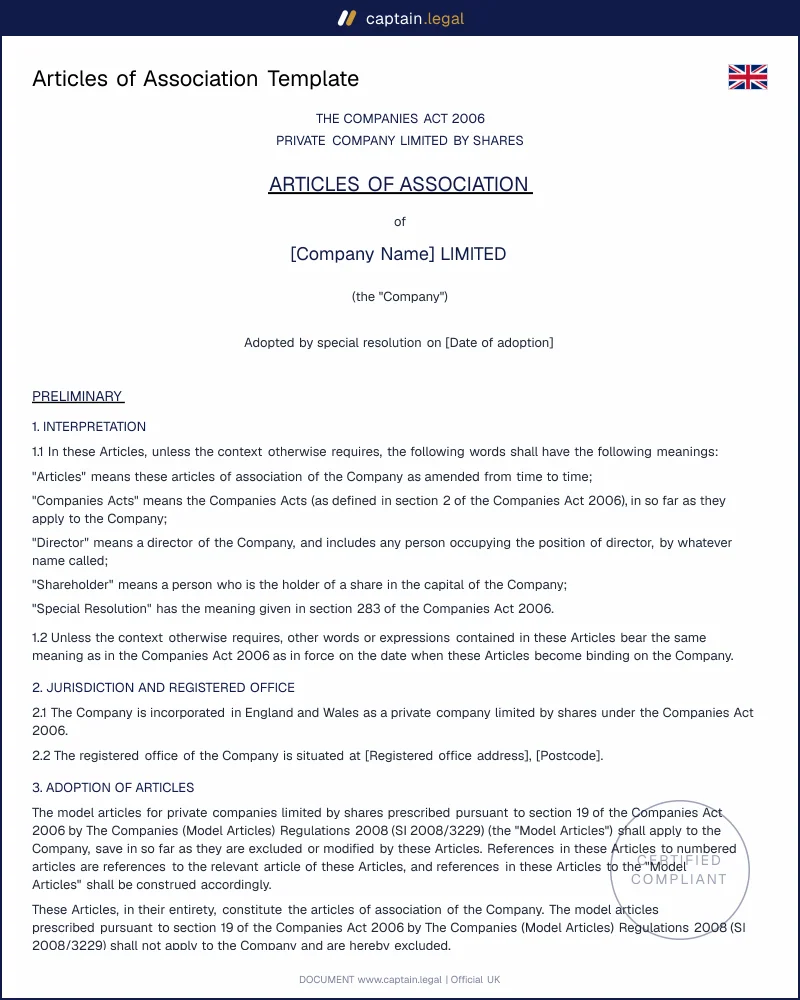
Form requirements are strict but light. The articles must be in writing, divided into consecutively numbered paragraphs and submitted to Companies House in PDF or via the digital incorporation service. They take effect from the date of incorporation, or from the date of the special resolution that adopts them post-incorporation under section 21. The Companies House guidance on this point is collected in its official guidance on a company's constitution and articles of association, which remains the reference text on filing and amendment procedure.
When do you need this document?
The first and most obvious trigger is incorporation. Every company submitting form IN01 to Companies House must attach articles or expressly adopt the Model Articles by ticking the relevant box. Founders who tick the box to save time often regret it within twelve months, because the model has no pre-emption rights on transfer, no good leaver / bad leaver mechanics, no protection against the dilutive issue of new shares, and no reserved matters list. Any subsequent investor will then demand a full restatement of the articles before injecting capital, which is more expensive than getting it right at day one.
The second trigger is a funding round. When a seed or Series A investor signs a subscription agreement, the closing always involves a special resolution adopting new articles that reflect the new share classes, the liquidation preferences, the anti-dilution mechanics and the investor consent matters. The articles become the public expression of those rights, while the shareholders' agreement template tailored to UK investment rounds handles the confidential commercial terms.
A third scenario is corporate restructuring: introducing a new share class for an EMI option pool, splitting voting and dividend rights between founders and a family trust, or migrating from a partnership to a limited company structure. Each of these requires bespoke articles. You cannot rely on Model Articles to issue B shares or non-voting shares ; the model recognises one class only, and any deviation must be expressly drafted. Finally, director or shareholder disputes often surface drafting gaps that no founder noticed at incorporation. Renegotiating the articles after a fall-out is doubly expensive : the legal fees plus the leverage lost to the counterparty.
Key clauses included in our template
Our articles cover the seven blocks that any English solicitor reviewing a deal would expect to find. Each clause is written in plain English where the Companies Act 2006 allows, and in statutory language where it does not.
- The share capital and class rights section sets the authorised classes (ordinary, A ordinary, preferred), the rights attached to each, and the procedure for varying class rights under sections 630 to 633 of the Act. We include a Bushell v Faith clause for founder protection where instructed.
- The issue and allotment of shares clauses cover directors' authority to allot under section 551, the disapplication of statutory pre-emption rights under section 570, and the contractual pre-emption mechanics that replace them. We track the Companies House SH01 filing requirements so the cap table and the public register stay aligned.
- The transfer restrictions are the heart of any private company's articles. The template includes pre-emption on transfer, drag-along and tag-along thresholds (typically 50 % and 75 %), good leaver and bad leaver definitions, and compulsory transfer triggers on death, bankruptcy or termination of employment.
- The directors and board procedures section deals with appointment, removal under section 168, conflicts of interest under sections 175 to 177, the chair's casting vote, written resolutions, and quorum at board level. We add a reserved matters schedule where investor consent is required before the board can act.
- The general meetings clauses set the notice periods (14 clear days for ordinary general meetings, 21 for AGMs of public companies), the quorum, the proxy rules, and the voting thresholds for ordinary and special resolutions.
- The dividend and distribution clauses align with Part 23 of the 2006 Act on distributable profits, and set the procedure for interim and final dividends declared by the board.
- The indemnity and insurance clauses give directors the maximum protection allowed under sections 232 to 235, including third-party indemnities and the company's right to take out D&O insurance.
How to fill out this articles of association template
You start by selecting your company type on the form: private limited by shares is the default, with options for limited by guarantee or unlimited. From there, the template asks for the registered name, registered office, and the initial subscribers with their share allocations. The questionnaire then walks you through the share structure question by question : do you want a single class of ordinary shares or multiple classes, do you want statutory pre-emption rights to apply or to be disapplied, what threshold should trigger drag-along, who counts as a good leaver. Each answer rewrites the relevant clause in real time so you see the final wording before paying.
Once the share structure is set, you move to governance: number of directors, quorum, casting vote, written resolution rules, and any reserved matters. The template offers a default reserved matters schedule used by most UK seed term sheets, which you can keep, edit, or replace. The final step generates a Companies House-ready PDF and a Word version for your solicitor to review. Both are formatted to match the Companies House digital incorporation service so the document can be uploaded without reformatting. If you also need an employment contract template aligned with UK employment law for your first hires, the platform will pre-fill the company details from the same questionnaire.
Common mistakes to avoid
The first mistake is adopting the Model Articles unchanged on the assumption that "we can amend them later". Amending articles requires a special resolution carrying 75 % of the votes, which is straightforward while the founders own 100 % but rapidly becomes hostile once outside investors hold a blocking minority. The second mistake is forgetting to disapply the statutory pre-emption rights under section 561 when adopting bespoke pre-emption clauses : without an express disapplication under section 570, the statutory regime applies in parallel and creates conflicting rights that paralyse the next allotment. We have seen Series A closings delayed by three weeks because of this single oversight.
A third frequent error is mismatching the articles and the shareholders' agreement. Drafters often copy a clause from the agreement into the articles word for word, forgetting that the articles are public and the agreement is private : the confidential commercial terms then end up on the Companies House register, available to any competitor for the cost of a search. The general rule is to put governance in the articles and economics in the shareholders' agreement, with cross-references handled carefully. Founders also forget that any entrenched provision under section 22 must be expressly stated and notified to Companies House on form CC01, otherwise the entrenchment has no effect against third parties. Finally, signatures are missed at adoption: a special resolution adopting new articles must be filed within 15 days of being passed under section 30, and late filing carries criminal liability for every officer in default.
Frequently Asked Questions
34 verified reviews · 50 000+ downloads
- Immediate access to the document
- PDF + Word download
- Compliant with 2026 legislation
- Reviewed by lawyers
You might also like