The Assured Shorthold Tenancy agreement, almost universally referred to by its acronym AST, has been the cornerstone of residential lettings in England and Wales since the Housing Act 1988 came into force. For more than three decades it framed the legal relationship between landlord and tenant in the private rented sector, defining how rent is paid, how possession is recovered, and what protections each side could rely on. Our template is drafted in the language a solicitor would recognise across any letting agent's compliance file, with the statutory disclosures, deposit clauses and prescribed information requirements built in by default. It is suitable for landlords and letting agents managing existing assured shorthold tenancies, for tenants reviewing the terms they have signed, and for anyone who needs a properly drafted tenancy agreement in the standard pre-1 May 2026 form.
Before going further, a word on the legal landscape. The AST regime has changed substantially in recent years, and the contract you are about to draft must reflect the right rules for the right jurisdiction. The sections below set out exactly what is still in force, what has been replaced, and how to use this template safely.
Compliant
2026 Legislation
50,000+ clients
trust us
Affordable
From $4.90 / doc
Secure payment
Instant download
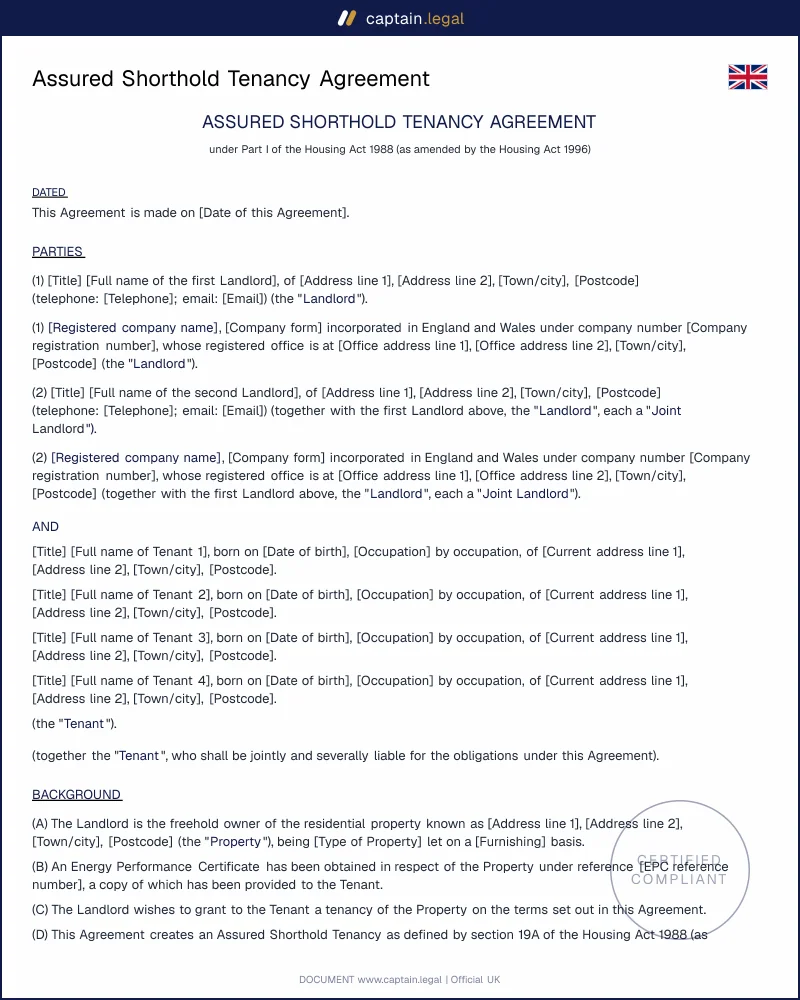
AST Agreement (Assured Shorthold Tenancy) | Solicitor-Drafted
Secure payment
What is an assured shorthold tenancy agreement?
An assured shorthold tenancy is a form of assured tenancy introduced by sections 19A to 21 of the Housing Act 1988, originally distinguished from a full assured tenancy by two features: limited security of tenure beyond the fixed term, and the availability of a Section 21 notice giving the landlord a route to possession without proving fault. From 28 February 1997, after the changes brought by the Housing Act 1996, any new tenancy of a dwelling-house let as a separate dwelling to an individual, where the rent fell within the statutory thresholds and where the landlord did not live in the property, was automatically an AST unless a specific procedure was followed to create a different tenancy. That default rule is why the AST became, in practice, the contract used for the overwhelming majority of private residential lettings in England and Wales.
The AST should not be confused with neighbouring instruments. A lodger agreement governs a licence rather than a tenancy and applies where the landlord shares living accommodation with the occupier. A company let is a common law tenancy outside the AST regime, used where the tenant is a corporate entity rather than an individual. Tenancies above the statutory rent ceiling, or tenancies of nominal rent below the lower threshold, are also excluded and have always been governed by ordinary contract law. Selecting the correct instrument is not a matter of style: serving a Section 21 notice on what is in fact a common law tenancy, or treating a lodger as an AST tenant, is one of the most frequent and costly errors seen in possession proceedings.
Legal framework
The statutory backbone is the Housing Act 1988, supplemented by the Housing Act 1996, the Localism Act 2011, the Deregulation Act 2015 and a long line of regulations dealing with deposits, prescribed information and energy performance. The full consolidated text is available at the legislation.gov.uk reference page for the Housing Act 1988, which remains the single most important resource for anyone drafting or interpreting an AST. Section 19A and Schedule 2A set out when a tenancy is automatically a shorthold; Section 5 explains how a fixed term tenancy rolls into a statutory periodic tenancy once the term ends; Section 8 governs fault-based possession on prescribed grounds; Section 21 historically provided the no-fault route to possession with two months' written notice.
A practitioner should now read those provisions alongside two more recent statutes that have reshaped the landscape. In Wales, the Renting Homes (Wales) Act 2016 came into force on 1 December 2022, and from that date no new AST can be granted in Wales: the AST regime is replaced by Standard Occupation Contracts, with tenants becoming contract-holders. Existing Welsh ASTs converted automatically, fixed-term ASTs becoming fixed-term standard contracts and periodic ASTs becoming periodic standard contracts.
In England, the Renters' Rights Act 2025 received Royal Assent on 27 October 2025 and its core tenancy reforms commenced on 1 May 2026. From that commencement date, no new AST can be granted in England either: every new private residential tenancy of a dwelling-house let to an individual is now an assured periodic tenancy. Existing ASTs converted automatically, fixed-term clauses became unenforceable, and Section 21 no-fault possession was abolished, with limited transitional protection for notices validly served before commencement. Section 8 grounds for possession remain available, with revised notice periods and new mandatory grounds.
This template therefore serves a precise purpose. It reflects the AST as it stood under the Housing Act 1988 up to 30 April 2026, and it remains directly relevant for parties dealing with an existing tenancy that has converted into an assured periodic tenancy, for litigation concerning a tenancy that began before 1 May 2026, and for any matter where the original AST terms still control the relationship.
When do you need this document?
The most common modern use is to formalise the written terms of a tenancy that began before 1 May 2026 and is now operating as an assured periodic tenancy by force of statute. Section 16E of the Housing Act 1988, inserted by the Renters' Rights Act 2025, requires landlords to provide tenants with a written statement of terms if the original agreement was verbal or incomplete, and a properly drafted AST template is the natural starting point for that exercise. A second scenario covers possession proceedings: solicitors regularly need to produce the original AST in support of Section 8 claims relating to rent arrears, anti-social behaviour or breach of tenancy under the Housing Act 1988's amended grounds.
A third use case arises in the management of property portfolios containing tenancies of mixed vintage. Letting agents preparing renewal documentation, estate planners advising on the disposal of let residential property, and investors completing due diligence on a buy-to-let acquisition all need a clean reference document that mirrors the AST terms historically used in the sector. The template is also relied upon by tenants themselves: a renter facing a notice or an inventory dispute will often need to compare the agreement they signed against a benchmark drafted to current statutory standards.
One edge case deserves attention. Properties let at rents above £100,000 per annum, or below £1,000 in Greater London and £250 elsewhere, fell outside the AST regime even before the 2026 reforms. Using an AST template for these lets has always been technically incorrect and can create unintended consequences where statutory provisions are read into a contract the parties did not need to comply with. For those situations, a common law tenancy drawn from our business and property documents is the appropriate starting point.
Key clauses included in our template
Our AST template tracks the structure used by reputable London letting agents and reflects the statutory requirements that have accumulated around the Housing Act 1988 over more than three decades. Each clause has been drafted with both enforceability and readability in mind.
- The identification of the parties and the property captures the full legal name of every named tenant, the landlord's name and address for service as required by Section 48 of the Landlord and Tenant Act 1987, and a precise description of the dwelling-house and any included furniture. A defective parties clause is one of the most frequent reasons a Section 21 or Section 8 notice has been struck out.
- The term and rent provisions record the start date, the original fixed term, the rent amount, the payment frequency and the payment method. The clause is structured so that it remains coherent once the tenancy has rolled into a statutory periodic tenancy under Section 5 of the Housing Act 1988 or, post-1 May 2026 in England, into an assured periodic tenancy under the Renters' Rights Act 2025.
- The deposit clause confirms compliance with the tenancy deposit protection regime under Sections 212 to 215A of the Housing Act 2004, naming an authorised scheme and recording the date by which prescribed information must be given. Failure to protect the deposit within the statutory window exposes the landlord to a penalty of one to three times the deposit and bars the use of Section 21.
- The repair and condition obligations reflect Section 11 of the Landlord and Tenant Act 1985 and the Homes (Fitness for Human Habitation) Act 2018, allocating responsibility for the structure, exterior and installations to the landlord while leaving everyday upkeep to the tenant.
- The possession and termination provisions preserve the historic Section 21 and Section 8 routes in their pre-1 May 2026 form, with explanatory drafting that helps parties identify which grounds remain available under the Renters' Rights Act 2025 transitional rules.
- The prescribed information schedule lists the How to Rent guide, the Energy Performance Certificate, the Gas Safety Record, the Electrical Installation Condition Report and any Right to Rent documentation, all of which must be served at the prescribed times.
Regional considerations
England is now the jurisdiction where the AST template plays its primary residual role. Since the commencement of the Renters' Rights Act 2025 on 1 May 2026, every existing AST has converted into an assured periodic tenancy, and any fresh letting must be granted as a periodic assured tenancy from day one. Section 21 possession is no longer available for notices served on or after 1 May 2026, but valid notices served before that date can still be enforced through court proceedings provided the application is made within the statutory window. Rent increases on existing tenancies are now governed by the revised Section 13 procedure, limited to once per year and challengeable before the First-tier Tribunal (Property Chamber). Practitioners drafting documents for English landlords should pair this template with the up-to-date employment and HR documents where the letting concerns a workplace tied accommodation arrangement.
Wales has been operating under the Renting Homes (Wales) Act 2016 since 1 December 2022. New private lettings are Standard Occupation Contracts rather than ASTs, with prescribed fundamental, supplementary and additional terms, and a six-month minimum no-fault notice period under Section 173 of the Welsh Act. Existing Welsh ASTs converted to standard contracts on the commencement date, and landlords were required to issue written statements within six months. The AST template is therefore used in Wales chiefly for historical reference, for tenancies that began before 1 December 2022, and for the small number of Schedule 2 exceptions where occupation contracts do not apply.
Scotland and Northern Ireland stand outside the AST regime entirely. Scotland uses Private Residential Tenancies under the Private Housing (Tenancies) (Scotland) Act 2016, which abolished the short assured tenancy for new lets from 1 December 2017. Northern Ireland operates under its own Private Tenancies (Northern Ireland) Order 2006 as amended by the Private Tenancies Act (Northern Ireland) 2022. An AST template should never be used for property in Scotland or Northern Ireland: the statutory framework, notice forms and deposit schemes are entirely different, and the document would be unenforceable on its face.
How to fill out this assured shorthold tenancy agreement
You begin by selecting the jurisdiction the property sits in, because the form will branch immediately depending on whether the letting is in England before or after 1 May 2026, in Wales, or outside the AST regime altogether. From there you enter the landlord's full name and address for service, the names of every adult tenant who will be in occupation, and the address of the dwelling-house with any included parking, storage or garden. The template then asks for the tenancy start date and the original fixed term, automatically generating the statutory periodic continuation language so the document remains coherent once the term ends. Rent details follow, including the amount, the payment day, the method of payment and any pro-rated first instalment.
The deposit section captures the protected sum and the authorised scheme reference, prompting the date by which prescribed information must be served. Repair allocation, prohibitions on alterations and the pet policy are configured next, with sensible defaults that solicitors recognise. The final block compiles the prescribed information schedule and produces a signature page suitable for electronic execution under the Law of Property (Miscellaneous Provisions) Act 1989. The output is delivered in editable Word format and as a polished PDF for signing, ready to file alongside your personal legal documents.
Common mistakes to avoid
The first and most damaging mistake is using the wrong instrument for the wrong jurisdiction or the wrong commencement date. A landlord in England granting what they call an AST after 1 May 2026 has in fact created an assured periodic tenancy under the Renters' Rights Act 2025; the contractual fixed-term clause is void, and a Section 21 notice will be invalid because the section no longer applies. The mirror error in Wales is to issue an AST after 1 December 2022 rather than a Standard Occupation Contract, exposing the landlord to penalties under the Renting Homes (Wales) Act 2016 and to claims for breach of statutory duty.
The second category of error sits around the deposit. Late protection of the deposit, late service of the prescribed information, or use of an unregistered scheme each carry the Section 214 penalty of one to three times the deposit and disable Section 21 possession until the breach is cured. The third recurring failure is sloppy service of statutory notices: serving a notice that misnames the parties, omits the property address, or specifies a date that falls within the protected period of the tenancy will be struck out by the County Court without further analysis. Finally, failing to provide the How to Rent guide, Energy Performance Certificate, Gas Safety Record and Electrical Installation Condition Report before the start of the tenancy creates compliance gaps that surface only when the landlord later needs to recover possession, and by then the omission cannot be retrospectively cured.
Frequently Asked Questions
40 verified reviews · 50 000+ downloads
- Immediate access to the document
- PDF + Word download
- Compliant with 2026 legislation
- Reviewed by lawyers
You might also like