A Partnership Agreement is the deed that turns a handshake into a business. Two or more individuals carrying on a trade together with a view of profit form a partnership the moment they start trading, whether they have signed anything or not — that is the practical reality of working under the Partnership Act 1890. Without a written agreement, the default rules of that statute apply line by line: equal profit shares, equal say, joint and several liability, automatic dissolution on the death or bankruptcy of any partner. A bespoke partnership agreement replaces those Victorian defaults with terms the partners actually want, covering capital contributions, profit splits, decision rights, the entry and exit of partners, and the procedure for winding up the firm.
This template has been drafted for a general partnership under English and Welsh law (Scottish partnerships, which have separate legal personality, are noted where it matters). It is suitable for professional firms, family businesses, joint ventures between sole traders, and any unincorporated business with two or more partners. It is not intended for limited partnerships under the Limited Partnerships Act 1907, nor for limited liability partnerships incorporated under the Limited Liability Partnerships Act 2000.
Compliant
2026 Legislation
50,000+ clients
trust us
Affordable
From $4.90 / doc
Secure payment
Instant download
UK Partnership Agreement Template for General Partnerships
Secure payment
What is a partnership agreement?
A partnership agreement is a written contract between two or more persons who carry on a business in common with a view of profit. The legal definition comes straight from section 1(1) of the Partnership Act 1890, and it is broader than most founders realise: a partnership can arise from conduct alone, with no document and no intention to create one, simply because two people start sharing the takings of a joint venture. The written agreement does not create the partnership; it disciplines it.
The distinction between a partnership agreement and the documents it is most often confused with is worth nailing down. A shareholders' agreement governs a company limited by shares incorporated at Companies House, where the entity has separate legal personality and the owners enjoy limited liability. An LLP members' agreement plays the same role for a limited liability partnership, an incorporated body that combines partnership-style flexibility with the protection of a corporate veil. A general partnership has neither separate legal personality (in England and Wales) nor limited liability: every partner is personally and jointly liable for the firm's debts. A robust partnership agreement is therefore not optional comfort, it is the only instrument standing between the partners and the harsh defaults of an Act drafted under Queen Victoria. For founders weighing structures, our UK business document templates cover the alternatives side by side.
Legal framework
The governing statute remains the Partnership Act 1890, a remarkably durable codification that has weathered more than a century of commercial change with only minor amendment. Section 1 defines partnership, section 5 makes every partner the agent of the firm and of every other partner, and sections 9 to 18 spell out the joint and several liability that exposes each partner's personal assets to the firm's creditors. The default position on profit and loss sits in section 24: equal shares regardless of capital contributed, equal management rights, no entitlement to a salary, and no interest on capital advanced. Most working partnerships look nothing like this default, which is precisely why a written agreement matters.
The Act is permissive about form. Section 19 confirms that the mutual rights and duties of partners may be varied by consent, express or inferred from a course of dealing, and the courts will give effect to the parties' intentions wherever a provision is unambiguous. There is no statutory requirement to register the agreement, no obligation to file it at Companies House, and no notarisation required. The deed needs only to be signed by each partner, ideally in the presence of an independent witness for evidential weight; execution as a deed becomes essential where the agreement contains restrictive covenants intended to bind former partners after they leave, since deeds carry a twelve-year limitation period under the Limitation Act 1980 rather than the standard six.
Tax compliance lives outside the agreement but cannot be ignored. The partnership itself must register with HMRC for self-assessment using form SA400, each partner registers individually on form SA401, and the firm files an annual SA800 partnership return showing how profits and losses have been allocated. The full text of the Act is available on the official UK legislation portal for the Partnership Act 1890. Recent reforms touch the limited partnership and LLP regimes rather than the general partnership, but the Economic Crime and Corporate Transparency Act 2023 has tightened beneficial ownership reporting across the wider partnership landscape and is worth tracking if the firm ever considers conversion to an LLP.
When do you need this document?
The first and most pressing case is the two-founder start-up that has graduated from kitchen-table conversations to invoicing customers. The moment money flows through a joint account and tax returns reference shared income, the Partnership Act 1890 applies by default and silence becomes a liability. A written agreement at this stage is cheap insurance against a future falling-out, and the cost of drafting now is a fraction of the cost of unwinding an undocumented partnership later. Founders moving towards incorporation will find the parallel issues for limited companies covered in our UK shareholder and founders' agreement templates.
Professional firms form the second great category, and they typically come to a deed when admitting a new partner or buying out a retiring one. Solicitors, accountants, surveyors, GPs and dental practices have all kept the general partnership alive in 2026 despite the LLP option, often because of regulatory rules requiring named principals or because of a partnership culture that pre-dates incorporation. The exit of a long-serving partner without a written agreement triggers section 33 of the Act, which dissolves the firm by default; without an express continuation clause, the remaining partners find themselves running an unwound partnership while still trading, which is a recipe for tax and creditor disputes.
The third common trigger is the joint venture between two existing businesses for a discrete project. A pair of sole-trader builders pooling labour on a development, two consultancies bidding for a single contract together, two food producers running a pop-up: each scenario looks transient but creates a partnership the day it generates revenue. An edge case worth flagging is the family farm or estate, where multiple generations farm common land without ever signing anything; HMRC's treatment of these arrangements during inheritance has driven a steady demand for retrospective written agreements, often coupled with the personal estate planning documents in our personal legal forms library.
Key clauses included in our template
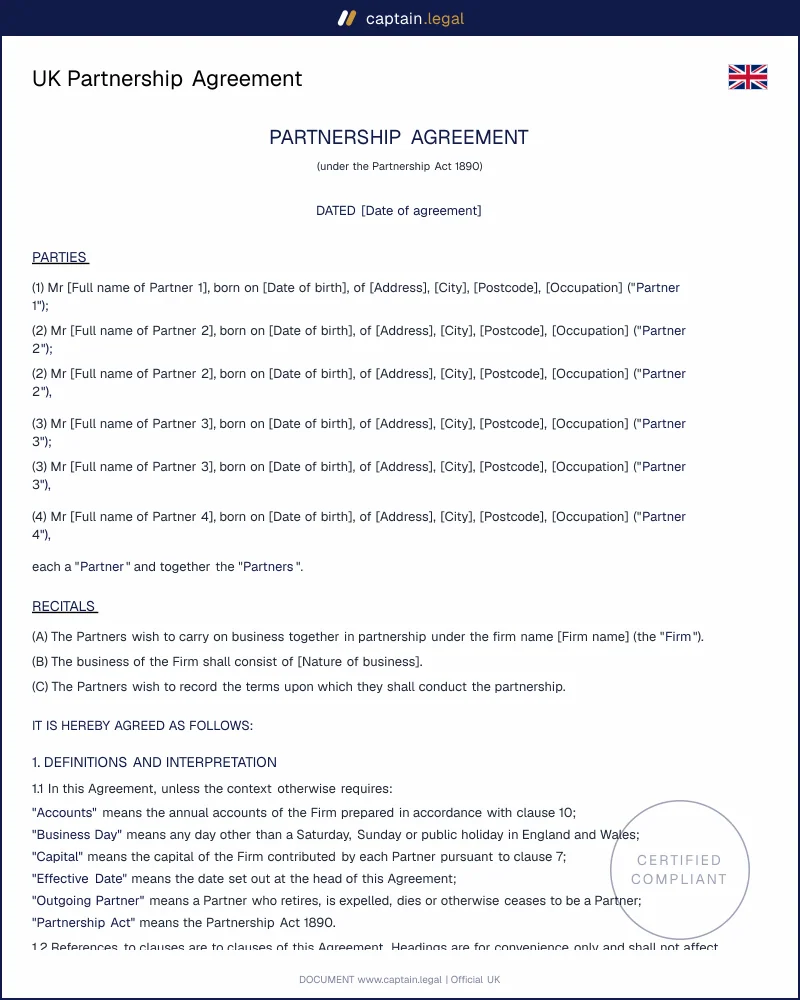
- The identification of the partners and the firm name records every partner's full legal name, residential address and date of birth, alongside the trading name registered with HMRC. Where the partnership trades under a name that does not consist of the partners' surnames, the Companies Act 2006 Part 41 requires the partners' names and a service address to be displayed at all business premises and on all business correspondence.
- The capital contributions and partnership property clause sets out exactly what each partner brings to the firm, whether cash, equipment, intellectual property or goodwill, and treats it as partnership property within the meaning of section 20 of the Partnership Act 1890. The clause distinguishes capital from loans, since the two are taxed differently and rank differently on dissolution.
- The profit and loss allocation displaces the default equal split of section 24(1). Profits can be divided by reference to capital, by fixed percentages, by hours worked, or by any formula the partners agree, and the clause permits separate treatment of trading profits, capital gains on partnership property, and notional interest on capital.
- The management and decision-making provisions specify which decisions require unanimity (admission of new partners, change of business, dissolution), which require a majority, and which fall within the day-to-day authority of an individual managing partner. This clause neutralises the default in section 24(8) under which any partner can outvote the others on ordinary matters by simple majority but no one can change the nature of the business without unanimous consent.
- The partner duties and restrictive covenants clause codifies the fiduciary duties imposed by sections 28 to 30 (rendering true accounts, accounting for benefits derived from the partnership, refraining from competing with the firm) and adds tailored non-compete and non-solicitation obligations binding for a defined period after a partner leaves.
- The admission, retirement and expulsion of partners clauses provide the procedure that the Act conspicuously fails to supply. The default position is dissolution on any partner leaving, so this clause is the one that keeps the firm trading, with valuation mechanisms, payment timetables and indemnities for outgoing partners.
- The dispute resolution and dissolution clause sets a tiered process: internal mediation, external mediation under a recognised scheme, then arbitration or court proceedings. It also defines the events triggering automatic dissolution and the procedure for winding up under sections 39 to 44 of the Partnership Act 1890.
Regional considerations
England and Wales is the natural home of this template. Partnerships here have no separate legal personality, which means the firm cannot own property in its own name, cannot sue or be sued except in the names of the partners, and cannot itself enter contracts independently of its members. Restrictive covenants are enforceable to the extent that they protect a legitimate business interest and go no further than necessary, applying the Herbert Morris v Saxelby line of authority refined by the modern Supreme Court. Property held for partnership purposes must be conveyed to up to four partners as trustees on behalf of the firm, a quirk that often surprises new partners purchasing premises through the partnership.
Scotland changes one fundamental rule: a Scottish partnership has separate legal personality under section 4(2) of the Partnership Act 1890, meaning the firm itself can hold title to moveable property, contract in its own name, and be sued as an entity. Heritable property nevertheless cannot be held in the firm's name and must be vested in the partners as trustees. Practitioners drafting for Scottish clients should also note the longer prescriptive periods under the Prescription and Limitation (Scotland) Act 1973, which affect how long claims between partners or against the firm remain live.
Northern Ireland applies the Partnership Act 1890 with no material modification, and the case law of the Northern Ireland courts tracks the English position closely. The single drafting watch-point is the registration of business names, which falls under the Business Names Act 1985 as preserved in Northern Ireland rather than the Companies Act 2006 framework that governs in Great Britain. The local courts also continue to recognise certain pre-1922 statutory references that have been repealed elsewhere, so any reference to ancillary legislation in the agreement should be checked against the version in force in the relevant jurisdiction.
How to fill out this partnership agreement
You begin by selecting the home jurisdiction of the partnership: England and Wales, Scotland, or Northern Ireland. The template adjusts the relevant statutory references and the property-holding clauses automatically, so a Scottish partnership ends up with the separate legal personality language and an English partnership with the trustee-style property clauses. From there, you enter each partner's details, the firm name, the principal place of business, and the start date of the partnership. The form asks whether the firm is being formed from scratch or whether an existing unincorporated business is being formalised retrospectively, and adapts the recitals accordingly.
The next step covers the financial architecture: capital contributions per partner, profit and loss percentages, drawing rights and the treatment of any partner's salary. The form prompts you to set quorum and majority thresholds for partner meetings, to identify any decisions reserved for unanimous consent, and to nominate a managing partner if the firm wants one. You then choose the duration (fixed-term or partnership at will) and the consequences of departure events, picking from a menu of valuation methods that includes net asset value, multiple of profits, and independent expert determination.
Once every clause is calibrated, the document generates as a fully-paginated deed in Word and PDF, ready for signature by every partner. Captain.Legal also produces a clean signature page suitable for execution as a deed in the presence of a witness, which is the recommended formality wherever the agreement contains restrictive covenants. For professional firms with employees, the partnership agreement pairs naturally with the documents in our UK employment contract library.
Common mistakes to avoid
The most damaging error is the assumption that the Partnership Act 1890 default rules will be sensible enough to live with. Partners who skip the agreement discover, sometimes years later, that they have been splitting profits equally despite contributing wildly different capital, that any one of them can dissolve the firm on a whim under section 26, and that the death or bankruptcy of any partner immediately ends the business under section 33. A second classic mistake is using a US or Australian partnership template downloaded from a generic forms site: the statutory references will be wrong, the fiduciary duties will be misstated, and HMRC will not care that the document looks impressive.
A third pitfall is drafting around the wrong tax assumption. Partners often agree a profit share that ignores the difference between trading profits, savings income and capital gains, and end up arguing every January about which partner owes what to HMRC. Closely related is the failure to plan for the admission of a new partner: without an express clause, every admission requires the unanimous consent of the existing partners (which is fine) and triggers a fresh agreement (which is often forgotten). The fourth recurring error is the silent restrictive covenant — partners assume that a non-compete is implied, when in fact sections 28 to 30 of the Partnership Act 1890 impose only narrow duties that fall away the moment a partner leaves. Finally, partners running a charitable or community-focused trading arm sometimes confuse the partnership with the charity itself; the governance documents for charitable structures live in our UK charity and nonprofit templates, and the two should never share a single instrument.
Frequently Asked Questions
15 verified reviews · 50 000+ downloads
- Immediate access to the document
- PDF + Word download
- Compliant with 2026 legislation
- Reviewed by lawyers
You might also like