Create my document
Login

Choose country

FranceBelgiqueEspañaUnited StatesUnited KingdomMarocDeutschlandItaliaSchweiz
Real Estate

UK Memorandum of Sale | Subject to Contract Template

Solicitor-grade memorandum of sale drafted around s.2 LP(MP)A 1989 and the Standard Conditions of Sale. Records price, deposit and completion. Word, PDF.
4.7/517 reviews50 000+ downloadsInstant download
Share

A memorandum of sale records what a seller and buyer have actually agreed once an offer is accepted: the purchase price, any deposit, the proposed completion date, and the conditions attached to the deal. In a private sale, where no estate agent sits in the middle, this document does the job the agent's memo would normally do. It is written in plain English, marked subject to contract, and used to brief both sides' conveyancers so the legal work can start without delay. This template is built for residential property in England and Wales and downloads in Word and PDF.

It is not the contract that transfers the property. It is the bridge between a handshake and the formal exchange, and getting it down on paper early is what stops a private sale unravelling over a misremembered figure three weeks later.

Compliant

2026 Legislation

50,000+ clients

trust us

Affordable

From $4.90 / doc

Secure payment

Instant download

UK Memorandum of Sale | Subject to Contract Template

Secure payment · No subscription

Fill in the template

What is a memorandum of sale?

A memorandum of sale is a written summary of the agreed terms of a property transaction, produced after an offer is accepted but before contracts are exchanged. In a typical sale an estate agent prepares it; in a private sale between two individuals, the seller and buyer prepare it themselves, then send identical copies to their respective solicitors. It names the parties, identifies the property, states the agreed price and any deposit, sets out the target completion date, and lists the conditions both sides are relying on, such as a mortgage offer, a satisfactory survey, or the sale being free of an onward chain.

People sometimes confuse it with the contract of sale, and the distinction is the whole point. The contract of sale is the binding legal instrument, drafted by the seller's conveyancer and signed before exchange. The memorandum sits before that: it is a record of intent, not an enforceable promise to buy or sell. Either party can still walk away after the memorandum is issued, without penalty, right up to the moment contracts are exchanged. That is why the property is marked sold subject to contract during this window. The memorandum's real value is practical. It puts the deal in writing while memories are fresh, gives both solicitors a single agreed reference point, and reduces the risk that a private transaction stalls because the parties remember the figures differently.

2

When do you need this document?

The most common situation is a private treaty sale with no estate agent, where the seller has found the buyer directly, perhaps a neighbour, a family member, or a contact, and there is no agency memo to circulate. Here the memorandum is the only written record of what was agreed, and producing it promptly is what allows both solicitors to open files and begin conveyancing. The second frequent scenario is a sale to a sitting tenant or a buy-to-let landlord disposing of a property to another investor, where the parties know each other and want the commercial terms pinned down before instructing lawyers. You might also reach for it after an informal auction or a private bidding process between known parties, to capture the winning figure and conditions in one place.

A memorandum earns its keep whenever a deal has several moving parts. If the agreement depends on the buyer securing a mortgage by a set date, or on the property being sold with vacant possession, or on a specific list of fixtures staying behind, those conditions need recording while they are clear in both minds. Two edge cases reward extra care. The first is a sale within a chain, where your completion date can only be a target until the linked transactions align, and the memorandum should say so explicitly. The second is a sale of part of a title, or a property with a shared driveway or septic tank, where rights and obligations carried into the contract must be flagged at this stage rather than discovered during enquiries before contract. For sales involving rented property, our assured shorthold tenancy agreement template for England and Wales covers the letting paperwork a buyer may inherit.

3

Key clauses included in our template

  • The identification of the parties and the property sets out the full legal names and addresses of every seller and buyer, alongside the property address and, where known, its title number at HM Land Registry. Accuracy here matters because these details flow straight into the draft contract; a misspelled name or a wrong title number forces a correction later and slows the conveyancers down.
  • The agreed price and deposit records the full purchase figure and the deposit the buyer will pay on exchange, expressed as a percentage or a fixed sum. The template keeps the two distinct, because the deposit is handled under the Standard Conditions of Sale at exchange and is not the same thing as a pre-contract holding payment, which a private seller should generally avoid taking.
  • The proposed completion date captures the target date both sides are working towards, with a clear note that it is provisional until fixed in the contract. This is the field most likely to shift in a chain, so the wording leaves room for it to move without anyone treating the memorandum as broken.
  • The conditions of sale list the things the deal depends on: mortgage approval, a satisfactory survey or homebuyer report, vacant possession, and any chain dependency. Each is stated plainly so that a solicitor reading the memorandum cold understands exactly what still has to fall into place.
  • The fixtures and fittings summary records what is included in the price and what the seller is removing, mirroring the structure of the TA10 form. Disputes over a fitted kitchen or garden shed are common and entirely avoidable when the position is written down at the outset.
  • The subject to contract statement and solicitor details confirms the document is not binding and names the conveyancers acting for each side, so both firms can make contact and begin work immediately. A landlord disposing of a let property may also want our deposit receipt and prescribed information template to hand over a clean tenancy file.
4

Regional considerations

England and Wales share a single conveyancing framework, so the memorandum of sale works identically on both sides of the border for residential property, governed by the same Law of Property (Miscellaneous Provisions) Act 1989 and the same Law Society standard conditions. The differences that arise are practical rather than statutory, and they tend to follow the type of property and the local market rather than the nation.

In Wales, sellers and buyers should be aware that residential lettings now sit under the Renting Homes (Wales) Act 2016, which uses occupation contracts rather than the assured shorthold tenancies still found in England. This rarely changes the memorandum itself, but where a property is sold with a sitting occupier, the conditions section should describe the arrangement accurately using Welsh terminology, because the buyer is taking on a different legal relationship from the English equivalent.

In England, the points to watch are usually about property type and location. A sale of a leasehold flat needs the memorandum to flag the leasehold interest, the ground rent, and any service charge position, since these feed directly into the additional enquiries the buyer's conveyancer will raise. Properties in conservation areas, or those with restrictive covenants common across much of London and the South East, should have any known restriction noted early. If the property is a house in multiple occupation or sits in a selective licensing area, that status belongs in the conditions, because it affects what the buyer can lawfully do after completion. For the wider set of forms a private seller may need around a transaction, the UK personal legal document templates section gathers declarations, consents and acknowledgements in one place.

5

How to fill out this memorandum of sale

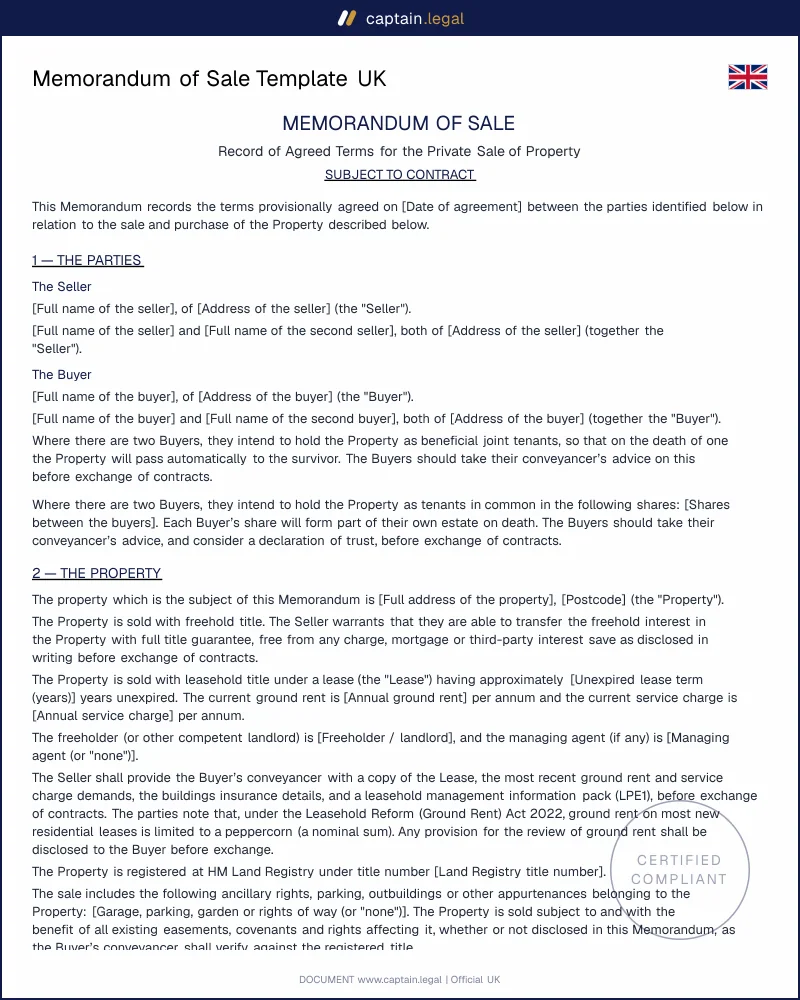
You start by entering the full legal names and contact addresses of the seller and the buyer, then the property address and its HM Land Registry title number if you have it to hand. From there you set the agreed price and state the deposit, keeping the two figures separate so there is no confusion at exchange. The template then prompts you for the proposed completion date, where you confirm whether it is a firm target or provisional because of a chain.

Next you work through the conditions, ticking and describing the ones that apply: mortgage approval, survey, vacant possession, fixtures included. The fixtures section lets you list what stays and what goes, mirroring the standard TA10 layout so your conveyancer recognises it instantly. You then add the details of both solicitors, so the firms can make contact straight away. The document is pre-marked subject to contract, which you leave in place. Once complete, you download it in Word or PDF, sign it, and send identical copies to each conveyancer. If you are selling without a solicitor in the early stages, the UK private loan agreement template is a useful companion where part of the price is being deferred between the parties.

6

Common mistakes to avoid

The mistake that causes the most trouble is treating the memorandum as if it were the contract. People sign it, assume the sale is locked in, and are then surprised when the other side withdraws. It is subject to contract by design, and no amount of detail or signing changes that under section 2 of the 1989 Act. A related error is taking a substantial pre-contract deposit from the buyer in a private sale; this creates risk and confusion, because the real deposit is paid on exchange under the standard conditions, and a private seller holding a buyer's money before exchange invites a dispute if the deal falls through. Vague figures are the next trap. Writing "around the asking price" or leaving the deposit blank defeats the purpose, because the whole reason for the memorandum is to give both conveyancers a precise, agreed reference point.

Two further slips appear again and again. The first is forgetting to record the conditions properly, so a sale that everyone understood to depend on a mortgage offer or a clear survey ends up looking unconditional on paper. The second is leaving the completion date stated as if it were certain when the property sits in a chain. Always describe a chained completion date as a target, not a commitment, or you risk one side accusing the other of slipping when the linked transactions are simply taking their normal course. Finally, a private seller who skips the fixtures summary almost always regrets it, because arguments over what was included surface at the worst possible moment, just before completion.

Key takeaways

STATUS

It is not the sale contract

A memorandum of sale is a written snapshot of the agreed deal once an offer is accepted, but it is marked subject to contract and does not transfer the property. It sits between the handshake and exchange, and either side can still walk away without penalty until contracts are exchanged. Treat it as a briefing note for conveyancers, not a binding promise.

FORMALITIES

Section 2 keeps the contract separate

Section 2 of the Law of Property (Miscellaneous Provisions) Act 1989 requires a land sale contract to be in writing, contain all expressly agreed terms in one document, and be signed by or for both parties. This template is deliberately not drafted to meet those formalities. Even a detailed or signed memo will not force a sale, as confirmed in Firstpost Homes Ltd v Johnson [1995].

DETAILS

Lock down price, deposit and completion early

The memo earns its keep by fixing the key figures and assumptions while memories are fresh: purchase price, any deposit, the target completion date, and conditions like a mortgage offer, a satisfactory survey, or no onward chain. In a private sale, it replaces the estate agent’s memo and gives both solicitors the same reference point, cutting down later disputes over misremembered numbers.

Frequently Asked Questions

No, and that is by design. A memorandum of sale records the agreed terms but does not commit either party to the transaction. Under section 2 of the Law of Property (Miscellaneous Provisions) Act 1989, a contract for the sale of land is only binding when it is in writing, incorporates all agreed terms in one document, and is signed by both parties as a formal contract. The memorandum is marked subject to contract precisely so it falls outside those formalities. The sale becomes legally binding only on exchange of contracts, which your conveyancers handle. Until then, either side can withdraw without penalty.

The template downloads in both Word and PDF. The Word version lets you edit every field, names, price, deposit, completion date and conditions, so you can tailor it to your exact transaction before printing or signing. The PDF version is the clean, fixed copy you send to each conveyancer once the details are settled. Most private sellers complete and adjust the Word file first, then save a PDF for circulation, which keeps an unalterable record of what was agreed. Both formats carry the same plain-English wording drafted for England and Wales.

As soon as the terms are agreed. The memorandum is what tells both conveyancers to open their files and begin the legal work, so any delay in issuing it directly delays the whole conveyancing process. In practice a sale moves from accepted offer to completion in roughly one to three months, and that clock effectively starts when the memorandum reaches the solicitors. Sending identical copies promptly to each side also reduces the chance of the parties remembering the figures differently, which is one of the most common causes of a private sale stalling early on.

No. This template exists precisely for private sales where no estate agent is involved. Where an agent acts, they normally prepare the memorandum; without one, the seller and buyer produce it themselves and send it to their conveyancers. The legal effect is identical either way, because the memorandum is never the binding instrument. What matters is that the agreed terms are recorded accurately and that both solicitors receive matching copies. For other documents a private seller may need around the transaction, the UK statutory declaration template covers sworn statements that sometimes arise during conveyancing.

Include every condition the deal genuinely depends on. The usual ones are mortgage approval by a set date, a satisfactory survey or homebuyer report, the property being sold with vacant possession, and any dependency on a linked sale in a chain. Each condition should be stated plainly so a solicitor reading it understands exactly what still has to happen. If the buyer is relying on selling their own property first, say so. The point is to give both conveyancers an honest picture of what is settled and what remains contingent, which is what keeps the transaction moving cleanly toward exchange.

Yes. Because the memorandum is not binding, terms can change as the transaction develops, which happens often. A survey may reveal a defect that justifies a price reduction, or a chain may push the completion date back. You generally do not need to reissue the whole memorandum for every adjustment; you simply notify both conveyancers, and the change is carried into the draft contract. The figures only become fixed and enforceable when contracts are exchanged. This flexibility is one reason the memorandum is so useful: it captures the starting position without locking anyone into terms that may sensibly need to shift.

No. The two documents do different jobs at different stages. The memorandum of sale comes first and records the agreed terms in plain English, subject to contract. The contract of sale comes later, is drafted by the seller's conveyancer, usually incorporates the Standard Conditions of Sale (Fifth Edition, 2018 Revision), and is the binding legal document signed before exchange. The memorandum feeds information into that contract, particularly the special conditions unique to your property, but it never replaces it. Treating the memorandum as the final agreement is the single most common misunderstanding in a private sale, and it is worth being clear about from the start.

4.7/5

17 verified reviews · 50 000+ downloads

UK Memorandum of Sale | Subject to Contract Template
  • Immediate access to the document
  • PDF + Word download
  • Compliant with 2026 legislation
  • Reviewed by lawyers
Fill in the template
Secure payment · No subscription
Updated on June 7, 2026

You might also like

Tenancy Inventory & Schedule of Condition
Rent Receipt UK Template