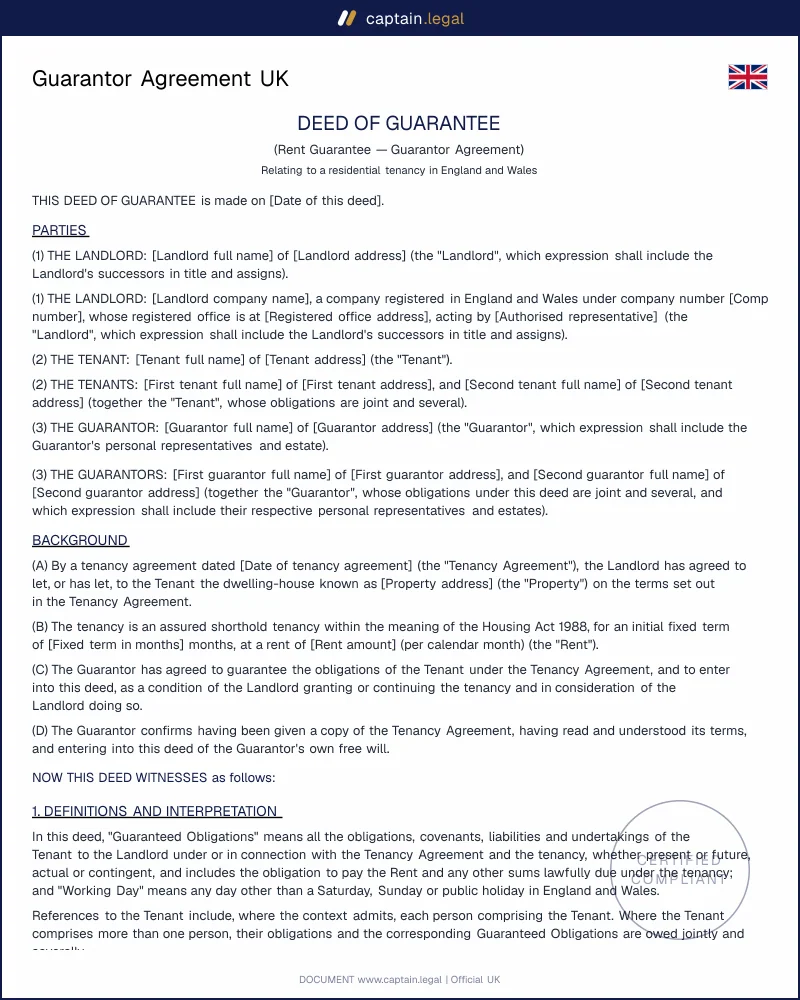
A rent guarantee in England and Wales draws on three distinct sources of law, and getting any one wrong can void the document. First, the Statute of Frauds 1677 requires a guarantee to be in writing and signed by the guarantor or someone authorised by them. An oral promise to stand behind a tenant's rent is unenforceable, full stop. Second, where the guarantee is given after the tenancy has already started, or where the parties simply want the strongest form, it must be executed as a deed under section 1 of the Law of Property (Miscellaneous Provisions) Act 1989. A deed must make clear on its face that it is intended to be a deed, be signed by the guarantor in the presence of a witness who attests the signature, and be delivered. A party to the deed cannot act as the witness, a rule confirmed in Seal v Claridge (1881). Executing as a deed also removes the need for separate consideration, which is why it is the safer route.
The third and newest source is the Renters' Rights Act 2025, in force from 1 May 2026, which abolished fixed-term assured shorthold tenancies and made all new tenancies periodic from day one. This reshapes guarantor drafting. A guarantee tied to "12 months from [date]" can now expire while the tenancy continues as a periodic assured tenancy, leaving the landlord exposed. Courts had already held in Superstrike Ltd v Rodrigues (2013) that a guarantee does not automatically extend to a statutory periodic tenancy. The Act also caps, in defined circumstances, the sum a guarantor can be required to cover, and section 19 releases a guarantor from liability for rent falling due after the death of the tenant they were guaranteeing. For the current statutory text, see the Renters' Rights Act 2025 on the official legislation.gov.uk register.