Create my document
Login

Choose country

FranceBelgiqueEspañaUnited StatesUnited KingdomMarocDeutschlandItaliaSchweiz
Employment

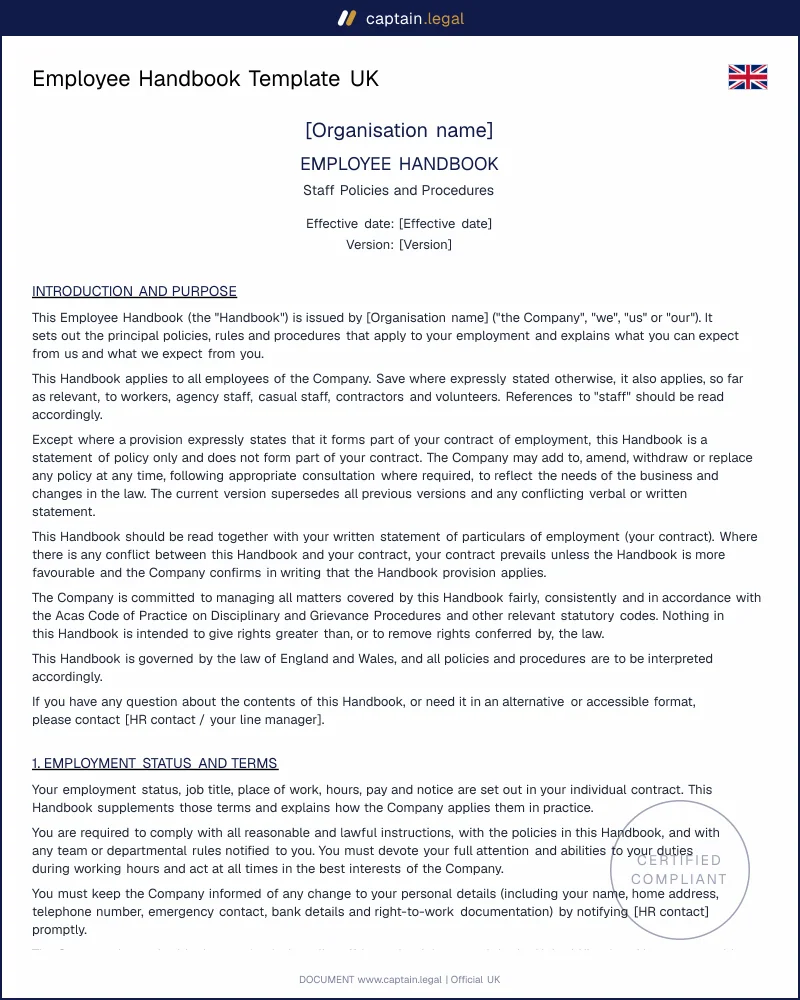
Employee Handbook UK | ACAS Code & Equality Act 2010

Lawyer-grade UK staff handbook drafted to the ACAS Code, Equality Act 2010 and UK GDPR. Disciplinary, grievance, absence and IT policies in editable Word & PDF.
4.6/518 reviews50 000+ downloadsInstant download
Share

A staff handbook is the single document that tells your people how things actually work : how you deal with misconduct, how someone raises a grievance, what happens when they are off sick, what counts as acceptable use of your systems, and how you treat everyone fairly. An employee handbook is not legally mandatory in the UK, but several of the policies inside it are, and the way you write and follow them decides whether you win or lose at an employment tribunal. This template pulls your disciplinary, grievance, absence, equality and IT rules into one ACAS-aligned handbook, drafted for small and growing UK employers and supplied as a fully editable Word file and a clean PDF.

The point of getting it right is simple. A tribunal judge does not read your good intentions, they read your documents and your decisions against them. A clear, current handbook is the difference between a defensible process and an expensive guess.

Compliant

2026 Legislation

50,000+ clients

trust us

Affordable

From $4.90 / doc

Secure payment

Instant download

Employee Handbook UK | ACAS Code & Equality Act 2010

Secure payment · No subscription

Fill in the template

What is a UK employee handbook?

A staff handbook is a collection of workplace policies and procedures gathered in one place, setting out the standards you expect and the processes you will follow. It sits alongside the contract of employment but does a different job. The contract creates binding promises about pay, hours and notice; the handbook usually explains how you run the workplace day to day, from sickness reporting to internet use. That distinction matters more than most employers realise.

Most handbooks are drafted as non-contractual, and deliberately so. If your disciplinary or absence policy is contractual, departing from it even slightly can hand an employee a breach of contract claim on top of everything else. Keeping the handbook non-contractual gives you room to apply policies sensibly to the facts, while still showing a tribunal that you had a fair, written process and stuck to it. The usual approach is a short statement confirming the handbook is non-contractual, with a clear note that a handful of provisions (data protection duties, for instance) do carry contractual or legal weight.

The handbook also doubles as evidence. If you follow your own policy it works for you; if you ignore it, it works against you. That is why a vague, copied-from-the-internet handbook is often worse than none : it sets a standard you then fail to meet. A handbook drafted for your business, kept up to date and actually read by staff, is the version that protects you. You can pair it with a compliant UK statement of written particulars under section 1 of the ERA 1996 so the contractual core and the policy layer line up cleanly.

2

When do you need this document?

The most common trigger is your first hire. The moment you employ someone, you take on disciplinary, grievance, absence and data protection obligations, and a handbook is the cleanest way to set them out once instead of improvising email by email. Small employers often skip this and regret it the first time a problem lands. By then you are writing a policy under pressure, which is exactly when fairness slips.

The second scenario is growth. A founder managing three people by instinct cannot manage thirty the same way, and informal "we'll sort it out" arrangements stop scaling. When you bring in managers who will run disciplinaries and sign off absence, they need a written standard to apply consistently, otherwise two employees in identical situations get treated differently and one of them has a discrimination argument. You will likely want to align the handbook with your full-time UK employment contract drafted to ERA 1996 at this stage.

A third trigger is a near miss. Plenty of employers only build a proper handbook after a grievance they handled badly, a resignation that smelled of constructive dismissal, or an ACAS early conciliation letter. The handbook becomes the corrective : a documented process they can point to next time. One edge case worth flagging is the mixed workforce. If you engage workers and contractors as well as employees, the ACAS Code technically applies mainly to employees, but applying the same fair procedure to everyone classed as a worker is the safer practice and avoids awkward status arguments later. Another is a TUPE transfer, where incoming staff arrive with expectations set by a previous employer's policies and you need a clear handbook to harmonise the rules.

3

Key clauses included in our template

  • The disciplinary policy is drafted to the ACAS Code, with informal resolution first, then a staged formal process covering investigation, a hearing with the right to be accompanied, written outcomes and a right of appeal. The point is a procedure a tribunal will recognise as fair, not a list of punishments.
  • The grievance policy mirrors that structure for complaints raised by staff, with informal and formal routes, timescales for response, and an appeal stage. UK employers are expected to set out a grievance procedure in writing and share it, and this clause does exactly that.
  • The absence and sickness policy sets reporting requirements, certification rules, return-to-work expectations and the interaction with Statutory Sick Pay, so managers handle absence consistently rather than on gut feel. It links naturally to your UK statutory sick pay decision letter when you formally decide entitlement.
  • The equality and diversity policy commits the business to the Equality Act 2010, names the nine protected characteristics, and sets out how harassment and discrimination complaints are handled, which matters more as the enhanced harassment prevention duty bites.
  • The IT and data protection policy covers acceptable use of email, internet and devices, monitoring, and each employee's responsibilities under the UK GDPR and Data Protection Act 2018, including the duty to report a suspected breach promptly.
4

Regional considerations

England and Wales form the core jurisdiction this handbook is drafted for. The Employment Rights Act 1996, the Equality Act 2010 and the ACAS Code all apply, and tribunal claims are heard in the Employment Tribunals (England and Wales). For the great majority of small employers operating here, the template works as drafted, provided you complete the company-specific detail. Do not leave placeholder text in a policy you may later rely on in a hearing.

Scotland shares the same primary employment statutes, since employment law is largely reserved to Westminster, so your disciplinary, grievance, equality and absence policies carry across without rewriting. The differences are procedural rather than substantive : tribunal practice sits within the separate Scottish system, and references to courts and certain enforcement mechanisms differ. A handbook drafted for England and Wales is generally sound in Scotland, but a Scottish employer should sense-check any reference to court procedure.

Northern Ireland is the genuine exception and needs care. Employment law there is devolved and diverges in important ways : the governing statute is the Employment Rights (Northern Ireland) Order 1996 rather than the ERA 1996, discrimination is governed by separate Northern Ireland legislation rather than the Equality Act 2010, and the Labour Relations Agency plays the role ACAS plays in Great Britain. An employer based in Northern Ireland should treat this template as a strong structural starting point and replace the statutory references with the local equivalents before relying on it.

5

How to fill out this employee handbook

You start by entering your company details and confirming the basics, including the all-important statement that the handbook is non-contractual, which the template positions for you. From there you move section by section through the disciplinary, grievance, absence, equality and IT policies, completing the prompts where the document needs your specifics : who hears appeals, how staff report absence, which manager owns data protection questions. The structure and the legally sensitive wording are already drafted, so you are personalising a sound document rather than writing one from scratch.

As you work through it, the template flags the choices that carry risk, so you know where a casual decision could weaken a later defence. Once finished, you download a fully editable Word file and a clean PDF, circulate it to staff, and keep a record that each person received and read it. That acknowledgement step is easy to skip and costly to skip : a policy nobody saw is hard to enforce. If you need to compare your starter paperwork, the full UK employment document category sets out the contracts and letters that sit alongside the handbook.

6

Common mistakes to avoid

The first and most damaging mistake is having a handbook and then not following it. A tribunal reads your own policy back to you, and a disciplinary that skips the investigation or denies an appeal looks worse precisely because your handbook promised both. The second is making the whole handbook contractual, often by accident, through loose wording that binds you to every line. That converts a flexible policy into a promise you can breach, so the non-contractual statement is not boilerplate, it is load-bearing. The third is copying a generic handbook and leaving in references that do not match your business, your jurisdiction or current law, which is how Northern Ireland employers end up quoting the wrong statute.

A further error is letting the handbook go stale. Employment law moves, and a policy that ignores the harassment prevention duty or the changes coming under the Employment Rights Act 2025 signals to a tribunal that your processes are out of date. Employers also routinely under-document the equality and data protection sections, treating them as filler, then find they cannot show they took reasonable steps when a harassment or data complaint arrives. Finally, many skip the acknowledgement record entirely. You should be able to evidence that each employee received the handbook, because an unread policy is difficult to rely on when it matters most.

Key takeaways

ACAS CODE

Fail the Code, pay up to 25% more

Your disciplinary and grievance procedures must meet the ACAS Code standard of fairness. If you unreasonably fail to follow it, an employment tribunal can uplift compensation by up to 25%. That is why the process matters: investigation first, then a hearing the employee can attend with a companion, a clear written decision, and a genuine right of appeal, all recorded and followed.

STATUS

Keep the handbook non-contractual by default

Most handbooks should be expressly non-contractual, so you can apply policies sensibly without turning every deviation into a breach of contract claim. The contract covers binding terms like pay, hours and notice; the handbook explains day-to-day rules such as absence reporting and IT use. Add a short non-contractual statement, while flagging any parts that still carry legal or contractual weight.

EVIDENCE

Your handbook will be used against you

A handbook is not legally required, but it becomes evidence of what you said you would do. If you follow your own policy it supports your case; if you ignore it, it undermines you. A vague, copy-and-paste handbook can be worse than none because it sets standards you cannot meet. Keep it tailored, current, and actually read by staff.

Frequently Asked Questions

No single law forces you to produce a handbook, but several of the policies inside one are effectively required. You must have written disciplinary and grievance procedures aligned with the ACAS Code, an equality framework under the Equality Act 2010, and data protection arrangements under the UK GDPR and Data Protection Act 2018. A health and safety policy is required once you have five or more employees. The handbook is simply the practical way to document and communicate all of this in one place, and most legal and HR guidance, including from ACAS, recommends having one to reduce risk.

The template is drafted to be non-contractual, which is the standard and usually safer approach. A non-contractual handbook lets you apply policies sensibly to the facts without every clause becoming a contractual promise you could be sued for breaching. That said, a small number of provisions, such as an employee's data protection obligations, may carry legal or contractual weight, and the template makes that distinction clear. The disciplinary and grievance procedures still matter enormously even though they are non-contractual, because a tribunal will judge your fairness against them under the ACAS Code.

The ACAS Code of Practice sets the minimum standard of fair procedure a tribunal expects, covering investigation, a hearing the employee can attend with a companion, a written outcome and a right of appeal. It is not a contract, but tribunals must take it into account. The financial consequence is direct : where an employer unreasonably fails to follow the Code, a tribunal can increase the employee's compensation by up to 25%, and where an employee fails to follow it their award can be cut by the same margin. Drafting your policies to the Code is the cheapest insurance you can buy.

For England, Wales and Scotland the core works without rewriting, because the Employment Rights Act 1996 and Equality Act 2010 apply across Great Britain, with only procedural differences in Scotland. Northern Ireland is different and needs adaptation : it has its own Employment Rights (Northern Ireland) Order 1996, separate discrimination legislation, and the Labour Relations Agency in place of ACAS. If you employ staff in Northern Ireland, use the template's structure but swap the statutory references for the local equivalents before relying on it.

You receive the handbook as a fully editable Microsoft Word document and a clean PDF. The Word version lets you personalise every section, add your branding, and update policies as the law changes without breaking the structure. The PDF gives you a tidy version to circulate to staff and store as your record. Having both means you can keep one master in Word and issue the PDF, which is the sensible way to control versions and prove what each employee actually received.

Review it at least once a year, and sooner whenever the law shifts. The next wave of change is already visible : the Employment Rights Act 2025 is expected to introduce day-one unfair dismissal protection, enhanced harassment prevention duties and new fire-and-rehire restrictions over the coming period. A handbook that ignores upcoming duties looks dated to a tribunal and exposes you on the exact issues regulators are prioritising. Treat the annual review as a fixed diary entry, not an optional housekeeping task.

You are not strictly required to obtain a signature, but you should keep a record that each employee received the handbook and had the chance to read it, ideally with a signed or electronic acknowledgement. This step is easy to overlook and genuinely valuable : a policy you cannot show the employee saw is much harder to enforce. The acknowledgement also helps when you rely on the handbook in a disciplinary or grievance, because it closes off the "I never saw that policy" defence before it starts.

4.6/5

18 verified reviews · 50 000+ downloads

Employee Handbook UK | ACAS Code & Equality Act 2010
  • Immediate access to the document
  • PDF + Word download
  • Compliant with 2026 legislation
  • Reviewed by lawyers
Fill in the template
Secure payment · No subscription
Updated on June 7, 2026

You might also like

Zero-Hours Contract Template UK
UK Fixed-Term Contract