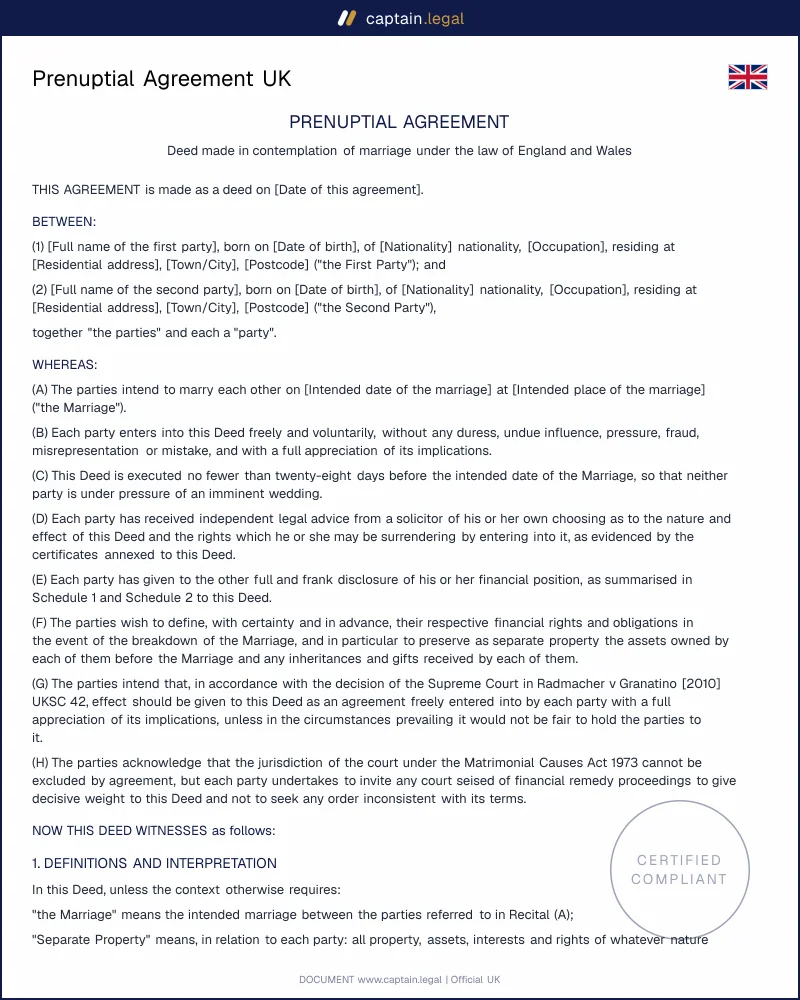
Prenuptial agreements in England and Wales sit on a foundation of case law rather than a single statute, and understanding that foundation is what separates a robust agreement from a worthless one. The governing statute is the Matrimonial Causes Act 1973, whose section 25 obliges the court to have regard to all the circumstances of the case, with first consideration given to the welfare of any child under eighteen, when deciding financial provision on divorce. The eight factors listed there, from each party's income and earning capacity to the standard of living enjoyed during the marriage, remain the lens through which any agreement is judged. You can read the statutory factors in the official text of section 25 of the Matrimonial Causes Act 1973 on legislation.gov.uk.
The turning point came with Radmacher (formerly Granatino) v Granatino [2010] UKSC 42, where the Supreme Court held by a majority of eight to one that a court should give effect to a nuptial agreement freely entered into by each party with a full appreciation of its implications, unless in the prevailing circumstances it would not be fair to hold them to it. That single sentence now drives how every prenup is assessed. The court read the agreement together with the section 25 discretion, drawing on the fairness strands of needs, compensation and sharing identified in White v White and Miller v Miller; McFarlane v McFarlane. The practical consequence is that a prenup which leaves one spouse unable to meet basic housing and living costs, while the other keeps substantial wealth, is unlikely to survive, and no agreement can bind the court on child maintenance.
Reform has been discussed for years without arriving. The Law Commission proposed statutory qualifying nuptial agreements in 2014, and its December 2024 scoping report on financial remedies revisited the question, but as of early 2026 no binding regime has been enacted and Radmacher remains the law. Until Parliament legislates, execution as a deed, honest disclosure and independent advice are what give a prenup its weight. A property and financial affairs LPA drafted to the Mental Capacity Act 2005 is a useful companion document for couples who want their financial wishes respected across every scenario, not only divorce.