A witness statement is the foundation of factual evidence in nearly every civil claim heard by the courts of England and Wales. Drafted properly, it carries the same weight as oral testimony given from the witness box ; drafted poorly, it is excluded, struck through, or used to undermine the credibility of the witness who signed it. Our template follows the structural and formal requirements of Civil Procedure Rules Part 32 and its accompanying Practice Direction, including numbered paragraphs in the witness's own words, properly referenced exhibits, and a compliant statement of truth. It is built for litigants, supporting witnesses and solicitors who need a procedurally sound document ready to file with the County Court, the High Court, or a tribunal that follows the CPR.
Compliant
2026 Legislation
50,000+ clients
trust us
Affordable
From $4.90 / doc
Secure payment
Instant download
CPR Part 32 Witness Statement | UK Civil Procedure Template
Secure payment
What is a witness statement under CPR Part 32?
A witness statement is a written, signed account of the facts a person would be allowed to give orally if called to give evidence at trial. Rule 32.4(1) defines it in those exact terms, and rule 32.5(2) establishes that, once served, the statement stands as the witness's evidence in chief unless the court orders otherwise. The procedural consequence is significant. In most civil trials the witness does not retell the story from the box ; the judge reads the statement before the hearing, and the live testimony jumps straight to cross-examination. Whatever was not captured in the written document is generally lost.
The document is distinct from an affidavit, which must be sworn or affirmed before an authorised person and remains mandatory for a narrow set of applications such as freezing injunctions and search orders under rule 32.15 and PD 32 paragraph 1.4. It is also distinct from an expert report, which falls under CPR Part 35 and may only be served with the court's permission. A witness statement is for lay evidence: what the person saw, heard, did, or was told within their own knowledge. The template sits alongside other everyday personal legal documents for UK individuals where formal accuracy decides whether a third party accepts the document.
Legal framework
Witness evidence in civil proceedings is governed primarily by CPR Part 32 and its detailed companion text, Practice Direction 32. Both are published by the Ministry of Justice and remain the authoritative starting point for any litigator drafting a statement in England and Wales : see the Ministry of Justice procedural text on Part 32 witness evidence. PD 32 sets the form. The document must bear the case title and claim number in the top right of the first page and on the backsheet, identify the witness and capacity, number every paragraph, and reference each exhibit by initials followed by a serial number. Failure on any of these formal points rarely kills a statement on its own, but it signals to the court that the drafter does not know the rules, and that perception colours everything that follows.
The substantive obligations are tighter. Rule 32.8 requires compliance with PD 32 ; Part 22 and PD 22 govern the statement of truth, whose exact wording was tightened by the 113th Update to include an express acknowledgment that contempt of court proceedings may follow a false statement. Practice Direction 57AC, in force for all trial witness statements signed on or after 6 April 2021 in the Business and Property Courts, layers further duties : a confirmation of compliance signed by the legal representative, a list of the documents the witness was shown when preparing the statement, and explicit limits on how heavily a solicitor may shape the wording. Any statement filed in the Commercial Court, the Chancery Division, the TCC or the IPEC must navigate both PD 32 and PD 57AC, and the two interact in non-obvious ways.
When do you need this document?
The most frequent trigger is a contested civil claim already on track. Once directions are given, the court orders each party to serve their factual witness evidence by a fixed date, usually between 8 and 12 weeks before trial in standard multi-track matters. Missing that deadline without a successful application for relief from sanctions under rule 3.9 and the Denton v TH White test is one of the most expensive procedural failures in modern litigation.
Beyond trial directions, witness statements support a wide range of interim applications. Summary judgment under CPR Part 24, interim injunctions, security for costs, strike-out applications under rule 3.4, and freezing relief all require written evidence ; in most cases that evidence takes the form of a witness statement rather than an affidavit. Landlords preparing to issue possession proceedings frequently rely on a CPR-compliant statement alongside residential tenancy and property dispute templates, and employers facing a constructive dismissal claim pair their statement with UK workplace and HR document templates.
A statement drafted to CPR standards also strengthens any pre-action letter under the Practice Direction on Pre-Action Conduct. Directors documenting a corporate dispute, often filed alongside commercial and corporate document templates, benefit from putting their account on paper in the form a court would later accept. The earlier this is done, the more credible the account. Memories degrade fast, and a statement written six months after the events it describes will always be challenged on that ground.
Key clauses included in our template
The template is built to satisfy every formal requirement of PD 32 while remaining readable enough for a non-lawyer to complete unaided. A few of the most consequential blocks deserve specific attention.
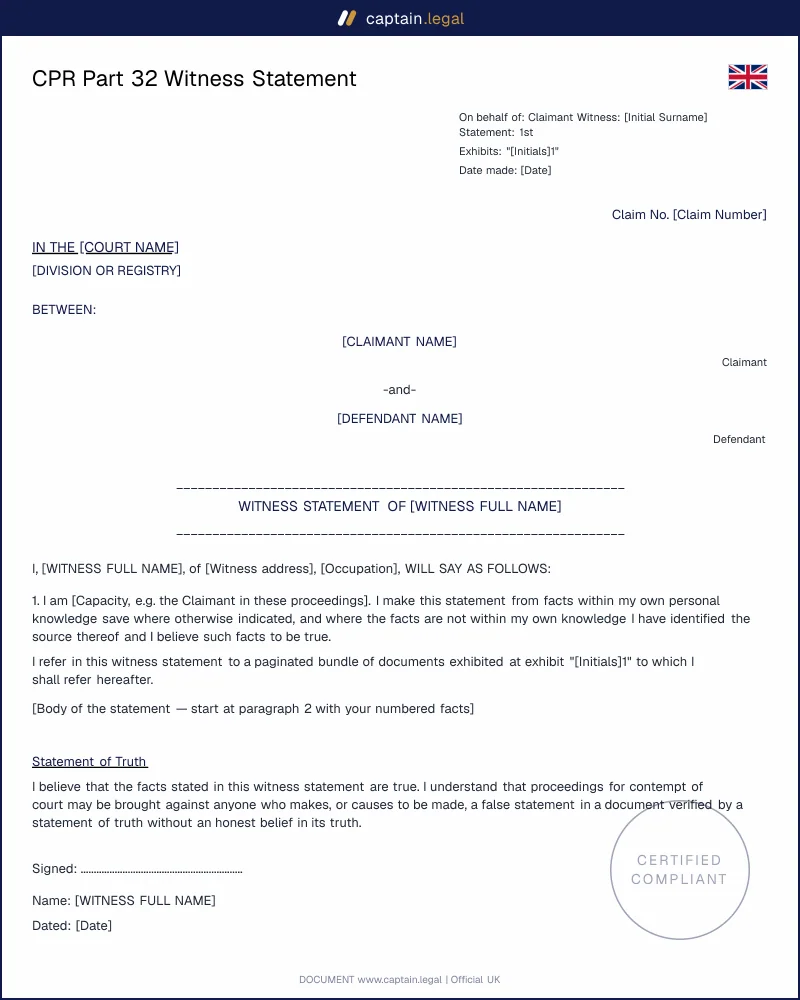
- The case heading and identification block sets out the court, the division, the claim number, the parties in their correct status order, and the witness's full name, occupation, address and capacity. PD 32 paragraph 17.1 requires this layout, and a mismatch with the claim form is one of the easiest grounds on which an opponent will object to admissibility.
- The paragraph on knowledge and belief complies with PD 32 paragraph 18.2 : the witness states which parts of the statement are made from their own knowledge, which are matters of information or belief, and identifies the source of the latter. Skipping this paragraph produces evidence the court can disregard.
- The numbered factual paragraphs are written in the first person, in chronological order, in the witness's own language, and limited to facts within direct knowledge. Each paragraph addresses a single point. Trial judges read evidence faster when the numbering allows them to navigate it during cross-examination.
- The exhibits block uses the formula "there is now produced and shown to me marked 'JS1' the (description of exhibit)", with consecutive numbering throughout the case and a separate paginated exhibit bundle. Exhibits referenced loosely are the single most common source of admissibility arguments at trial.
- The statement of truth uses the exact wording mandated by the 2020 amendments to PD 22, including the express reference to contempt of court. A statement of truth in any other form will be challenged.
- The signature, date, and translator's certificate close the document. Date the signature on the day it is signed, not in advance. A misdated statement of truth is treated as no statement of truth at all.
Court-specific considerations
The CPR govern civil proceedings in England and Wales, and that geographic limit is sharper than many overseas users assume. Scotland operates under the Court of Session Rules and the Sheriff Court Ordinary Cause Rules, with its own affidavit and witness statement practice. Northern Ireland applies the Rules of the Court of Judicature (NI) 1980 and parallel County Court rules. A statement drafted on the CPR template will not be procedurally compliant in either jurisdiction without significant modification.
Within England and Wales, the choice of court alters the drafting standard. The County Court applies CPR Part 32 and PD 32 in full, with no additional layer ; statements there are the most forgiving of minor formal slips. The High Court, King's Bench Division sits in the same procedural framework but expects a noticeably higher standard of drafting, particularly on length discipline and exhibit referencing. Hearings before a Master turn on the contents of the written evidence almost exclusively.
The Business and Property Courts, which include the Chancery Division, the Commercial Court, the Technology and Construction Court, the Insolvency and Companies Court, and the Intellectual Property Enterprise Court, apply Practice Direction 57AC in addition to PD 32 for all trial witness statements signed since 6 April 2021. PD 57AC adds the confirmation of compliance signed by the legal representative, the list of documents the witness was referred to during drafting, and explicit prohibitions on rehearsing arguments or commenting on documents. Trustees and officers of registered charities involved in governance proceedings, whose disputes often land in the Chancery Division, regularly file their witness evidence alongside charity governance and trustee dispute documents. If your dispute is commercial in any substantial sense, draft to PD 57AC from the outset.
How to fill out this witness statement
You start by entering the case heading : the court, the division or list, the claim number, and the parties in their correct status order as they appear on the claim form. The template then asks for the witness's full name, address, occupation, and capacity (party, employee of a party, or independent witness), and adjusts the introductory paragraph accordingly. This single step covers most of the formal compliance under PD 32 paragraph 17.1.
The next stage is the substantive evidence. The form provides a numbered paragraph structure with prompts for the chronology : when did the witness first encounter the relevant facts, what did they do, what did they observe, and what did others say or do in their presence. You write each paragraph in your own words ; that is a hard requirement under PD 32 and PD 57AC, and the template guards against the most common drift into legal language. Exhibits are added through a dedicated block that auto-numbers each item with the witness's initials and produces the standard "now produced and shown to me marked" formula.
The form closes with the statement of truth, pre-filled with the wording required by the 2020 amendments to PD 22, and a dated signature block. If a translator is involved, the template generates the additional certificate required by PD 32 paragraph 23.2. The output arrives in Word and PDF, ready to print, sign, and file, or to upload to MyHMCTS and CE-File where electronic filing is required.
Common mistakes to avoid
The cardinal error is treating the witness statement as a vehicle for argument. A witness who explains why the contract was breached, why the dismissal was unfair, or what the defendant must have been thinking has stopped giving evidence and started making submissions. PD 57AC paragraph 3.6 is explicit on this point, and even outside the Business and Property Courts a competent opponent will ask the court to strike through every offending paragraph at pre-trial review. The remedy is disciplined : state what you saw, what you did, what you were told, and stop. The lawyer's job is to draw the inferences in skeleton argument.
The second most frequent mistake is exhibit chaos. Statements that reference "the email of 3 March" without exhibiting it, or that pin a single exhibit number to a bundle of unrelated documents, force the trial judge to do work the parties were paid to do themselves. Number each document, attach it consecutively, and refer back to it by exhibit number in the body of the statement. The third recurring failure is solicitor-drafted language signed by witnesses without proper review ; PD 57AC now requires an express compliance certificate from the legal representative for precisely this reason. If a sentence does not sound like you, change it before you sign. Finally, witnesses regularly date the statement of truth with the day the document was emailed rather than the day they actually signed it. The two are not the same, and a misdated statement is treated as defective.
Frequently Asked Questions
44 verified reviews · 50 000+ downloads
- Immediate access to the document
- PDF + Word download
- Compliant with 2026 legislation
- Reviewed by lawyers
You might also like