A Last Will and Testament is the formal document by which an adult of sound mind sets out who should inherit their estate, who should administer it, and who should look after any minor children once they are gone. In England, Wales and Northern Ireland, a will only takes effect at death, but the choices recorded inside it shape everything that follows: probate, inheritance tax, family disputes, and the fate of property held for decades. Our UK will template is drafted to the standards of the Wills Act 1837, signed in the presence of two independent witnesses, and broad enough to cover the everyday estate of a homeowner, a parent, or a professional with savings and pensions in the United Kingdom.
This page explains when an English-law will is the right instrument, what the statute actually requires, which clauses appear in the template, and how the document is signed so that it is admissible to probate without challenge.
Compliant
2026 Legislation
50,000+ clients
trust us
Affordable
From $4.90 / doc
Secure payment
Instant download
UK Will Template | Wills Act 1837 Compliant
Secure payment
What is a last will and testament under English law?
A last will and testament is a revocable disposition of property taking effect on death. The person making it, known as the testator, retains full ownership and control of their assets during their lifetime ; the will only becomes operative when the Probate Service issues a Grant of Probate after death. Until that moment, the testator can amend the will by a codicil, revoke it by a later will, or destroy it with the intention of revocation under section 20 of the Wills Act 1837.
The instrument should not be confused with a living will or advance decision, which deals with refusal of medical treatment under the Mental Capacity Act 2005, nor with a lasting power of attorney, which appoints a representative to act during the donor's lifetime. A will speaks from death and only from death. It is also distinct from intestacy: where no valid will exists, the Administration of Estates Act 1925 and the Intestacy Rules dictate who inherits, often in a way that surprises unmarried partners, stepchildren, and modern blended families. Cohabiting partners receive nothing under intestacy, regardless of how long they have lived together, which is the single most common reason solicitors urge clients to make a will. The document also lets the testator name executors, appoint testamentary guardians for minor children under section 5 of the Children Act 1989, and create trusts for vulnerable beneficiaries through the personal legal documents available for individuals in the United Kingdom.
Legal framework
The governing statute remains the Wills Act 1837, a Victorian text that, despite its age, still sets the formal requirements for every English will. Section 9, as amended by the Administration of Justice Act 1982, requires the document to be in writing, signed by the testator (or by another person in the testator's presence and at their direction), made or acknowledged in the presence of two witnesses present at the same time, and signed by those two witnesses in the testator's presence. A will failing any one of those four elements is void on its face and the estate falls into partial or total intestacy. The Law Commission's 2017 consultation paper and the 2025 Law Commission report on wills reform have proposed modernisation, including electronic wills, but as the law currently stands, a wet-ink signature on paper witnessed by two adults remains the safe path. Detailed guidance on making a will is published by the UK government at the official GOV.UK guide to making a will and the rules of intestacy.
Capacity is governed by the common law test in Banks v Goodfellow (1870), reaffirmed by the modern courts: the testator must understand the nature of making a will, the extent of the property being disposed of, and the claims of those who might expect to benefit. The Mental Capacity Act 2005 now sits alongside Banks v Goodfellow, and practitioners often obtain a golden rule medical opinion when the testator is elderly or unwell. Two further provisions deserve attention. First, marriage or civil partnership automatically revokes a prior will under section 18, unless the will is expressed to be made in contemplation of that union. Second, the Inheritance (Provision for Family and Dependants) Act 1975 allows a spouse, child, cohabitant of two years, or other dependant to apply to court for reasonable financial provision even where the will excludes them, which means the freedom of testamentary disposition in England is wider than in civil-law countries but is not absolute.
When do you need this document?
The most common moment a UK adult should make a will is the purchase of a first property, because the equity in a home is usually the largest single asset of the estate and intestacy seldom delivers it where the owner would want. The second classic trigger is the birth of a child : without a will, the surviving parent is not automatically the guardian if both parents die together, and the court will decide who raises the children. Testamentary guardianship clauses prevent that lottery. A third scenario covers cohabiting couples ; English law does not recognise common-law marriage, so partners who never married need a will simply to inherit from each other.
Business owners form another category. A shareholder's will should mirror the company's articles and any shareholders' agreement, otherwise shares may pass to a beneficiary who cannot vote them or who is bound by a pre-emption clause, producing exactly the deadlock the founders sought to avoid. The same logic applies to landlords with multiple let properties, where alignment with the underlying tenancy agreements and other UK real estate templates matters when the rental portfolio passes on. Two edge cases recur in practice. Couples in a second marriage with children from a prior relationship often want a life-interest trust so the surviving spouse can live in the matrimonial home while preserving capital for the children of the first union. And anyone with assets abroad, particularly in civil-law jurisdictions, should consider whether a separate foreign will is needed for the foreign estate or whether EU Regulation 650/2012 (the Brussels IV regulation, still relevant for UK nationals with property in EU member states) applies.
Key clauses included in our template
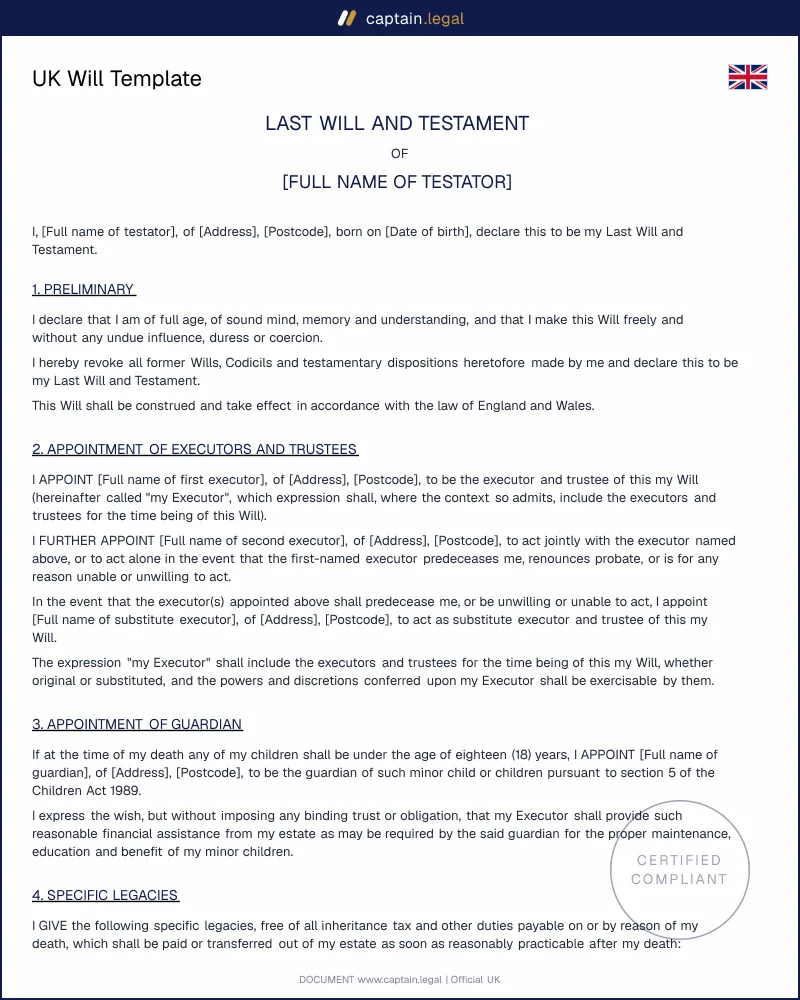
- The declaration and revocation clause opens the will by identifying the testator with full name, address and date of birth, and revokes all previous testamentary instruments. Without an express revocation, a court faced with two surviving wills will read them together to the extent they are consistent, which is rarely what the testator intended.
- The appointment of executors names one to four executors, with at least one substitute. The template prompts the testator to consider whether a professional executor (solicitor or bank) is appropriate where the estate is large, taxable, or likely to be contentious, and explains that executors derive their authority from the Senior Courts Act 1981 once probate is granted.
- The guardianship clause appoints testamentary guardians for any children under 18, taking effect only if no person with parental responsibility survives the testator, in accordance with section 5 of the Children Act 1989. The template invites the testator to name a substitute guardian and to leave a letter of wishes to guide the guardian's day-to-day decisions.
- The specific legacies and pecuniary legacies allow the testator to leave individual items (a watch, a piece of jewellery, a painting) or fixed sums of money to named beneficiaries. Each gift is drafted with a substitution clause in case the beneficiary predeceases the testator, avoiding a lapsed gift under section 33 of the Wills Act 1837.
- The residuary gift disposes of everything that remains after debts, taxes, expenses and specific gifts have been paid. The template supports outright gifts, gifts to a class (such as "my children equally"), and life-interest trusts where a surviving partner takes the income while capital passes to the next generation.
- The attestation clause records the formal signing ceremony : the testator's signature, the simultaneous presence of two adult witnesses with no interest under the will, and the witnesses' own signatures. A witness who is also a beneficiary forfeits the gift under section 15, which is the single most frequent drafting trap in homemade wills.
Regional considerations within the UK
England and Wales are the natural home of this template. The Wills Act 1837 applies in full, probate is granted by the Probate Service of HM Courts and Tribunals Service, and the Inheritance Tax threshold is set under the Inheritance Tax Act 1984, currently delivering a nil-rate band of £325,000 plus a residence nil-rate band of up to £175,000 where the family home passes to direct descendants. The template assumes the testator is domiciled in England or Wales unless stated otherwise.
Northern Ireland applies a parallel framework. The formal requirements largely track the Wills Act 1837, supplemented by the Wills and Administration Proceedings (Northern Ireland) Order 1994. Probate is issued by the Probate Office in Belfast rather than London, and certain family provision claims fall under the Inheritance (Provision for Family and Dependants) (Northern Ireland) Order 1979. Beneficiaries and executors based there should expect minor differences in procedural timetables but not in the substantive structure of the will itself.
Scotland is the important carve-out. Scots succession law is governed by the Succession (Scotland) Act 1964 as substantially amended by the Succession (Scotland) Act 2016, and recognises legal rights under which a spouse, civil partner and children are entitled to a fixed share of the moveable estate regardless of the will's terms. The notion of prior rights and legitim has no English equivalent. If the testator is domiciled in Scotland, this English-law template is not the right instrument ; a Scottish-style will drafted to Scots law is required, and a separate document should be created for any heritable property north of the border.
How to fill out this UK will template
You begin by confirming the country in which you are domiciled and the location of your main assets, which lets the platform set the correct statutory wording and exclude clauses that do not apply. You then enter your full legal name as it appears on your passport or driving licence, your current residential address, and your date of birth, because those three identifiers will be used by the Probate Service to match the will to the estate after death.
The next section captures your family situation : spouse or civil partner if any, names and dates of birth of children, and any dependants for whom you wish to make provision. The form then walks through the appointment of executors, the optional appointment of guardians, the list of specific and pecuniary legacies, and finally the structure of the residuary gift. Each step explains, in plain English, the consequences of the choice you are making, including the impact on inheritance tax and on the rights of beneficiaries who may have a claim under the Inheritance Act 1975. Once every section is complete, you download the document in Word and PDF, print it on plain paper, and arrange the signing ceremony described in the next section. The whole drafting process is similar in spirit to the HR and statutory employment templates compliant with UK law in our library : a structured form behind, a clean legal output in front.
Common mistakes to avoid
The most damaging error is the witness who is also a beneficiary, or whose spouse or civil partner is a beneficiary. Section 15 of the Wills Act 1837 voids the gift to that witness or their partner, even though the will itself remains valid, and there is no judicial discretion to repair the mistake. A second classic error is signing on different days or in different rooms : both witnesses must be physically present at the same time when the testator signs, and must then sign in the testator's presence. Remote signing by video link, briefly permitted during the 2020-2024 emergency provisions, is no longer available for new wills.
A third mistake involves marriage. A will made before a wedding or civil partnership is automatically revoked on the day of the ceremony unless it expressly states that it is made in contemplation of that specific union. Couples who marry without updating their will frequently die intestate without realising it. Failing to appoint a substitute executor and a substitute guardian is another recurring oversight ; when the named individual has died or declined the role, the estate falls back on whoever the Probate Registry is prepared to appoint, often a creditor or a distant relative. Finally, many testators store the original will somewhere safe and tell no one where it is. An unfindable will is, for probate purposes, no will at all ; the Probate Service will assume the testator destroyed it with intent to revoke, and the estate passes under intestacy. Either deposit the original with a solicitor, lodge it at the Probate Service deposit facility for a small statutory fee, or tell at least one executor exactly where it is kept, alongside the wider records that often accompany a business owner's articles, NDAs and UK company documents.
Frequently Asked Questions
20 verified reviews · 50 000+ downloads
- Immediate access to the document
- PDF + Word download
- Compliant with 2026 legislation
- Reviewed by lawyers
You might also like