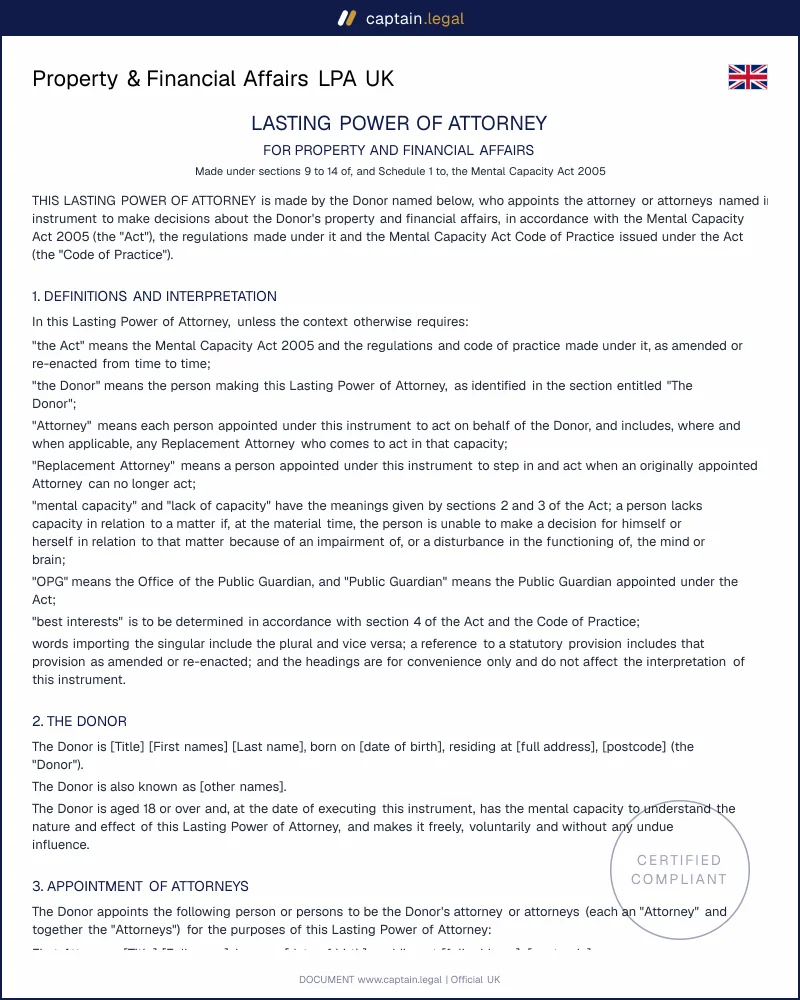
This template is drafted for England and Wales, where the Mental Capacity Act 2005 and the OPG govern every LPA. That jurisdictional boundary is not a technicality, it is decisive, because Scotland and Northern Ireland operate entirely separate systems and a document made under the English regime will not be accepted there.
In Scotland, the equivalent is a Continuing Power of Attorney for financial matters, made under the Adults with Incapacity (Scotland) Act 2000 and registered with the Office of the Public Guardian (Scotland), a different body with different forms. A donor who has moved north of the border, or who owns Scottish assets, should not assume an English LPA reaches them.
In Northern Ireland, the position is different again. There is no LPA system of the English kind; the older Enduring Power of Attorney still operates under the Enduring Powers of Attorney (Northern Ireland) Order 1987, registered with the Office of Care and Protection. Reforms have been legislated but not fully commenced, so anyone with Northern Irish property should take local advice before relying on a template.
A practical cross-border point affects donors who own property in more than one UK nation. An English property and financial affairs LPA covers English and Welsh assets only, so a person with a holiday home in Scotland and a main residence in England may need parallel documents in each jurisdiction. The same caution applies to assets held overseas, where a foreign bank or land registry may simply not recognise an English LPA at all, and a local power of attorney becomes necessary.