A deposit receipt accompanied by the prescribed information is the single most important compliance document a UK landlord issues at the start of a tenancy. It evidences receipt of the tenant's deposit, identifies the authorised scheme protecting that money, and discloses the statutory disclosures required by section 213 of the Housing Act 2004. Get it right within thirty days and the tenancy proceeds normally. Get it wrong, late, or unsigned, and the consequences range from a financial penalty of one to three times the deposit to the loss of the right to recover possession under section 21.
This page covers the legal foundation of the deposit receipt and prescribed information, when each must be served, the clauses our template includes, and the practical mistakes that turn a routine letting into expensive litigation.
Compliant
2026 Legislation
50,000+ clients
trust us
Affordable
From $4.90 / doc
Secure payment
Instant download
Deposit Receipt & Prescribed Information UK — Template (PDF, Word)
Secure payment
What is a deposit receipt and prescribed information?
The deposit receipt is the written acknowledgement that a landlord or letting agent has received a sum of money from a tenant as security for the performance of obligations under an assured shorthold tenancy (AST). On its own, a receipt is not enough. UK law layers a second document on top of it: the prescribed information, a set of statutorily defined disclosures introduced by the Housing (Tenancy Deposits) (Prescribed Information) Order 2007. The two documents are usually served together as a single pack, signed by the landlord and acknowledged by the tenant.
The distinction matters in practice. A simple receipt confirms a payment was made ; the prescribed information confirms that the money has been protected in one of three government-authorised schemes (TDS, DPS, or MyDeposits) and that the tenant has been told everything Schedule 1 of the 2007 Order requires. Letting agents sometimes treat the receipt as the entire compliance step — that error has cost landlords thousands of pounds in section 214 claims. The prescribed information is what unlocks the right to use a section 21 notice ; the receipt alone does not. Both must be served within thirty days of the deposit being received, and the deadline is calendar days, not working days.
Legal framework
The statutory regime begins with Part 6, Chapter 4 of the Housing Act 2004, which created the obligation to protect every deposit taken under an AST in one of three government-backed schemes. Sections 212 to 215 set out the architecture : the Tenancy Deposit Scheme (TDS), the Deposit Protection Service (DPS), and MyDeposits are the three authorised providers in England and Wales, and a landlord may use any one of them, choosing between a custodial model (where the scheme holds the money) and an insurance-backed model (where the landlord retains it but pays a premium). The official UK government guidance on tenancy deposit protection lists the precise items every prescribed information notice must include.
The companion instrument is the Housing (Tenancy Deposits) (Prescribed Information) Order 2007 (SI 2007/797). Its Schedule 1 enumerates fourteen mandatory items, ranging from the address of the property to the procedure for recovering the deposit at the end of the tenancy and the contact details of the scheme's free dispute resolution service. The 2007 Order also requires the landlord to certify the accuracy of the information by signature, and to procure the tenant's confirmation that they have received it. The certification step is non-negotiable: an unsigned prescribed information form is treated by the courts as no information at all. Captain.Legal's UK real estate document templates reflect this signature requirement on the face of the form.
The thirty-day deadline was tightened by the Localism Act 2011, which amended section 213(3) and section 213(6) of the 2004 Act to replace the previous fourteen-day period and to bring late protection within the scope of section 214 penalties. Superstrike Ltd v Rodrigues [2013] EWCA Civ 669 later confirmed that statutory periodic tenancies arising at the end of a fixed term are treated as new tenancies for protection purposes, meaning the prescribed information sometimes needs to be reissued. The Deregulation Act 2015 introduced limited relief for tenancies straddling that case, but the safer course is always to re-serve.
When do you need this document?
The most common trigger is the start of a new assured shorthold tenancy in England or Wales where the landlord takes any cash deposit from the tenant. The thirty-day clock begins on the day the money clears, not on the date the tenancy starts, and the duty applies whether the deposit is paid in one transfer or in instalments. A landlord who allows the tenant to spread the deposit across the first three months of rent must still serve a complete receipt and prescribed information within thirty days of the first payment, with subsequent top-ups documented through addenda.
A second, frequently overlooked scenario is the renewal of a fixed-term AST. Where the parties sign a fresh agreement rather than letting the tenancy roll over into a statutory periodic, the prevailing view since Superstrike is that a new tenancy has been created and the deposit, although still sitting in the same scheme, must be the subject of fresh prescribed information. Many landlords assume the original pack carries forward ; it does not. A third common context is a change of tenant within a shared house, where one occupant departs mid-tenancy and another replaces them. The deposit is usually re-allocated rather than refunded, but the new tenant has never received the prescribed information about money they are now responsible for, so a fresh service is required in their name.
Finally, a change of landlord triggers the duty afresh. A buyer who acquires a tenanted property inherits the deposit and must, within thirty days of completion, serve their own prescribed information naming themselves as the protected party. Captain.Legal's UK landlord and letting agent forms include the assignment notices that pair with this transition.
Key clauses included in our template
- The identification block records the full legal names of every adult tenant and every landlord or letting agent, the registered address for service of notices, and the precise address of the demised premises including any flat number, parking space, or storage unit. Misnaming one of three joint tenants is a frequent ground for section 214 claims, because the prescribed information has not technically been served on the unnamed party.
- The deposit particulars state the exact sum received, the date of receipt, the form of payment, and the breakdown if part of the money relates to a pet deposit or a holding deposit converted into a tenancy deposit. The clause aligns with the Tenant Fees Act 2019 cap of five weeks' rent (six weeks where annual rent exceeds £50,000) and flags any sum above that ceiling as repayable.
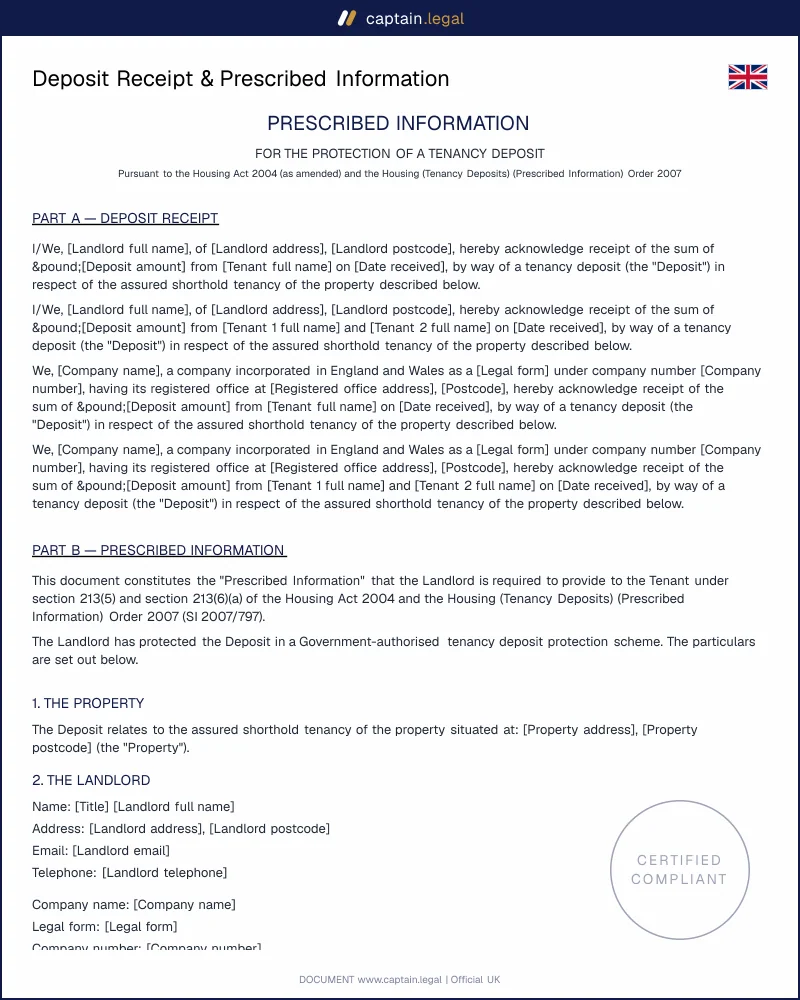
- The scheme certificate section names the chosen scheme, identifies the deposit reference issued by TDS, DPS, or MyDeposits, and reproduces the scheme's published contact details and dispute resolution route as required by paragraph 2 of Schedule 1.
- The statutory disclosures reproduce verbatim the fourteen items mandated by the 2007 Order, including the circumstances in which the landlord may retain part of the deposit and the procedure for the tenant to apply for its return at the end of the tenancy.
- The landlord certification and tenant acknowledgement carry signature blocks on the same page, ensuring the document cannot be challenged for missing the section 213(6)(c) certification step.
Regional considerations
England. The Tenant Fees Act 2019 caps assured shorthold tenancy deposits at five weeks' rent where the annual rent is below £50,000 and at six weeks' rent above that threshold. Any excess is automatically repayable, and a landlord who refuses to refund the surplus risks a Trading Standards penalty of up to £5,000 for a first offence and unlimited fines on repeat. The three authorised schemes (TDS, DPS, MyDeposits) operate identically across England, so the choice is essentially commercial: the DPS custodial scheme is free, while the insurance variants of TDS and MyDeposits let the landlord retain the money in exchange for a per-tenancy fee.
Wales. Welsh ASTs were absorbed into the occupation contract regime by the Renting Homes (Wales) Act 2016, which came fully into force on 1 December 2022. The protection schemes remain the same, but landlords must reissue a written statement of contract that incorporates equivalents of the prescribed information clauses. Crucially, the thirty-day deposit deadline is preserved, but the documentary template differs from the English form. Captain.Legal's Wales-compliant real estate templates include a Welsh occupation-contract variant of the deposit pack.
Scotland. Scotland operates a separate regime under the Tenancy Deposit Schemes (Scotland) Regulations 2011. Three different schemes apply (SafeDeposits Scotland, Letting Protection Service Scotland, MyDeposits Scotland), the deadline is thirty working days rather than calendar days, and the prescribed information is set out in regulation 42 with its own list of mandatory items. An English-style deposit pack served on a Scottish tenant is non-compliant.
Northern Ireland. Northern Ireland uses a fourth regime under the Tenancy Deposit Schemes Regulations (Northern Ireland) 2012, with two authorised schemes (TDS Northern Ireland, MyDeposits Northern Ireland) and a fourteen-day protection deadline. The prescribed information differs again. Cross-border landlords with portfolios in multiple UK jurisdictions should never assume one form fits all.
How to fill out this deposit receipt and prescribed information
You start by selecting the jurisdiction where the rented property is located, because the form pulls a different statutory list of disclosures depending on whether you are letting in England, Wales, Scotland, or Northern Ireland. From there, the questionnaire asks for the names and addresses of every tenant and landlord, the identity of any letting agent acting on the landlord's behalf, and the full address of the premises. The system then prompts for the deposit amount, the date of receipt, and which of the three authorised schemes is protecting the money, automatically inserting the scheme's published contact and dispute resolution details so you do not have to look them up.
The next step is the most important: confirming the deposit reference number issued by the scheme after you registered the money. The form will not finalise without this number, because paragraph 2(1)(g) of Schedule 1 makes it a mandatory disclosure. Once entered, the document compiles the fourteen prescribed items into the order most courts expect to see, places the section 213(6)(c) landlord certification block above the tenant acknowledgement, and outputs a single PDF and Word file ready to be signed and returned within the thirty-day window. The template ships with an envelope-friendly cover letter and a tenant acknowledgement copy you can keep on file. For ancillary documents that often pair with the deposit pack, our UK personal and property forms catalogue hosts the inventories and standing-order mandates landlords typically issue at move-in.
Common mistakes to avoid
The most expensive error is missing the thirty-day deadline by a day or two and assuming late protection cures the breach. It does not. Section 214 gives the court discretion to award a penalty of one to three times the deposit even where protection is achieved on day thirty-one, and the tenant can bring that claim up to six years after the breach under the Limitation Act 1980. A close second is serving the prescribed information without the landlord's signature in the certification block, which the courts have repeatedly held to render the entire pack ineffective ; Ayannuga v Swindells [2012] EWCA Civ 1789 is the leading authority, and the rule has not softened. The third recurring mistake is treating a renewal of the fixed term as a continuation rather than a new tenancy, leaving the prescribed information stale and unsigned for the new period.
A subtler trap is the wrong scheme entry. Landlords sometimes register the deposit with one scheme but copy contact details from another into the prescribed information, usually because they switched schemes mid-portfolio. The prescribed information then misdirects the tenant to a body that holds nothing, and the courts treat the disclosure as defective. Always copy the scheme's contact block from the certificate the scheme itself issued, never from a previous tenancy file. Finally, holding deposits taken before the AST is signed and then converted into a tenancy deposit are caught by the same regime: the thirty-day clock runs from the conversion date, and the prescribed information must explain that the money was originally a holding deposit. Our UK business and rental compliance hub covers the Tenant Fees Act mechanics that govern that conversion.
Frequently Asked Questions
65 verified reviews · 50 000+ downloads
- Immediate access to the document
- PDF + Word download
- Compliant with 2026 legislation
- Reviewed by lawyers
You might also like