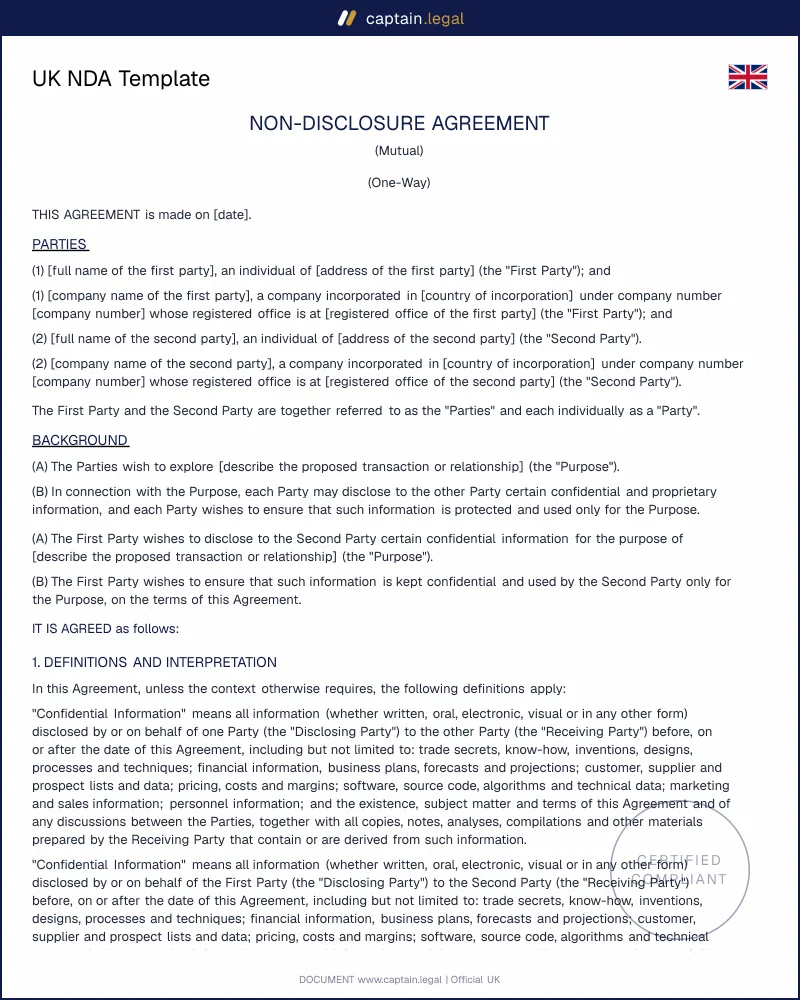
An NDA in England and Wales does not sit in a statute of its own. It works on two legs: ordinary contract law, and the equitable doctrine of breach of confidence. The leading authority is Coco v A.N. Clark (Engineers) Ltd [1969] RPC 41, where the court set the three-part test that still governs today. The information must have the necessary quality of confidence (it cannot be trivial or already public), it must have been shared in circumstances importing an obligation of confidence, and there must be unauthorised use to the discloser's detriment. A well-drafted NDA does not replace this doctrine; it sharpens it, recording exactly what is confidential and putting the obligation beyond argument.
Statute reinforces the position. The Trade Secrets (Enforcement, etc.) Regulations 2018 protect information that is secret, has commercial value because it is secret, and has been subject to reasonable steps to keep it so, which is precisely why your NDA should require "need-to-know" handling rather than loose circulation. Where the information includes personal data such as customer names or purchase history, the UK GDPR and the Data Protection Act 2018 apply on top, and you may need a separate data processing agreement, not just confidentiality wording. You can check the current statutory text through the UK government's official guidance on data protection and the Data Protection Act 2018.
One recent reform reshapes what an NDA can lawfully restrict. Since 1 October 2025, section 17 of the Victims and Prisoners Act 2024 means a confidentiality agreement cannot stop someone who is, or reasonably believes they are, a victim of crime from reporting it to the police, seeking legal advice, or obtaining medical or victim-support help. An NDA that tries to gag a victim of criminal conduct is unenforceable to that extent. The protection is narrow: it covers disclosures about the criminal conduct itself, not unrelated trade secrets the recipient happened to learn under the same agreement. Drafting that ignores this carve-out risks the whole confidentiality clause being read down.