A memorandum of association is the short, formal document that a company's first members sign to bring the company into legal existence. Under the Companies Act 2006, every UK company registered on or after 1 October 2009 must produce a memorandum naming its subscribers, recording their wish to form the company, and confirming that each of them agrees to become a member and, where the company has a share capital, to take at least one share. It is a one-off, founding instrument: once Companies House has accepted the application, the memorandum is filed and never amended. Founders, solicitors and company secretaries treat it as the certificate of intent that anchors the rest of the incorporation file.
Because the memorandum is short and standardised, the temptation is to copy a version found online and sign it without reading it. That habit causes preventable rejections at Companies House, especially when subscriber names do not match the IDs later submitted, when the authentication is missing, or when the wrong prescribed form is used for a guarantee company. This page walks through the legal regime that applies, the situations where you actually need a memorandum, and the clauses our template includes to keep your incorporation file clean.
Compliant
2026 Legislation
50,000+ clients
trust us
Affordable
From $4.90 / doc
Secure payment
Instant download
UK Memorandum of Association Template for Incorporation
Secure payment
What is a memorandum of association?
A memorandum of association under the 2006 Act is a statutory declaration in prescribed form authenticated by the company's first shareholders or guarantors, evidencing two things: that they wish to form a company under the Act, and that they agree to become members of it on incorporation. For a company limited by shares, each subscriber must also agree to take at least one share on formation, with that subscription recorded in the statement of capital and initial shareholdings delivered alongside the memorandum.
The memorandum drafted under the 2006 Act is a much narrower document than the pre-2006 version. Before 1 October 2009, the memorandum used to set out the company's name, registered office, objects clause, liability statement and share capital, and it operated as a "living" constitutional document throughout the company's life. The 2006 Act stripped most of that content out and moved it either to the articles of association or to standalone registration statements. What remains in the memorandum is essentially the act of incorporation itself: the subscribers' signatures or electronic authentications.
That distinction matters in practice. If you are buying a shelf company incorporated before October 2009, its memorandum still contains historic provisions, and section 28 of the Act treats those legacy provisions as part of the articles. New incorporations, by contrast, use the short statutory wording, and any rules about how the company is run belong in the articles. Do not draft an objects clause in a 2006-Act memorandum: it has no legal effect there, and it will confuse registry officers and future advisers reading the file.
Legal framework
The memorandum sits inside Part 2 of the Companies Act 2006, the part of the Act that deals with company formation. Section 7 sets out the basic method of forming a company under the Act: one or more persons subscribing their names to a memorandum and complying with the registration requirements at sections 9 to 13. Section 8 then defines what the memorandum is and how it must be authenticated, requiring it to be in the prescribed form and signed or electronically authenticated by every subscriber. The prescribed forms themselves are set out in The Companies (Registration) Regulations 2008 (SI 2008/3014), with separate templates for share companies and guarantee companies.
The other registration documents flow from the memorandum. Under section 9, the application for registration must be delivered to the registrar with the memorandum, the proposed articles (unless the company adopts the model articles), the statement of capital and initial shareholdings for share companies, the statement of guarantee for guarantee companies, and the statement of proposed officers. Section 31 makes the company's objects unrestricted unless the articles say otherwise, which is why charitable companies and community interest companies (CICs) still need their objects clauses, drafted in the articles rather than the memorandum. Charity-status memoranda are routinely scrutinised by the Charity Commission, and our charity governance documents are drafted with that scrutiny in mind.
Authentication is the single point that founders most often get wrong. Section 8(2) requires the memorandum to be authenticated by each subscriber, which in practice means a wet-ink signature, a typed name confirmed through the WebFiling authentication code, or an electronic signature meeting the requirements of The Companies Act 2006 (Annual Return and Service Addresses) Regulations. A memorandum signed by only one of two named subscribers is not in the prescribed form and will be rejected. The Cornell-equivalent in the UK is the official text on the legislation.gov.uk page for section 8 of the Companies Act 2006, which we recommend reading in full before signing anything.
When do you need this document?
The most common scenario is a standard private company limited by shares, where two or more founders are setting up an operating business and need to deliver a complete incorporation pack to Companies House. Without the memorandum signed by every subscriber, the IN01 application is incomplete and the registrar will not issue a certificate of incorporation. Single-member companies sit in the same regime: a sole founder still authenticates a memorandum, the only difference being that there is one signature line rather than several.
The second scenario is the company limited by guarantee, used by professional bodies, sports clubs, social enterprises and charities that do not issue shares. The prescribed form is different: instead of agreeing to take shares, each guarantor undertakes to contribute a stated amount, often £1, if the company is wound up while they are members or within twelve months of ceasing to be members. Choosing the wrong template here is a frequent rejection cause. If your project is a charity or a CIC, you will also want to coordinate the memorandum with bespoke articles, which our UK business templates cover for both share and guarantee structures.
A third, narrower, scenario is the re-registration of a company that changes its status, for instance from private to public, or from limited to unlimited. The 2006 Act does not require a fresh memorandum on re-registration, but the file produced for the registrar still includes a constitutional update: usually amended articles and, where shares are involved, a new statement of capital. Treat re-registration as a separate workflow; do not try to retrofit your original memorandum.
Key clauses included in our template
Our memorandum follows the prescribed form in SI 2008/3014, with one version for share companies and one for guarantee companies. The substantive clauses are:
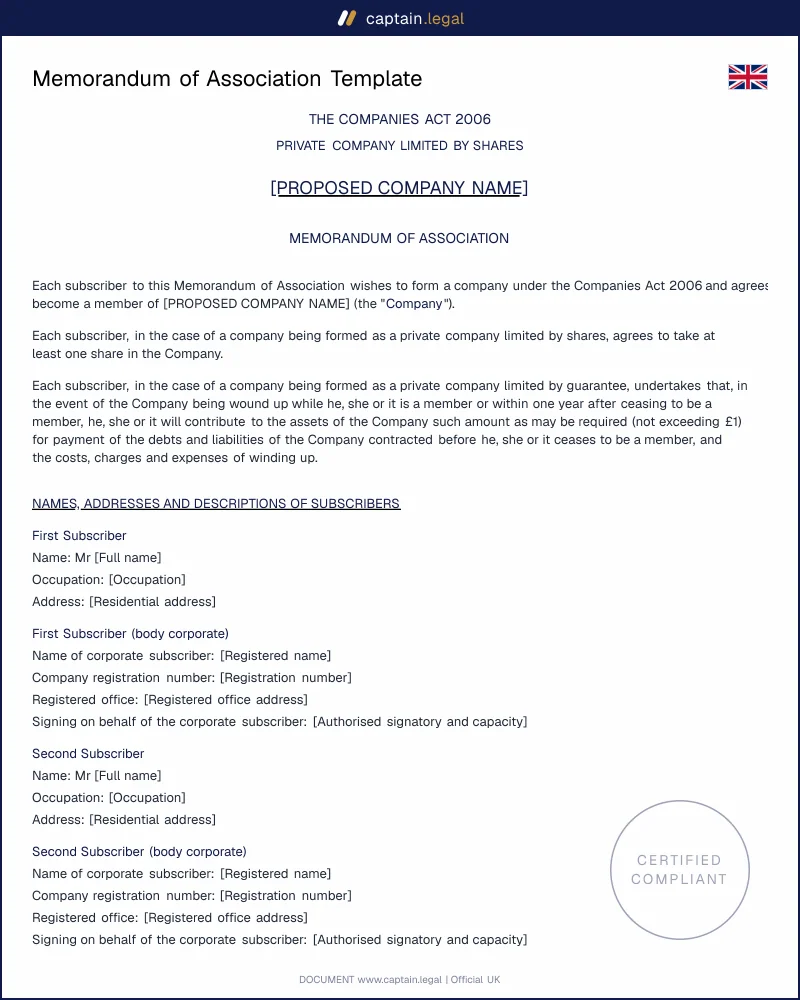
- The subscribers' declaration is the operative paragraph. It opens with the standard wording set out by section 8(1), stating that each subscriber wishes to form a company under the Companies Act 2006 and agrees to become a member on incorporation. We keep the wording verbatim, because Companies House officers compare it line-for-line against the prescribed form when reviewing the IN01.
- The share-taking commitment appears only in the share-company version. Each subscriber confirms that they will take at least one share on formation, with the precise number, class and nominal value reflected in the statement of capital and initial shareholdings filed under section 10. The memorandum itself records the agreement; the statement of capital records the figures.
- The subscriber identification block lists each subscriber's full name as it appears on their identity document, together with their service address. We keep this aligned with the statement of proposed officers and the statement of compliance so the registry's automated checks do not flag mismatches.
- The authentication block is where each subscriber signs or, on electronic filings, confirms authentication. Our template generates the correct fields for both wet-ink and WebFiling paths, including the date of authentication and a witness line where you choose the printed-and-signed route.
- A guarantee undertaking replaces the share-taking commitment in the guarantee version. Each subscriber undertakes to contribute up to a specified amount (commonly £1 or £10) towards the assets of the company in the event of winding up while they are members.
Regional considerations
The memorandum is governed by the same Companies Act 2006 across England and Wales, Scotland and Northern Ireland, but the registrar to whom it is delivered is different and the wording of the memorandum reflects that. Section 9(6) directs the application to the registrar of companies for England and Wales, the registrar for Scotland, or the registrar for Northern Ireland, depending on where the registered office will be situated. The registered office line in your incorporation file must therefore be consistent with the memorandum and the rest of the IN01.
England and Wales is the default jurisdiction for most new incorporations, with the registry based in Cardiff and an additional information point in London. Founders who want a Welsh-jurisdiction-only company tick the relevant box on the IN01 and have the memorandum reflect that the registered office will be in Wales specifically rather than England and Wales. Once chosen, that election is hard to reverse, so we surface it explicitly in the form.
Scotland uses Companies House Edinburgh and applies certain Scots-law specifics, particularly around floating charges and execution of documents. A memorandum signed in Scotland for a Scottish-registered company should follow the Requirements of Writing (Scotland) Act 1995 for valid execution, with two witnesses for self-proving status if the document is to be relied on without further evidence.
Northern Ireland has its own Belfast registry and a separate companies index, although the substantive law tracks the Companies Act 2006. Cross-border families of companies, with one entity in each UK jurisdiction, are common and need a coordinated set of memoranda referencing the same group structure.
How to fill out this memorandum of association
You start by selecting the company type, because the prescribed form differs between a company limited by shares and a company limited by guarantee. From there, the form asks for the proposed company name and the jurisdiction of the registered office, which together drive the wording of the memorandum and the registry it will be filed with. Each subscriber is added in turn, with full legal name, service address and email for the authentication step; if you incorporate alone, you complete a single subscriber line. The system generates the correct statement of capital fields for share companies, including share class, nominal value and amount paid up, and the matching guarantee undertaking for guarantee companies.
Once the data is captured, the platform produces the memorandum in PDF and Word, ready for PDF and Word legal templates download and either printed signature or electronic authentication. Where you intend to file electronically through WebFiling or a software filing agent, the same Word file gives you the text to paste, and the PDF is the archive copy you keep with your statutory registers. Keep the signed original alongside your share certificates and incorporation pack; you will need it whenever a bank, lender or buyer reviews the constitutional history of the company.
Common mistakes to avoid
The mistake we see most often is treating the memorandum as a draftable document. Founders who have read older textbooks try to insert an objects clause, a capital clause, or even a list of directors. Under the 2006 Act those provisions belong in the articles or in standalone statements, and adding them to the memorandum produces a document that is no longer in the prescribed form, which is a registration-level defect. The second recurring mistake is the mismatch between subscriber names and identity documents: a memorandum signed "Jon Smith" when the passport reads "Jonathan Andrew Smith" will be queried during Companies House identity verification checks, and a question raised at that stage usually delays incorporation by several days. A third mistake is the incomplete authentication, where one subscriber signs and the others rely on a covering email; the registry treats this as an unsigned memorandum.
Two further errors deserve attention. Founders sometimes forget that the registered office jurisdiction stated in the memorandum must match the address given in the IN01 and in any employment contract templates you issue from day one, because employment paperwork referencing a non-existent registered office creates evidential headaches in tribunals. Finally, where the company will sit at a residential address, founders often miss the service address requirement for each subscriber, which is a separate field that must be completed even when the subscriber is also the sole director.
Frequently Asked Questions
13 verified reviews · 50 000+ downloads
- Immediate access to the document
- PDF + Word download
- Compliant with 2026 legislation
- Reviewed by lawyers
You might also like