Create my document
Login

Choose country

United KingdomUnited KingdomChoose country
Personal

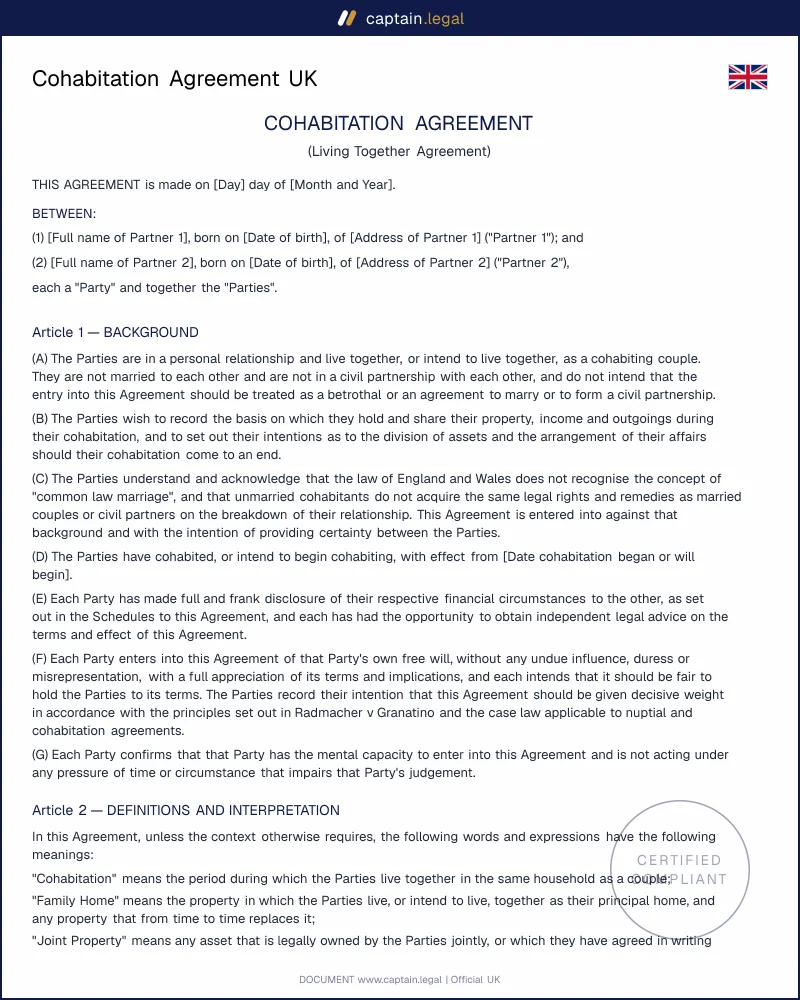
Cohabitation Agreement UK | TOLATA 1996 Deed Template

Cohabitation agreement drafted to contract law and TOLATA 1996, executed as a deed. Property, finances and separation covered. England & Wales, Word & PDF.
4.5/512 reviews50 000+ downloadsInstant download
Share

A cohabitation agreement is a written contract between two unmarried partners living together that records who owns what, how the bills and property are shared, and exactly what happens if the couple separates or one of them dies. It exists because of a hard fact most couples never hear until it is too late: in England and Wales, there is no such thing as a common law marriage. You can live with someone for twenty years, raise children, pour money into their mortgage, and still walk away with nothing. This cohabitation agreement (also called a living together agreement) is the single most effective tool an unmarried couple has to replace the automatic protections that marriage would otherwise provide.

Roughly one in five family units in England and Wales is now a cohabiting couple, and surveys repeatedly show that around half of them wrongly believe the law will look after them if things go wrong. It will not. A properly drafted living together agreement puts your intentions in writing, before goodwill runs out, so that separation becomes an administrative step rather than a courtroom battle.

Compliant

2026 Legislation

50,000+ clients

trust us

Affordable

From $4.90 / doc

Secure payment

Instant download

Cohabitation Agreement UK | TOLATA 1996 Deed Template

Secure payment · No subscription

Fill in the template

What is a cohabitation agreement?

A cohabitation agreement is a contract, nothing more mystical than that, but its subject matter is your home, your savings, your pension arrangements and your possessions. It sets out how you and your partner own and manage property while you live together, and how those assets are divided if the relationship ends. In England and Wales the term is descriptive rather than statutory, which means no single Act creates it. Instead the courts enforce it under ordinary contract law, most reliably when it is executed as a deed.

People confuse it with two neighbouring documents. A declaration of trust records the precise beneficial shares in a specific property, usually the home, and nothing else. A cohabitation agreement is wider: it captures rent or mortgage contributions, council tax, joint accounts, cars, furniture, pets, and the exit mechanics if you split. Many couples sensibly run the two together, using our declaration of trust and tenancy assignment deed for England and Wales to fix the property shares and the cohabitation agreement to govern everything else. A prenuptial agreement, by contrast, only bites if you later marry, and even then a court can override it. A cohabitation agreement, correctly drafted, is treated as a binding contract rather than a persuasive suggestion.

2

When do you need this document?

The clearest trigger is moving in together, especially into a home that only one of you owns. If you contribute to the mortgage, pay for a new kitchen, or cover the bills for years without your name on the title, you acquire no automatic stake. Recording the arrangement in writing before you pay a penny is the difference between a clean share and a doomed TOLATA claim. The second common scenario is buying a property jointly where your deposits are unequal. A couple splitting a home 70/30 by contribution but holding it as joint tenants will, on paper, own it 50/50, and only a written declaration corrects that. Our note on private loan agreements between individuals in the UK is worth reading where one partner is effectively lending the other a deposit.

Couples who have been together for years and never formalised anything are the third group, and often the most exposed, because memories of who paid for what have faded. A cohabitation agreement forces the conversation while both parties are still reasonable. It also earns its keep when one partner steps back from work to raise children or care for a relative, since that sacrifice carries no legal weight on separation unless the agreement says so. One edge case deserves flagging. If a child arrangements order or other court order already governs your family, you must read it before relying on any generic consent or financial clause, because the order takes priority and the agreement cannot override it. Blended families, second relationships with children from a first, and couples with a business between them all sit in this higher-risk band where bespoke drafting matters most.

3

Key clauses included in our template

  • The property and beneficial ownership clause records whether you hold as joint tenants or tenants in common, and in what shares. It states who paid the deposit, how the equity divides on sale, and whether one partner has a first right to buy the other out. This is the clause most often litigated, so it is drafted to dovetail with a declaration of trust where one exists.
  • The financial contributions clause sets out who pays the mortgage or rent, the council tax, utilities and food, and how any joint account is funded and split if closed. It also ringfences personal debts, so you are not left liable for a loan you never took, a point that quietly saves relationships as often as it saves money.
  • The separation and exit clause is the working heart of the document. It fixes what happens to the home, the contents, the vehicles and the savings if you part, including timescales for sale, valuation method, and how disputes are resolved before anyone reaches court.
  • The contents and possessions schedule lists significant items, cars, furniture, art, and who owns them, ending the familiar argument over who bought the sofa.
  • The children and intentions clause can record your intended financial support for children, while making clear that it cannot displace the Child Maintenance Service or the court's powers under Schedule 1.
  • The execution as a deed block carries the correct signing and witnessing wording, the formality that turns a friendly understanding into an enforceable contract.
4

Regional considerations

This document is drafted for England and Wales, and that scope is deliberate rather than incidental. There is no such thing as a single body of UK cohabitation law, and applying an England and Wales agreement to a Scottish or Northern Irish relationship is a genuine risk rather than a technicality.

In Scotland, cohabitants already have limited statutory rights under the Family Law (Scotland) Act 2006, which allows a former partner to apply to the court for a financial payment on separation within a strict time limit. Scottish couples typically formalise arrangements through a minute of agreement, which can be registered in the Books of Council and Session for preservation and execution, giving it a force this template does not replicate. A cohabitation agreement written for England and Wales does not map onto that regime and should not be used north of the border.

In Northern Ireland, the position is closer to England and Wales, with no common law marriage and property disputes resolved through trust and property principles, but the procedural detail and court practice differ enough that separate advice is sensible. Within England and Wales itself, the practical variation is not regional but factual: couples in high-value housing markets such as London face larger equity stakes and more contested TOLATA claims, which raises the premium on precise drafting. If your circumstances straddle jurisdictions, for example a home in one country and a partner resident in another, the agreement should record which law governs it, and you may need parallel documents. When in doubt, treat the border as a hard line rather than a formality.

5

How to fill out this cohabitation agreement

You start by identifying both partners and confirming the relationship is one of unmarried cohabitation, since the document is not designed for couples who are married or in a civil partnership. From there the form asks about your home: whether it is owned or rented, whose name is on the title or tenancy, and how each of you contributed to the purchase or the deposit. Those answers drive the ownership shares and the exit terms, so the more accurate your figures, the stronger the finished agreement.

Next you set out the running finances, the split of mortgage or rent, bills and joint accounts, and you list any significant possessions you want to allocate by name. You then choose how separation should work, whether the home is sold or one partner buys the other out, and how long that should take. The form prompts you to make the financial disclosure that enforceability depends on, and it builds in the deed execution wording so the document is signed and witnessed correctly. Once complete, you download it in Word and PDF, ready to sign. For couples who also want to record precise property shares separately, the child travel consent and parental authority letter for the UK sits usefully alongside where children are part of the picture.

6

Common mistakes to avoid

The most damaging mistake is treating the agreement as optional paperwork to sort out later. Couples move in, merge their finances, and only reach for a document once the relationship is already fracturing, at which point neither party feels generous and the disclosure is rarely honest. Draft it early, while goodwill still exists. The second frequent error is skipping independent legal advice or full financial disclosure, both of which give a disgruntled ex the strongest ground to challenge the agreement later. An agreement signed after one partner hid an asset, or without either understanding the terms, is the kind a court is most willing to set aside.

Two more traps recur in practice. People try to make the agreement do things it legally cannot, most often restricting child maintenance, and the offending clause is simply unenforceable. And couples forget that life moves on. An agreement written when you rented a flat says nothing useful once you have bought a house together and had a child. Review and re-sign the document after any major change, a new property, a new baby, a inheritance, or it slowly loses its grip. Finally, failing to execute it as a deed, or signing without a witness, downgrades a binding contract into a document a court may treat as merely persuasive. The formalities are the point, not decoration. If you are also organising wider affairs, our overview of UK personal legal document templates covers the wills and powers of attorney that naturally accompany a cohabitation agreement.

Key takeaways

MYTH-BUSTING

There is no common law marriage

In England and Wales, living together does not give you marriage-style rights, even after decades. You can pay into your partner’s mortgage, raise children, and still have no automatic claim if you split or they die. A cohabitation agreement is designed to replace those missing protections by spelling out, in writing, who owns what and what happens when the relationship ends.

SCOPE

Cover the whole household, not just

A cohabitation agreement is broader than a declaration of trust. It can deal with the home, bills, mortgage or rent contributions, council tax, joint accounts, cars, furniture, pets, and the practical exit steps if you separate. A declaration of trust focuses on beneficial shares in a specific property only, so many couples use both together: one to fix property shares, the other to govern everything else.

ENFORCEMENT

Draft it properly and sign as

Courts enforce cohabitation agreements under contract law, most reliably when executed as a deed. That means it should be voluntary, based on full and frank financial disclosure, fair in its terms, and signed with a clear intention to create legal relations. If you leave it unwritten, any dispute over the home can end up under TOLATA 1996, where you may have to prove a beneficial interest at significant cost and uncertainty.

Frequently Asked Questions

Yes, when it is drafted and executed properly. It is enforced under ordinary contract law and is treated as a binding contract, which is arguably stronger than a prenuptial agreement because a court cannot simply override it. To hold up, it must be entered voluntarily, supported by full financial disclosure, fair in its terms, and made with a clear intention to create legal relations. Best practice, confirmed by the High Court in Kirishani v Major [2026] EWHC 835 (Ch), is to execute it as a deed and for each partner to take independent legal advice. Get those elements right and a court will normally uphold it unless there is fraud, duress or gross unfairness.

You receive the cohabitation agreement in both Word and PDF. The Word version lets you edit names, figures, property details and any bespoke clauses cleanly before signing, which matters because your ownership shares and contributions are specific to you. The PDF gives you a tidy final version to print, sign and witness. Because the document must be executed as a deed to carry full weight, you will print the final copy, sign it in the presence of a witness, and keep the original safe. Storing a scanned copy alongside your declaration of trust and wills is sensible so the whole picture sits in one place.

There is no legal requirement to use a solicitor at all, and a well drafted template includes the clauses a court expects to see. That said, independent legal advice for each partner is strongly recommended, because it removes the argument that one of you did not understand the terms or was pressured into signing. Separate advice is what a court looks for when deciding whether the agreement was genuinely voluntary. A common and economical approach is to complete the template yourselves, agree the substance, then have a family solicitor review it before you execute it as a deed. That keeps costs down while preserving enforceability.

It can record your intentions, but it cannot restrict a child's legal right to support. Child maintenance in England and Wales falls under the Child Maintenance Service and Schedule 1 of the Children Act 1989, and no private agreement can oust that jurisdiction. Even where parents write maintenance into a document, either parent can still apply to the CMS afterwards, and a written agreement only keeps the CMS out for a limited period if the terms are embodied in a court order. Treat the children clause as a statement of good intentions and practical planning, not as a binding cap on what a child is entitled to receive.

It takes effect as soon as it is signed and witnessed correctly as a deed, so there is no waiting period and nothing to register with a court or public body. The realistic timeline is driven by preparation rather than formality: gathering your financial disclosure, agreeing the property shares, and arranging the signing. Many couples complete the template in an afternoon and sign within days. The one deadline worth respecting is doing it before you commingle significant money, because an agreement signed after a large unrecorded contribution has to unpick facts that a timely document would have prevented.

A cohabitation agreement governs separation and shared assets during life, but it does not replace a will. Unmarried partners do not inherit automatically under the intestacy rules, so if your partner dies without a will you could be left with no entitlement to the home or estate, regardless of how long you lived together. The agreement can clarify ownership shares, which helps, but the way to protect a surviving partner is a properly drafted will alongside it. Reviewing both documents together, and updating them after any major life change, is the reliable way to avoid a painful and expensive dispute at the worst possible moment.

Yes. You can vary or revoke a cohabitation agreement at any time, provided both partners agree and the change is made in writing and signed with the same formality as the original. This flexibility is a feature, not a weakness, because your finances and family will change. Buying a home, having a child, receiving an inheritance, or one partner leaving work are all moments to revisit the terms. An agreement that is reviewed and re-signed after each significant change carries far more weight than one drafted years ago and quietly ignored, since a court assesses fairness both at signing and at the point it is relied upon.

4.5/5

12 verified reviews · 50 000+ downloads

Cohabitation Agreement UK | TOLATA 1996 Deed Template
  • Immediate access to the document
  • PDF + Word download
  • Compliant with 2026 legislation
  • Reviewed by lawyers
Fill in the template
Secure payment · No subscription
Updated on July 1, 2026

You might also like

Deed of Assignment of Tenancy UK
Deed Poll Template UK