A parental consent letter for child travel is the written authority a non-accompanying parent or guardian gives to confirm that a minor may leave the United Kingdom with a named adult, for a defined trip, on agreed dates. Border Force officers, foreign immigration desks and airline ground staff regularly ask for one when a child crosses an international border without both holders of parental responsibility, and the absence of a clear written letter is one of the most common reasons families are pulled aside at check-in or refused boarding. The letter has no statutory form in English law, but it serves a serious legal purpose: it evidences consent under the Children Act 1989 and helps the accompanying adult demonstrate, on demand, that the trip is not an unlawful removal under the Child Abduction Act 1984.
This template is drafted for parents, separated parents, legal guardians, grandparents, teachers running school trips and any adult travelling abroad with someone else's child. It captures the child's identification, the itinerary, the accompanying adult, the consenting parent's contact details and an emergency clause for medical treatment.
Compliant
2026 Legislation
50,000+ clients
trust us
Affordable
From $4.90 / doc
Secure payment
Instant download
Child Travel Consent Letter UK — Avoid Border Refusal | Template
Secure payment
What is a parental consent letter for child travel?
A parental consent letter for child travel is a signed declaration in which every adult holding parental responsibility for a child confirms, in writing, that the child may travel outside the United Kingdom with a specifically named accompanying adult, between defined dates and to a defined destination. It is sometimes called a child travel consent form, a letter of authority to travel, or, when notarised abroad, an affidavit of consent. English law does not impose a single prescribed form for the document, but the wording must be unambiguous enough that a border officer reading it cold can identify the child, the trip, the consenting parent and the accompanying adult without needing further enquiry.
It is distinct from a court order. A Specific Issue Order under section 8 of the Children Act 1989 is what a parent applies for when the other holder of parental responsibility refuses or cannot be reached ; a consent letter, by contrast, records voluntary agreement and avoids any need for litigation. It is also distinct from a letter before action and from the unaccompanied minor forms that airlines circulate for children flying alone : those are commercial forms, whereas this letter is the underlying legal record that the trip has been authorised. Carrying the original signed letter, not only a scan, is strongly advised, because several destinations and airlines will only accept a wet-ink signature, sometimes accompanied by a notary's certification.
Legal framework
The starting point in English and Welsh law is section 3 of the Children Act 1989, which defines parental responsibility as "all the rights, duties, powers, responsibilities and authority which by law a parent of a child has in relation to the child and his property". Where two or more individuals hold parental responsibility, section 2(7) permits each to act alone in most matters, but the rule does not extend to taking a child out of the jurisdiction. The constraint is found in the criminal sphere : under section 1 of the Child Abduction Act 1984, a person connected with a child commits an offence if they take or send the child out of the United Kingdom without the appropriate consent of every other person with parental responsibility, or without the leave of the court. The offence is committed even where the travelling adult is a parent and the child shares the same surname.
A narrow statutory exception applies where a child arrangements order names a person as the one with whom the child lives. That person may take the child abroad for up to 28 days without further consent, unless the order itself imposes a contrary condition. Beyond that window, written consent is required for every additional day, and the safest evidence of that consent is a dated letter signed by every other holder of parental responsibility.
Two further legal layers matter in practice. The first is destination country law, which is independent of UK law : South Africa, the United States, Mexico, Brazil and several Schengen states each impose their own documentary requirements at entry, and many demand a notarised or apostilled signature. The second is safeguarding under section 55 of the Borders, Citizenship and Immigration Act 2009, which obliges Border Force to safeguard the welfare of children at the UK frontier and to question the accompanying adult where the relationship is not self-evident. Official UK guidance is published on the GOV.UK page on getting permission to take a child abroad, which our template tracks closely. For families that also need to organise other administrative documents in advance of the trip, our UK personal legal documents library brings together the most commonly requested templates in one place.
When do you need this document?
The most common scenario is the single-parent holiday. A mother taking her child to Spain for half-term, while the father remains in the UK, will be expected to produce written authority from the father at the Spanish border and increasingly at UK check-in too, because airlines have shifted the verification burden onto the gate agent. The reverse situation is identical : a father travelling with the child without the mother needs the mother's signed letter. Sharing a surname with the child does not exempt the travelling parent from this requirement, a misconception that catches out hundreds of families every summer.
The second pattern covers grandparents, aunts, godparents or family friends who take the child abroad for a few days, often during school holidays. Border officers will not assume that an adult of a different surname has any authority over the child, and the consent letter becomes the central piece of evidence. The same logic applies to school trips and to organised activities run by sports clubs, music ensembles or faith groups : the organiser needs a consent letter from every parent for every participating child, and most insurers now refuse to indemnify the trip in the absence of those signatures.
Two edge cases deserve flagging. The first is the separated or divorced parent where contact with the other holder of parental responsibility has broken down. A trip that begins with a missing signature is, in the eyes of the Child Abduction Act 1984, a potential offence, regardless of the travelling parent's good faith. The second is the bereaved parent, where one signature is impossible to obtain : the consent letter should be accompanied by a certified copy of the deceased parent's death certificate and, where the family name has changed, a marriage certificate. Families who routinely need to evidence facts of this kind also rely on statutory declarations, available alongside other UK consent forms and personal templates.
Key clauses included in our template
Every clause below is drafted to satisfy both UK practice and the most common foreign requirements, so the same letter can be produced at the British exit point and at the destination border without redrafting.
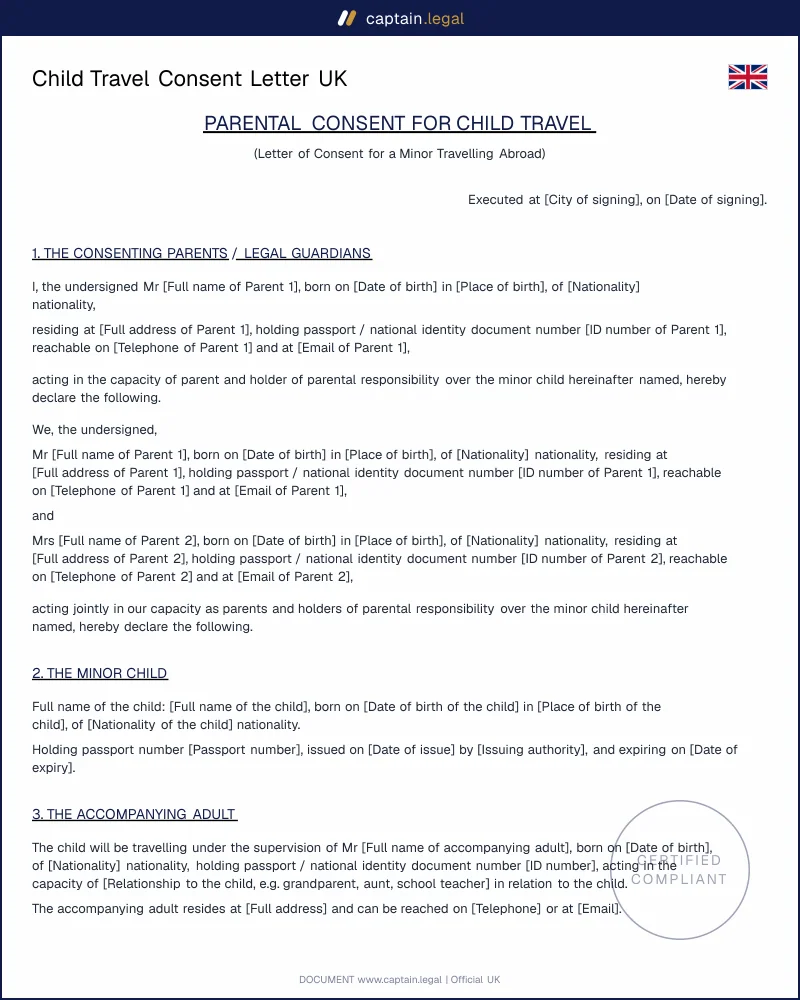
- The identification of the consenting parent or guardian lists the full legal name, residential address, date of birth, nationality, passport number and contact details of every adult who holds parental responsibility for the child and is not travelling. Anything less and the receiving authority cannot match the signatory against the child's records.
- The child's identification block records the full legal name, date and place of birth, nationality, passport number and passport expiry. A child whose passport details do not match the consent letter is, in border-control terms, an unidentified minor, and the trip can be held at the gate.
- The accompanying adult clause names the travelling adult, their relationship to the child, their passport details and their UK address. Where more than one adult is travelling, each must be listed by name : a generic reference to "the group leader" has been rejected in several documented cases.
- The itinerary clause sets out the destination country and city, the departure and return dates, the carrier or transport, and the accommodation address abroad. Open-ended itineraries are a red flag for child-protection officers and should be avoided.
- The scope of consent clause states explicitly that the consenting parent authorises the child to leave the United Kingdom for the stated trip, with the named adult, between the stated dates. The letter avoids ambiguous phrases such as "general travel" in favour of the precise dates and country.
- The emergency medical clause authorises the accompanying adult to consent to urgent medical treatment for the child during the trip, in line with the consenting parent's instructions, and lists the child's known allergies, conditions and current medication.
- The statement of truth and signature block carries a declaration that the contents are true to the best of the signatory's knowledge, the date, the place of signature and, where required by the destination, a witness section or a notary's jurat.
Destination-specific considerations
International requirements vary widely, and the same letter that suffices for an Italian beach holiday may be refused at a Johannesburg border post.
South Africa. Border officials apply the Immigration Act 13 of 2002 and require a notarised parental consent letter together with an unabridged birth certificate showing both parents' details, the non-travelling parent's certified passport copy and, where the consenting parent is deceased, the death certificate. A standard letter is routinely rejected at OR Tambo without these accompanying documents.
United States. US Customs and Border Protection has no fixed national form, but officers are trained to ask for a notarised letter of consent whenever a minor travels with one parent or with a third-party adult. Airlines flying into the US, particularly via Canada or Mexico, frequently demand the notarised version at check-in in the UK, before boarding is allowed.
Schengen Area. Spain, France, Italy and Portugal apply their own rules. Spain accepts an autorización de viaje de menores signed before a Spanish notary or a Spanish consul, but in practice an English-language letter signed in the UK and presented with the child's passport is also accepted at most ports of entry. France relies on the autorisation de sortie du territoire for French-resident minors, which does not replace the UK consent letter and applies only to children habitually resident in France.
Other destinations. Brazil requires a Portuguese-translated, notarised and apostilled authorisation for any minor entering or leaving with one parent only ; Australia and New Zealand will accept a clearly drafted English letter without notarisation in most cases ; the United Arab Emirates increasingly asks for the letter to be attested by the Foreign, Commonwealth and Development Office before travel. Where the destination country requires apostille certification, allow at least ten working days for the FCDO Legalisation Office to complete the process.
How to fill out this parental consent letter
You begin by selecting the trip configuration that matches your situation : one parent travelling without the other, a third-party adult travelling with the child, or a school or organised group. The template then asks for the consenting parent's identity, address and passport details, followed by an identical block for any second consenting parent if both hold parental responsibility and neither is travelling. The child's section captures the full passport-matching identity, including any middle names exactly as they appear on the passport, which is the field that most often goes wrong in homemade letters.
You then enter the itinerary, with departure and return dates, transport, destination country and city, and accommodation address abroad. The accompanying adult's identity block follows, with their relationship to the child stated in plain English rather than legalistic shorthand. The emergency medical clause is pre-drafted to authorise urgent treatment and to list any known allergies, current medication and the GP's contact details. The final step is the signature page, which generates a witness section automatically where you select a destination that commonly requires one, such as South Africa or the United States, and an apostille-ready layout for destinations that require FCDO legalisation. The completed document is delivered in Word and PDF, ready to print and sign in wet ink, which remains the safest format for cross-border use. Once completed, you can store the letter alongside any other family templates from the Captain.Legal UK document catalogue.
Common mistakes to avoid
The single most common error is omitting the second holder of parental responsibility. A mother who assumes that her daughter's father does not need to sign, because he has not been involved in the child's life for years, is on dangerous ground : unmarried fathers registered on the birth certificate after 1 December 2003 automatically hold parental responsibility under the Adoption and Children Act 2002, and step-parents acquire it only by formal agreement or court order. Border officers will ask, and a letter signed by only one of two PR-holders is, on its face, deficient. Closely related is the failure to provide a death certificate when one parent has died, which leaves the officer to infer the situation rather than read it. Families often look at this kind of consent question alongside other property and household matters, and our UK property and tenancy documents cover the parallel paperwork that frequently goes with international moves.
The second error is generic wording. A letter that authorises "any holiday" or "travel in 2026" will be rejected by stricter border posts, and any consent given under such loose terms can be challenged later as void for vagueness. The third is failure to notarise for destinations that require it : a non-notarised letter for South Africa or Brazil is, in practice, no letter at all. The fourth is using a photocopy rather than the original on the day of travel, an issue that arises most often when one parent has signed in advance and posted the letter. The fifth, surprisingly common in school-trip contexts, is the absence of an emergency medical clause : when a child needs urgent treatment abroad, hospitals will not act on a generic travel letter and will demand explicit medical-consent wording.
Frequently Asked Questions
20 verified reviews · 50 000+ downloads
- Immediate access to the document
- PDF + Word download
- Compliant with 2026 legislation
- Reviewed by lawyers
You might also like